Navigating the SaaS-pocalypse Part 2: Winning in the Short Term
Velocity, Acquisition, Value, Monetization


In Part 1, I made the case that despite all the news, the rules of the game aren't changing.
You still need to find an arbitrage, build distribution, and protect it before it gets competed away.
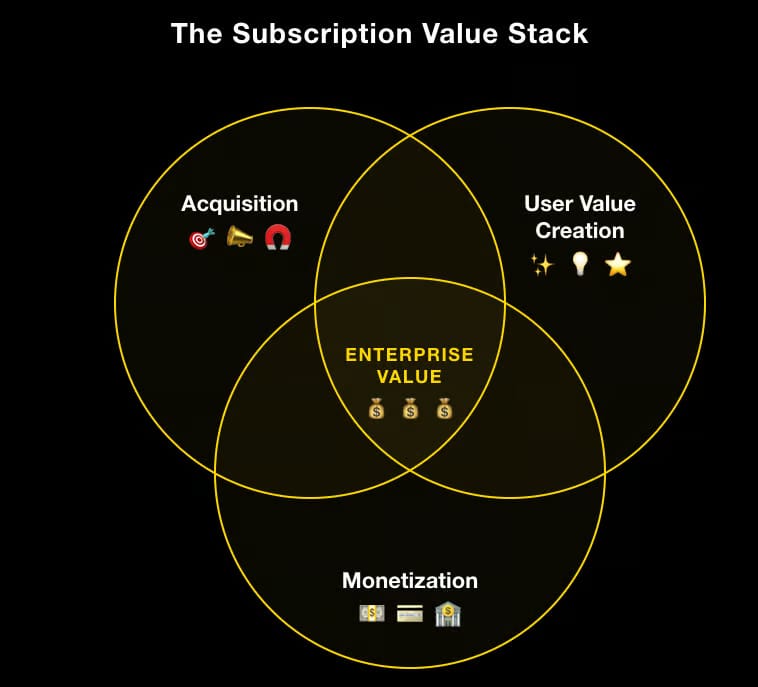
This post is about what that actually looks like across the three levers that matter:
User acquisition,
Creating user value,
Monetizing that value.
But first lets talk about the best leading indicator of success.
Velocity Still Wins, But the Bar Is Higher
From what I see in companies, teams that ship the fastest are the most successful. Hands down.
Of all the companies that I’ve worked with, those that ship multiple times per week are much, much more likely to hit double digit growth numbers, raise money, get aquired, etc.
Velocity is relative. There is no "fast enough."
You’re in a race that you need to win.
There is no “acceptable speed”, there is only faster than your competition.
You need to be fast and constantly get faster.
With AI, the obvious move is fewer employees doing more, but that’s only partially right.
If you've touched Claude Code or Cursor, you already know you can work 10-100x faster than before.
The temptation is to do the same work with 10 people instead of 100.
That's going to happen at some companies — Block just fired half their staff.
But the best path is 100 people moving 100 times faster.
Speed only matters with direction.
The constraint isn't shipping anymore. It's knowing what to ship .
The work that was always important — defining the right metrics, knowing your highest-LTV persona, building a proper north star — becomes more important now.
It's still not helpful to move 10x faster in the wrong direction.
Measurement compounds the velocity advantage.
The product development loop hasn't changed: Ideate → Decide → Build → Measure → Learn → Repeat.
Companies that can validate faster can ship faster.
That means traffic volume matters more (more users = faster statistical significance), frequent-use products have a structural advantage, and the discipline to ship with a measurement plan in place is more valuable than ever.
Acquisition: Distribution Matters More, Channels Shift
It's fairly obvious to say that distribution is going to matter more now that execution is easier.
The bar for "good enough product" is going up fast.
Which means the thing that's actually hard — getting users to show up in the first place — matters more than it ever did.
Free products are about to multiply.
It's cheaper than ever to build software, so the incentive to launch a free product that cannibalizes a competitor's paid product is stronger than ever.
At Codecademy, we spent 30-40% of engineering capacity on the free product — deliberately, because it built the brand and the funnel. This was millions of dollars a year.
A lot of new entrants are now able to do that for much, much less.
If your paid product competes in a category where a good free alternative can exist, you need to be thinking about that now.
CAC is going up in Most Channels
More competitors entering more markets means more competition for the same attention and the same ad inventory.
If you were already margin-thin on CAC, that's going to get worse.
This puts more pressure on monetization — specifically on shortening payback periods.
You can't afford to wait 18 months to recoup your CAC when CAC is rising and churn is still churn.
Not all acquisition channels are equal here.
Paid ads get more expensive as competition rises. Content SEO is also getting hit — AI-generated content is flooding search results and the channels that used to reward volume are penalizing it.
The channels that hold up best are the hardest to replicate: brand, word of mouth, community, referral loops.
These don't deteriorate when a hundred new competitors show up.
Brand is one of the few genuinely defensible things in this environment.
When every competitor can ship a comparable product quickly, trust is one of the things that can't be copied overnight.
Brand compounds in a way paid channels don't — lower churn, higher referral rates, better conversion, all at once.
There's a reason it shows up in Hamilton Helmer's 7 Powers as a durable competitive advantage. More on this next week.
User Value: The Bar for PMF is Moving Up
"We're the only team that can build this" is no longer a moat.
If your defensibility was execution speed or engineering talent, that moat is shrinking.
You need to be thinking about the other kinds: network effects, switching costs, proprietary data, brand.
The average product quality is going to rise dramatically across every category.
Think about what happened to physical goods when mass manufacturing arrived.
The cost to produce quality dropped, and the definition of "good enough" reset upward permanently.
The same thing is happening to software. The ugly & confusing parts of your product experience are no longer acceptable.
More product choices means onboarding & faster time to value is key.
When users have more options, evaluating them gets harder.
Most users aren't going to spend a week getting to know your product.
You have maybe 2 minutes on day zero.
A great product they never fully understand churns just as fast as a mediocre one.
Data from RevCat's 2025 State of Subscriptions shows roughly 80% of users who start a trial do so on day zero. If you don't activate them immediately, you don't get a second chance.
Nuanced Understanding of the Problem Matters
Understanding why a user showed up, what problem they're trying to solve, and getting them to their "aha moment" based on that — this work becomes foundational.
The products that feel like they were built for you specifically will win over the ones built for everyone.
Monetization: More Important than Ever
Winning monetization allows you to win distribution.
This Dan Kennedy quote is more true than ever “ Whoever can spend the most to acquire a customer wins”
All new users cost money in some form. You either buy them through ads, need to write SEO content to attract them, or need to put money into brand dollars.
The better you are at making money from your users, the more you can spend.
Get to monetization best practices ASAP
Setting up smart payment retry logic, building a proper cancellation flow, running pricing tests — this used to require meaningful engineering investment.
That barrier is dropping.
If you're still not doing the basics, the excuse is getting thinner.
And if your competitors weren't doing them before but can now spin them up in a sprint, the gap between best-in-class and average compresses fast.
Move up the value chain or get squeezed.
If your product takes on more complex, higher-stakes work, you have more pricing power than ever.
Software is going to start taking over more complex tasks, which means budgets that are usually reserved for salaries.
So What Do You Do With This Information?
The companies that win through this shift are the ones that treat it as an accelerant on the fundamentals, not a replacement for them.
Move faster on the work that was already important — churn reduction, monetization optimization, acquisition efficiency.
Invest in measurement so you can actually know if you’re on the right track.
And keep moving up the value chain. The floor is rising. The only safe place is to make yourself genuinely hard to replace.
More on the long-term defensibility side of this in Part 3.
Good luck out there.
Dan