Churn Rate: What It Really Costs You (And How to Fix It)
Your churn rate is costing you more than you think. Learn the formulas, benchmarks, and specific fixes that actually recover lost revenue.

Dan Layfield
Growth at Codecademy, $10M → $50M ARR
In This Guide
- Churn Rate at a Glance
- What Is Churn Rate?
- How to Calculate Churn Rate
- Annual Churn Rate
- Churn Rate Benchmarks: What's Actually Good?
- The Compounding Cost of Churn
- The Two Types of Churn (And Why This Distinction Changes Everything)
- How to Fix Involuntary Churn
- How to Fix Voluntary Churn
- When Reducing Churn Isn't the Right Focus
- Churn Rate Calculator
- FAQ
- What to Do Next
Most operators treat churn like a single retention problem. Fix the product, fix the onboarding, fix the cancel flow.
That's backwards. 20-40% of your churn is involuntary — subscribers whose payments failed, cards expired, or banks flagged a charge. They want to keep paying you. You're treating a billing problem like a product problem, and the involuntary slice is the cheaper part to fix.
I figured this out at Codecademy while scaling the business from $10M to $50M in annual recurring revenue. Most operators obsess over acquiring new subscribers while silently bleeding revenue from the ones they already have — and most of that bleeding is happening in the payment system, not the product.
A 5% monthly churn rate sounds manageable. It's not. It means you lose nearly half your subscriber base every year. You're filling a bucket with a hole in the bottom, and pouring more water in is the most expensive possible fix.
This guide covers how to calculate your churn rate, what "good" looks like, and — most importantly — the specific fixes that actually move the number. Not generic advice. The stuff that works.
Churn Rate at a Glance
| Customer Churn | Revenue Churn | |
|---|---|---|
| **What it measures** | Subscribers lost | Dollars lost |
| **Formula** | Cancellations ÷ starting subscribers | MRR lost ÷ starting MRR |
| **What "good" looks like** | <2%/mo B2B, <5%/mo B2C | Net <0% (negative churn) |
| **Lies to you when** | High-value customers leave at same rate as low-value | Expansion masks underlying cancellation problem |
| **Primary fix** | Onboarding, value delivery | Pricing, packaging, expansion motion |
| Voluntary Churn | Involuntary Churn | |
|---|---|---|
| **What it measures** | Subscribers who chose to cancel | Subscribers whose payment failed |
| **Share of total churn** | 60-80% | 20-40% (sometimes higher) |
| **Subscriber intent** | Wants to leave | Wants to stay |
| **Primary fix** | Product, onboarding, cancellation flow | Smart Retries, dunning, card updaters |
| **ROI timeline** | Weeks to months | Days |
The short answer: Track revenue churn, not customer churn. Then split it into voluntary and involuntary — because 20-40% of all churn is involuntary (failed payments), and that half is the cheapest, fastest part to fix. Start there before you touch product.
What Is Churn Rate?
Churn rate is the percentage of subscribers who cancel or stop paying during a given period.
That's it. Simple concept. But the way you calculate it — and which type of churn you're measuring — matters a lot. There are several versions of "churn rate" and they tell you very different things. Here are the ones you need to know:
Customer churn. The percentage of subscribers who cancel in a period. If you start the month with 1,000 subscribers and 50 cancel, customer churn is 5%. Treats a $9/month subscriber the same as a $299/month subscriber, which is why it's the wrong number to optimize against.
Revenue churn (gross). The percentage of MRR lost to cancellations and downgrades in a period. If you start the month with $100,000 MRR and lose $4,000 to cancellations, gross revenue churn is 4%. This is the honest number — it weights losses by what they actually cost you.
Revenue churn (net). Gross revenue churn minus expansion revenue (upsells, cross-sells, plan upgrades from existing customers). If you lost $4,000 but gained $5,000 from expansions, net revenue churn is -1%. Negative churn — your existing customers grow in value faster than others leave. This is what the best subscription businesses optimize for.
Voluntary churn. Subscribers who actively chose to cancel. They decided your product wasn't worth the price, found an alternative, or no longer need it. The fix is product, packaging, and cancellation flows.
Involuntary churn. Subscribers who lost access because their payment failed — expired card, declined charge, bank fraud flag. They want to keep paying. The fix is payment infrastructure: Smart Retries, dunning emails, account updaters. Accounts for 20-40% of all subscription churn — sometimes higher.
Net revenue retention (NRR). 100% minus net revenue churn. An NRR of 115% means your existing customer base grew in value by 15% this year before any new acquisitions. The best subscription businesses run 110-130% NRR. More on this below.
How to Calculate Churn Rate
Customer Churn Rate Formula
The basic formula:
Customer Churn Rate = (Customers Lost During Period ÷ Customers at Start of Period) × 100
If you start the month with 1,000 subscribers and 50 cancel, your monthly customer churn rate is 5%.
Simple. But this number lies to you in an important way: it treats all customers equally. Losing a $9/month subscriber and a $299/month subscriber count the same. That's a problem.
Revenue Churn Rate Formula
This is the one that actually matters:
Gross Revenue Churn Rate = (MRR Lost to Cancellations and Downgrades ÷ MRR at Start of Period) × 100
If you start the month with $100,000 in MRR and lose $4,000 to cancellations and downgrades, your gross revenue churn rate is 4%.
But there's an even better version:
Net Revenue Churn Rate = ((MRR Lost − MRR Gained from Expansions) ÷ MRR at Start of Period) × 100
Net revenue churn accounts for upsells, cross-sells, and plan upgrades from existing customers. If you lost $4,000 but gained $5,000 from expansions, your net revenue churn is actually -1%. That's negative churn — your existing customers are growing in value even after cancellations.
This is what the best subscription businesses optimize for. More on that later.
Which One Should You Track?
Both. But make decisions based on revenue churn, not customer churn.
I've seen businesses with a 3% customer churn rate panic because the number sounds high — while their revenue churn was under 1% because the customers leaving were on the cheapest plan. I've also seen the opposite: low customer churn masking the fact that high-value subscribers were quietly walking out the door.
Customer churn tells you how many people are leaving. Revenue churn tells you how much it costs.
Annual Churn Rate
Monthly churn × 12 overstates annual churn because of compounding — the right formula uses (1 - retention)^12. A 5% monthly churn rate equals 46% annual churn, not 60%. For the full formula, benchmarks, and the most common conversion mistakes, see our annual churn rate guide.
Churn Rate Benchmarks: What's Actually Good?
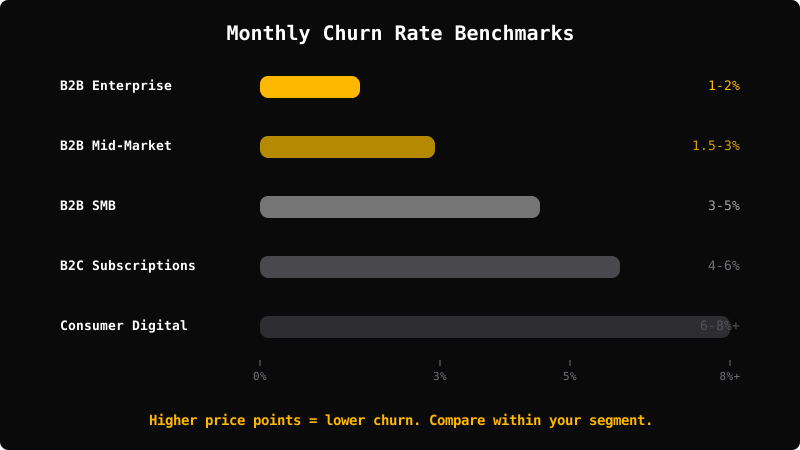
Benchmarks are tricky because they vary wildly by business type, price point, and customer segment. But here's what the data shows:
Monthly Churn Rate Benchmarks
| Business Type | Monthly Churn | What This Means |
|---|---|---|
| B2B SaaS (Enterprise) | 1-2% | Long contracts, high switching costs |
| B2B SaaS (Mid-Market) | 1.5-3% | Moderate contracts, some stickiness |
| B2B SaaS (SMB) | 3-5% | Shorter commitments, price-sensitive |
| B2C Subscriptions | 4-6% | Lower switching costs, discretionary spend |
| Consumer Digital Media | 6-8%+ | High churn is the norm, volume game |
By Price Point
This is the one most operators miss. Churn correlates heavily with ARPU:
| ARPU | Typical Monthly Churn |
|---|---|
| Under $25/mo | ~6% |
| $25-$100/mo | ~3-4% |
| $100-$500/mo | ~2-3% |
| Over $1,000/mo | ~1.5-2% |
Higher price points tend to mean more intentional purchase decisions, longer onboarding, and higher switching costs. If you're selling a $9/month product and comparing your churn to enterprise SaaS benchmarks, you're measuring against the wrong yardstick.
What Real Companies' Churn Looks Like
Segment-level benchmarks are useful, but specific companies are more useful. Here's what publicly reported (or reasonably estimated) churn looks like at well-known subscription businesses:
None of these companies report "monthly customer churn" identically — each row notes what the company actually discloses vs. what's estimated.
The insider subscription playbook
One tactic that moves the needle — every Thursday
Real companies, real numbers, strategies you can steal. From the operator who grew Codecademy from $10M to $50M ARR.
| Company | Segment | Reported Monthly Churn | Source | What This Tells You |
|---|---|---|---|---|
| Netflix | Consumer streaming | ~1.8% gross / 1.0% net monthly (Antenna est., Sept 2024) — Netflix itself does **not** disclose churn in its 10-K | [Antenna, Premium SVOD churn analysis (Sept 2024)](https://www.antenna.live/insights/checking-in-on-premium-svod-churn) | Lowest in Premium SVOD. Bingeable serialized content + ubiquity make it the streaming retention floor. |
| Spotify | Consumer streaming | ~2% monthly Premium churn (Antenna / Music Ally, mid-2024) — Spotify reports Premium sub count + ARPU, **not** a standardized churn rate | [Music Ally on Antenna data (June 2024)](https://musically.com/2024/06/04/us-study-hails-loyalty-of-spotifys-music-streaming-subscribers/); [Spotify Q4 2024 Shareholder Deck (Feb 4, 2025)](https://s29.q4cdn.com/175625835/files/doc_financials/2024/q4/Q4-2024-Shareholder-Deck-FINAL.pdf) | Music is "always on" with no natural endpoint — among the lowest-churn consumer subs anywhere. |
| HubSpot | B2B SMB SaaS | NRR 104% (Q4 2024), 102% (Q1 2025) — HubSpot reports NRR, **not** gross customer churn | [HubSpot Q4 and FY2024 Results (Feb 12, 2025)](https://ir.hubspot.com/news-releases/news-release-details/hubspot-reports-q4-and-full-year-2024-results); [SaaStr NRR history](https://www.saastr.com/the-complete-history-of-hubspots-net-revenue-retention-from-88-6-at-ipo-to-115-peak-and-why-102-today-is-still-strong/) | NRR ~100-104% means expansion is barely offsetting churn — typical for SMB SaaS, which churns harder than enterprise. Use as a proxy with the caveat that gross churn is hidden inside the number. |
| Slack (pre-Salesforce) | B2B SaaS | Net Dollar Retention 143% (FY ending Jan 31, 2019) — gross customer churn **not disclosed** | [Slack S-1 (April 2019)](https://www.sec.gov/Archives/edgar/data/1764925/000162828019004786/slacks-1.htm); [Tomasz Tunguz S-1 analysis](https://tomtunguz.com/slack-s-1-analysis/) | The textbook negative-churn business: existing customers paid $1.43 in Year 2 for every $1 in Year 1. Seat-based expansion + viral team adoption did the work. |
| Duolingo | Consumer learning | ~8-9% monthly subscriber churn (industry estimate) — Duolingo does **not** disclose churn in its 10-K, only paid subscriber count | [Duolingo Q2 2024 earnings (Aug 2024)](https://investors.duolingo.com/news-releases/news-release-details/duolingo-hits-100m-maus-reports-59-dau-growth-and-41-revenue); [TickerTrends churn analysis](https://blog.tickertrends.io/p/the-impact-of-churn-duol-duolingo) | Consumer learning has a built-in endpoint (you finish, give up, or hit a plateau). Churn is structurally higher than streaming. Duolingo offsets it with aggressive top-of-funnel + annual plans. |
The lesson: consumer streaming churn (Netflix, Spotify) is structurally lower than consumer learning (Duolingo) because the "job to be done" doesn't have a natural endpoint. Enterprise SaaS (HubSpot, Slack) sits an order of magnitude below consumer for the same reason — high switching costs and annual contracts.
The Number That Matters Most
Forget monthly churn for a second. Here's the question: what's your net revenue retention (NRR)?
NRR measures whether your existing subscriber base is growing or shrinking in value. It includes churn, downgrades, and expansion revenue.
- NRR above 100%: You'd grow even if you never added another customer. Expansion revenue exceeds losses.
- NRR of 90-100%: Stable, but not compounding. You need new customers to grow.
- NRR below 90%: Your existing base is shrinking. You're on a treadmill.
The best subscription businesses run 110-130% NRR. They've turned churn from a loss into a growth engine by pairing retention with expansion.
The Compounding Cost of Churn
Here's where churn becomes a monetization problem, not just a retention problem.
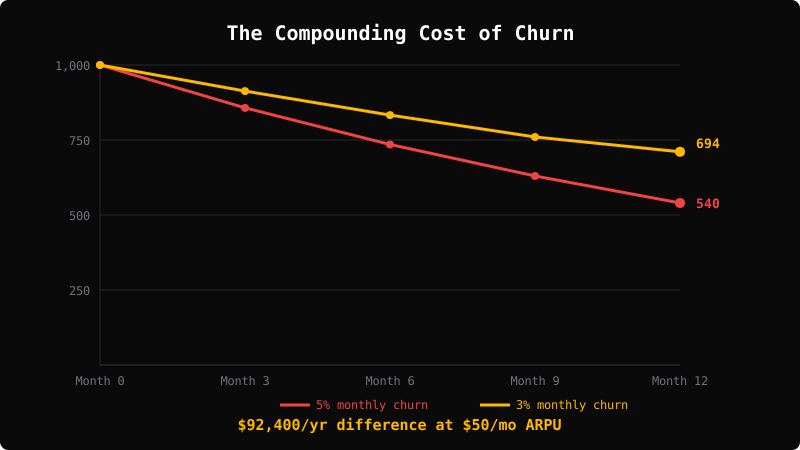
A 5% monthly churn rate doesn't mean you lose 60% of subscribers per year (5% × 12). It compounds. You actually lose about 46% annually — because each month's losses are calculated on a shrinking base.
Let me show you the math with a real example.
Scenario: 1,000 subscribers at $50/month, 5% monthly churn, no new acquisitions
| Month | Subscribers | MRR |
|---|---|---|
| 0 | 1,000 | $50,000 |
| 3 | 857 | $42,850 |
| 6 | 735 | $36,750 |
| 9 | 630 | $31,500 |
| 12 | 540 | $27,000 |
You lost $276,000 in annual revenue from those original 1,000 subscribers. Not $30,000 (one month's churn × 12). $276,000.
Now compare that to reducing churn from 5% to 3%:
| Month | Subscribers | MRR |
|---|---|---|
| 0 | 1,000 | $50,000 |
| 3 | 913 | $45,650 |
| 6 | 833 | $41,650 |
| 9 | 760 | $38,000 |
| 12 | 694 | $34,700 |
That 2-percentage-point reduction saves you $92,400 in annual revenue from the same starting base. Without acquiring a single new subscriber.
This is why I keep saying: most subscription businesses don't have a traffic problem. They have a monetization problem. The math on retention always beats the math on acquisition.
Another way to think about it: reducing churn from 5% to 3% increases average customer lifetime from 20 months to 33 months. That's a 65% increase in customer lifetime value — from every subscriber you already have.
The Two Types of Churn (And Why This Distinction Changes Everything)
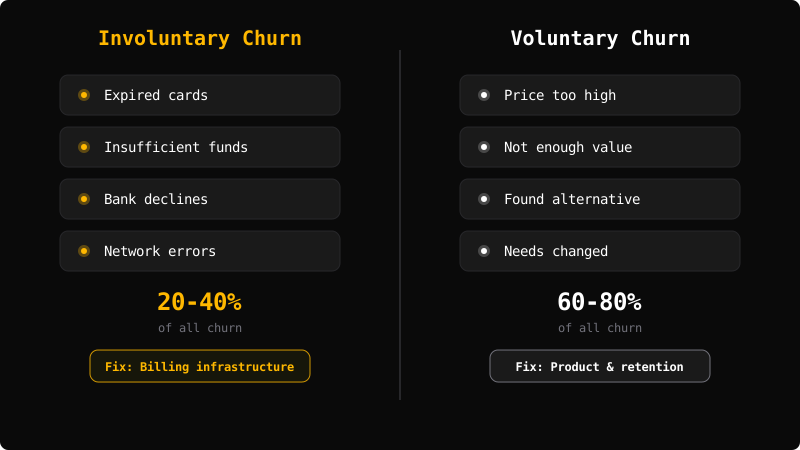
Most churn rate articles list a dozen generic tips and call it a day. That's useless, because there are two fundamentally different reasons subscribers leave, and the fixes for each are completely different.
Involuntary Churn: The Revenue You're Throwing Away
Involuntary churn happens when subscribers lose access because their payment failed — not because they chose to leave. Their credit card expired. Their bank flagged a charge. They hit a temporary spending limit.
These are subscribers who want to keep paying you.
How big is this problem? Involuntary churn accounts for 20-40% of all subscription churn (Recurly, 2024). Nearly 30% of payment cards in the US are reissued every year due to expiration, loss, or upgrades.
Think about that. As much as 40% of your churned subscribers didn't want to leave. You're literally throwing away customers because of a billing issue.
Voluntary Churn: The Revenue You Need to Earn
Voluntary churn is when subscribers actively choose to cancel. They decided your product isn't worth the price. They found an alternative. They don't need it anymore. Their circumstances changed.
This is harder to fix because it requires understanding why people leave — and that answer is different for every business.
Why the Distinction Matters
The fixes are completely different:
| Involuntary Churn | Voluntary Churn | |
|---|---|---|
| **Cause** | Payment failures | Active cancellation |
| **Fix** | Payment infrastructure + dunning | Product value + retention flows |
| **Effort** | Low (mostly setup and automation) | High (ongoing product and CX work) |
| **ROI timeline** | Immediate | Weeks to months |
| **Recovery rate** | 50-70% of failed payments | 10-15% of cancel intents |
If you don't know what percentage of your churn is involuntary vs. voluntary, you're flying blind. Find out today. Because if half your churn is involuntary, you're about to recover a lot of revenue with relatively little effort.
How to Fix Involuntary Churn
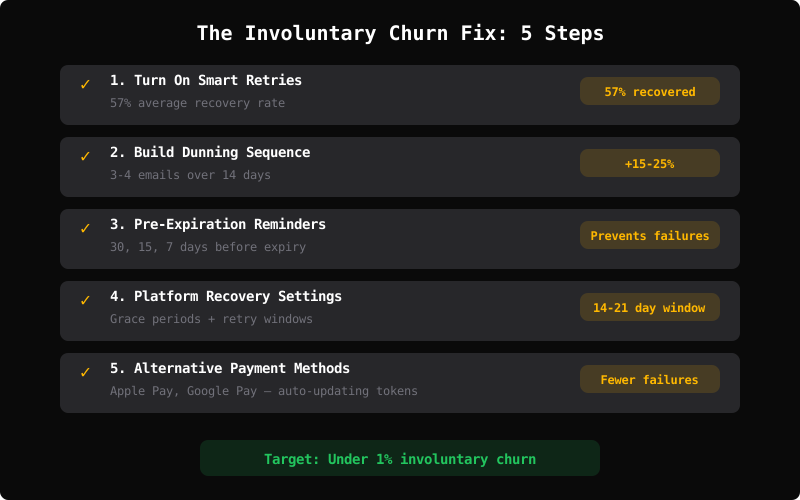
This is where I always tell people to start. It's the highest-ROI fix in subscription monetization: the effort is low, the results are immediate, and it works while you sleep.
1. Turn On Smart Retries
If you're on Stripe, there's a setting called Smart Retries. It uses machine learning — trained on billions of transactions across Stripe's network — to figure out the optimal time to retry a failed payment.
Most businesses never turn it on. They're retrying payments on day 1, day 3, and day 7 because that's the default fixed schedule. Stripe's ML can do significantly better because it factors in things you'd never know: when the customer's card is most likely to have sufficient funds, optimal processing times in their region, patterns from similar payment profiles.
Businesses using Stripe's full Revenue Recovery suite — Smart Retries plus Card Account Updater plus the emails — recover an average of 55% of failed recurring payments (Stripe, May 2026). If you're still on a fixed retry schedule, you're leaving money on the table.
How to enable it: Stripe Dashboard → Settings → Billing → Revenue Recovery → Smart Retries. Takes about 30 seconds.
2. Build a Dunning Email Sequence
When a payment fails, most businesses either send a generic "update your payment method" email or — worse — nothing at all.
The fix: a dunning sequence. 3-4 emails over 10-14 days.
Email 1 (Day 0 — payment fails): Subject: "There's an issue with your payment" Tone: Helpful, not alarming. "We noticed your payment didn't go through. This usually happens when a card expires or your bank flags an unfamiliar charge." Include: Direct link to update payment info. One click, no login wall if possible.
Email 2 (Day 3): Subject: "Quick reminder: your subscription payment needs updating" Tone: Gentle reminder. Mention what they'll lose access to.
Email 3 (Day 7): Subject: "Your [Product] access will be paused soon" Tone: Urgency without guilt. Specific date access will be lost.
Email 4 (Day 12): Subject: "Last chance to keep your [Product] subscription" Tone: Final notice. Clear deadline.
Key principles: Customize the error message based on the failure reason. "Your card expired" gets a different email than "payment declined." Always include a direct link to the payment update page. No drama, no guilt — just clarity and easy resolution.
3. Send Pre-Expiration Reminders
Don't wait for a payment to fail. Proactively email subscribers 30, 15, and 7 days before their credit card expires. Include a direct link to update their payment method.
This is pure prevention. Costs almost nothing to implement. Recovers revenue before it's ever at risk.
4. Set Up Platform-Specific Recovery
Stripe: Enable Smart Retries + set your retry schedule to work alongside ML-driven timing.
App Store subscriptions: Set the billing grace period and retry window to 16 days across billing periods. Apple will retry the charge during this window before cancelling the subscription.
Google Play: Enable account hold and grace period features. They serve a similar function.
5. Offer Alternative Payment Methods
If your audience skews mobile, offer Apple Pay and Google Pay at checkout. These payment methods use device-stored, automatically-updated tokens — which means fewer expired card failures.
The combined impact of these five fixes? You should be able to get involuntary churn below 1% of subscribers per month. If you're currently at 2-3% involuntary churn, you're about to recover 50-70% of those lost subscribers.
How to Fix Voluntary Churn
Voluntary churn is harder because there's no single fix. Subscribers leave for different reasons, and you need to understand yours.
But there are patterns I see across almost every subscription business I work with.
1. Add a [Cancellation Flow](/guides/cancellation-flow) (Not a Cancel Button)
Most subscription businesses have a "Cancel Subscription" button that immediately terminates the account. That's leaving money on the table.
A cancellation flow intercepts the cancel intent and offers alternatives:
- Pause option: "Take a break for 1-3 months instead of cancelling." This alone saves 10-15% of cancel intents, because many subscribers are leaving temporarily (vacation, budget crunch, busy period) and would come back — but won't bother re-subscribing later.
- Downgrade option: "Switch to a lower tier instead of leaving entirely." Keeps them as a paying customer at a lower rate — and you can win them back to the higher tier later.
- Discount offer: "Stay for 50% off your next 3 months." Use sparingly and only for high-value subscribers, but it works.
2. Survey Every Cancelling Subscriber
Before the cancellation completes, ask one question: "What's the main reason you're cancelling?"
Give them 4-5 options plus an open text field. Not a 20-question survey — one question.
This data is gold. After a few hundred responses, you'll see clear patterns. Maybe 40% say "too expensive." Maybe 30% say "not using it enough." Maybe 20% say "switched to [competitor]."
Now you know where to focus. "Too expensive" might mean your packaging is wrong, not your price. "Not using it enough" might mean your onboarding doesn't demonstrate value fast enough.
You can't fix what you don't understand. This survey gives you the diagnosis.
3. Know Your #1 Reason — and Fix It
Once you have the data, focus on the single biggest reason. Not all five. The #1 reason.
Codecademy: A Case Study in Onboarding-Driven Churn
Over the years I spent on growth at Codecademy, we found that a significant portion of churn happened because users didn't experience core product value quickly enough. They'd sign up, start a lesson, get confused or distracted, and never come back. The subscription lapsed.
In the 2015-2016 baseline period we had monthly churn running in the 15-20% range — typical short-lifecycle consumer numbers. The fix wasn't a cancellation flow or a discount. It was three things stacked: an LTV-formula-based annual plan reprice (2016-2017, which pushed annual adoption to 35-50% of new subs), a dunning + Smart Retries build (2017-2018, recovering 30-50% of failed payments), and an onboarding rebuild around the "first lesson in 24 hours" activation metric (2018-2020). Blended monthly churn dropped from 15-20% to roughly 5-8%. Onboarding alone had a bigger impact on churn than any single retention tactic — bigger than dunning, bigger than the cancel flow, bigger than the pricing changes.
The lesson generalizes: if your survey data says "not using it enough" is the #1 reason for cancellation, your fix is onboarding, not retention email cadence. Onboarding is the highest-leverage churn lever in any product with a learning curve.
If you offer a free trial, the trial experience is often where early churn is won or lost. For a practical breakdown of free trial strategy — credit card vs. no-card, trial length, freemium vs. time-bound — and how companies like Netflix and Spotify have evolved their approach, see our dedicated guide. Past the trial, the earliest signal of churn risk is whether new subscribers ever hit the activation moment in your subscription onboarding flow.
Your #1 reason will be different. But the principle is the same: find the biggest lever and push it hard.
4. Track Churn by Cohort
Don't just look at your overall churn rate. Break it down by when subscribers signed up.
If your January cohort churns at 3% but your March cohort churns at 7%, something changed — a new acquisition channel that attracts lower-quality subscribers, a product change that hurt onboarding, a pricing experiment that backfired.
Cohort analysis turns a single number into a diagnostic tool.
5. Turn Off Monthly Payment Receipt Emails
This one surprises people, but it's real: monthly payment receipt emails remind subscribers that they're paying. For subscribers who aren't actively using the product, that receipt is a trigger to cancel.
I'm not saying hide the charge. Subscribers can always find their billing history. But proactively sending "You just paid $49" to someone who hasn't logged in for two months is essentially prompting them to reevaluate whether they need you.
Check your billing platform settings. Most send receipts by default. Turn them off.
6. Shift More Subscribers to Annual Plans
Annual subscribers have one renewal decision per year instead of twelve. That alone reduces voluntary churn structurally. And the commitment drives higher engagement — subscribers who pay for a year develop stronger product habits, which leads to better renewal rates.
If you can move 20-30% of your monthly subscribers to annual plans, your headline churn rate will drop meaningfully. For the exact formula for setting your annual discount — based on your actual retention data, not guessing — see the annual vs monthly pricing guide.
When Reducing Churn Isn't the Right Focus
Churn reduction sounds universally good. It isn't. There are situations where every hour spent on churn is an hour stolen from a higher-leverage problem.
When your CAC payback is broken. If you're spending $400 to acquire a customer who pays $30/month and stays 5 months, no amount of retention work fixes that math. The product's unit economics are upside-down — your LTV:CAC ratio is well under 1:1 and you can't churn-reduce your way out of it. Fix pricing, packaging, or acquisition channels first. Retention optimization on a broken funnel is rearranging deck chairs.
When you're pre-product-market-fit. High churn before product-market fit isn't a problem to fix — it's a signal to listen to. Subscribers leaving is telling you the product isn't valuable enough yet. Survey them, ship the changes, then check whether the signal goes away. Building elaborate retention infrastructure before the product is loved is the most expensive way to defer the actual problem.
When your churn is already at the industry floor. Going from 1.5% to 1.2% monthly churn costs more than it returns. The marginal subscribers you save at that level are the ones most likely to be dissatisfied long-term anyway. Once you're at the floor for your segment, spend the energy on expansion revenue — moving NRR from 105% to 115% is a much bigger lever than squeezing the last 30 basis points out of gross churn.
When you're a short-lifecycle product by design. Noom, exam prep, weight-loss apps, learn-to-code platforms — these all have natural endpoints. The user achieves the goal (or gives up) and leaves. Trying to retain them past that point fights the product's own success. Better to accept structural churn, price for it (with aggressive annual plans), and optimize the lifetime value within the natural lifecycle.
Churn Rate Calculator
Here's a quick reference for calculating the key churn metrics:
Customer Churn Rate
(Subscribers lost during period ÷ Subscribers at start of period) × 100

Example: (50 lost ÷ 1,000 start) × 100 = 5% monthly churn
Revenue Churn Rate (Gross)
(MRR lost to cancellations + downgrades) ÷ MRR at start of period × 100

Example: ($4,000 lost ÷ $100,000 MRR) × 100 = 4% gross revenue churn
Revenue Churn Rate (Net)
(MRR lost − MRR gained from expansions) ÷ MRR at start of period × 100

Example: ($4,000 lost − $5,000 expansion) ÷ $100,000 = -1% net revenue churn
Annual Churn from Monthly Churn
Annual churn = 1 − (1 − monthly churn rate)^12

Example: 1 − (1 − 0.05)^12 = 1 − 0.54 = 46% annual churn
Average Customer Lifetime (in months)
1 ÷ monthly churn rate

Example: 1 ÷ 0.05 = 20 months
Example: 1 ÷ 0.03 = 33.3 months
Want to run these calculations interactively? Try the Churn Rate Calculator or the Growth Ceiling Calculator to model how churn reduction impacts your long-term ARR.
FAQ
What is a good churn rate for SaaS?
For B2B SaaS, aim for under 2% monthly (or under 5-7% annually). For B2C or consumer subscriptions, under 5% monthly is solid. But "good" depends on your price point, customer segment, and business model. A $9/month consumer app will always churn higher than a $500/month enterprise tool. Compare against your segment, not the internet's generic benchmarks.
What's the difference between gross and net churn?
Gross churn measures total revenue lost to cancellations and downgrades. Net churn subtracts expansion revenue (upsells, cross-sells, upgrades) from that loss. A business with 5% gross churn but strong upselling could have 1% net churn — or even negative net churn, meaning existing customers grow in value faster than others leave.
How much of my churn is involuntary?
If you don't know, check today. Log into your billing platform and look at cancellation reasons. Failed payments, expired cards, and declined charges are all involuntary. Industry-wide, it's 20-40% of total churn — sometimes higher. This is the easiest churn to fix because the subscribers want to keep paying you.
Can you have negative churn?
Yes, and it's the goal. Negative net revenue churn means your existing subscriber base is growing in value — expansion revenue exceeds losses from cancellations and downgrades. The best subscription businesses run 110-130% net revenue retention, which means negative churn is built into the model.
How does churn compound over time?
A 5% monthly churn rate doesn't mean 60% annual churn (5% × 12). It compounds to roughly 46% annual churn. Each month's losses are calculated against a shrinking base, and the lost revenue from early-month churners accumulates across remaining months. A subscriber who cancels in January costs you 12 months of potential revenue; one who cancels in June costs you 7 months.
What's the fastest way to reduce churn?
Fix involuntary churn first. Enable Smart Retries on Stripe (or equivalent ML-driven recovery on your billing platform), set up a 3-4 email dunning sequence, and send pre-expiration card reminders. This addresses 20-40% of your total churn with a few hours of setup. For voluntary churn, start by adding a cancellation flow with a pause option and a one-question survey — this recovers 10-15% of cancel intents and gives you data on why people leave.
What to Do Next
If you've read this far, you probably have a sense of where your churn problems live.
Here's my recommendation: start with involuntary churn. It's the fastest fix, the highest ROI, and it works automatically once set up. If you haven't enabled Smart Retries, built a dunning sequence, or set up card expiration reminders — do that this week.
Then dig into voluntary churn. Add a cancellation flow with a pause option. Start surveying cancelling subscribers. Find your #1 reason and fix it.
If you want a more complete picture of where your subscription business is leaking revenue — not just churn, but pricing, packaging, conversion, and expansion too — I built a free self-assessment that covers all of it.
Take the Subscription Revenue Leak Audit →
52 checklist items across 8 revenue leak categories. Takes 10 minutes. Shows you exactly where you're leaving money on the table.

Dan Layfield
Dan ran growth at Codecademy, scaling ARR from $10M to $55M before the company was acquired for $525M. He now advises subscription businesses on pricing, retention, and revenue optimization.
Work with Dan →Related Guides
Customer Lifetime Value: The Number That Should Be Running Your Business
Customer lifetime value (LTV) tells you what a subscriber is actually worth. Learn how to calculate it, benchmark it, and increase it.
20 min readCustomer Retention Strategies That Actually Increase Revenue
Skip the vague retention advice. This guide covers the specific strategies, tactics, and benchmarks that actually reduce churn and increase revenue.
18 min readDunning Emails That Actually Recover Revenue
Failed payments cause 20-40% of all churn — and it's the easiest to fix. Get the exact dunning email sequence and timing to recover lost revenue.
Get the playbook every Thursday
Weekly strategies for subscription businesses. Real companies, real numbers, tactics you can steal. From the operator who grew Codecademy from $10M to $50M ARR.