Customer Lifetime Value: The Number That Should Be Running Your Business
Customer lifetime value (LTV) tells you what a subscriber is actually worth. Learn how to calculate it, benchmark it, and increase it.

Dan Layfield
Growth at Codecademy, $10M → $50M ARR
Most subscription operators treat LTV as a single number to report. Calculate it once, paste it in a deck, move on.
That's the mistake. LTV isn't a number — it's a distribution. The average is almost always misleading. Your enterprise customers might be worth 10x your self-serve customers. Your organic-search subscribers might be worth 2x your paid-ad subscribers. Reporting one blended LTV hides exactly the information you need to make decisions.
When I ran growth at Codecademy from $10M to $50M ARR (2017-2021), LTV is what changed how we made decisions. We stopped asking "how do we get more signups?" and started asking "how do we make each subscriber worth more?" That shift — from acquisition thinking to monetization thinking — is what produced the 5x. But it only worked once we stopped treating LTV as one number and started treating it as a distribution by channel, segment, and plan.
This guide covers the calculation, the benchmarks, and the five specific levers that move it.
LTV at a Glance
| Revenue LTV | Profit LTV | Cohort LTV | |
|---|---|---|---|
| **Formula** | ARPU ÷ Monthly Churn | (ARPU × Gross Margin) ÷ Monthly Churn | Actual cumulative revenue per cohort, extrapolated |
| **Accuracy** | Lowest | Medium | Highest |
| **Data required** | ARPU + churn rate | + gross margin | + 12+ months of cohort data |
| **Best for** | Quick estimates, early-stage | Most planning and budgeting | Mature businesses with stable cohorts |
| **Common failure mode** | Ignores cost to serve | Assumes flat churn and ARPU over time | Slow to update; stale on fast-changing products |
The short answer: LTV is the total expected revenue (or profit) from one subscriber over their entire relationship with your business. The simple formula is ARPU ÷ monthly churn rate — but the answer that actually matters is profit LTV (ARPU × gross margin ÷ monthly churn) measured by segment, not the blended average. The five levers that move it: raise price, reduce churn, build expansion, improve onboarding, and shift subscribers to annual plans. Pricing and churn move LTV the fastest; expansion and onboarding compound the most.
What Is Customer Lifetime Value?
Customer lifetime value (LTV, CLV, or CLTV — all the same thing) is the total revenue you expect to earn from a subscriber over the entire duration of their relationship with your business.
A subscriber paying $50/month who stays for 20 months has an LTV of $1,000. Simple.
But the real power of LTV isn't the number itself. It's what it reveals about your business model:
- LTV relative to CAC tells you if your growth is sustainable
- LTV trending up or down tells you if your product is getting more or less valuable to customers
- LTV by segment tells you which customers to acquire more of — and which ones aren't worth the acquisition cost
Most operators look at LTV once, note the number, and move on. That's like checking your bank balance once a year. The value is in the trend and the segments, not the snapshot.
How to Calculate Customer Lifetime Value
There are several ways to calculate LTV, ranging from simple to sophisticated. Start with the one that matches your data.
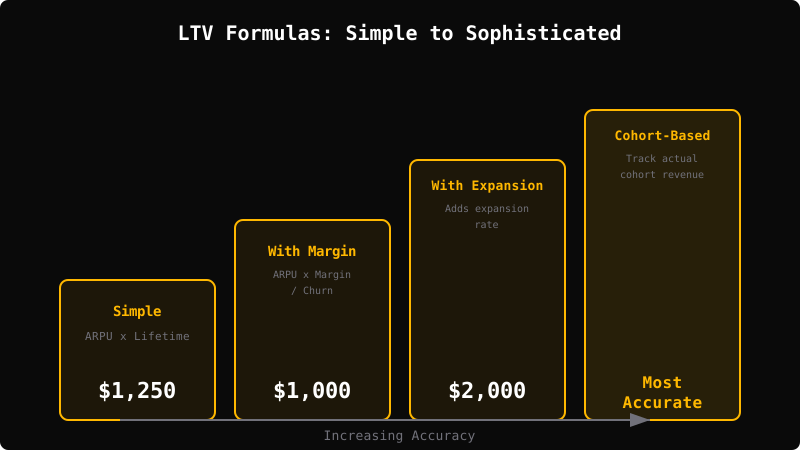
Formula 1: The Simple Version
LTV = ARPU × Average Customer Lifetime
Where:
- ARPU = Average Revenue Per User per month
- Average Customer Lifetime = 1 ÷ Monthly Churn Rate
Example:
- ARPU: $50/month
- Monthly churn rate: 4%
- Average lifetime: 1 ÷ 0.04 = 25 months
- LTV = $50 × 25 = $1,250
This works fine for a quick estimate. But it has two blind spots: it ignores your cost to serve the customer, and it assumes revenue per customer stays flat over time.
Formula 2: With Gross Margin
LTV = (ARPU × Gross Margin %) ÷ Monthly Churn Rate
This version accounts for the cost of delivering your product. For most SaaS businesses, gross margin is 70-85%. For digital subscriptions with minimal infrastructure costs, it can be 90%+.
Example:
- ARPU: $50/month
- Gross margin: 80%
- Monthly churn rate: 4%
- LTV = ($50 × 0.80) ÷ 0.04 = $1,000
This is the version I'd recommend for most subscription businesses. It gives you a realistic picture of what each subscriber is actually worth in profit, not just revenue.
Formula 3: With Expansion Revenue
LTV = (ARPU × Gross Margin %) ÷ (Monthly Churn Rate − Monthly Expansion Rate)
This is where it gets interesting. If your subscribers tend to spend more over time — upgrading plans, buying add-ons, increasing usage — your effective "churn" is lower than your cancellation rate.
Example:
- ARPU: $50/month
- Gross margin: 80%
- Monthly churn rate: 4%
- Monthly expansion rate: 2% (from upsells and upgrades)
- Effective net churn: 4% − 2% = 2%
- LTV = ($50 × 0.80) ÷ 0.02 = $2,000
Same subscribers. Same starting revenue. But because expansion revenue is factored in, the LTV doubles. This is why I keep saying net revenue retention is the metric that matters most — it directly amplifies your LTV.
Formula 4: Cohort-Based (Most Accurate)
The formulas above are estimates. They assume churn and expansion rates stay constant — which they don't. Early-month churn is usually higher than later-month churn (survivors tend to stick).
For the most accurate LTV, use cohort analysis:
- Take a cohort of subscribers who started in the same month
- Track their cumulative revenue over time (6 months, 12 months, 24 months)
- Plot the revenue curve
- Extrapolate based on the tail behavior
This is more work, but it captures the reality that Month 1 churn looks nothing like Month 12 churn. If you have the data, this is the gold standard.
Which Formula Should You Use?
| Situation | Use This |
|---|---|
| Quick estimate, limited data | Formula 1 (Simple) |
| Planning, budgeting, general use | Formula 2 (With Gross Margin) |
| Businesses with meaningful expansion revenue | Formula 3 (With Expansion) |
| Mature businesses with 12+ months of cohort data | Formula 4 (Cohort-Based) |
Start with Formula 2. Upgrade to Formula 3 or 4 as your data matures.
LTV Benchmarks
LTV:CAC Ratio
The most common way LTV is benchmarked is as a ratio to customer acquisition cost (CAC). For the full breakdown — by stage, by business model, and why the 3:1 number is more myth than rule — see our dedicated LTV:CAC ratio guide.
LTV:CAC Ratio = Customer Lifetime Value ÷ Customer Acquisition Cost
The insider subscription playbook
One tactic that moves the needle — every Thursday
Real companies, real numbers, strategies you can steal. From the operator who grew Codecademy from $10M to $50M ARR.
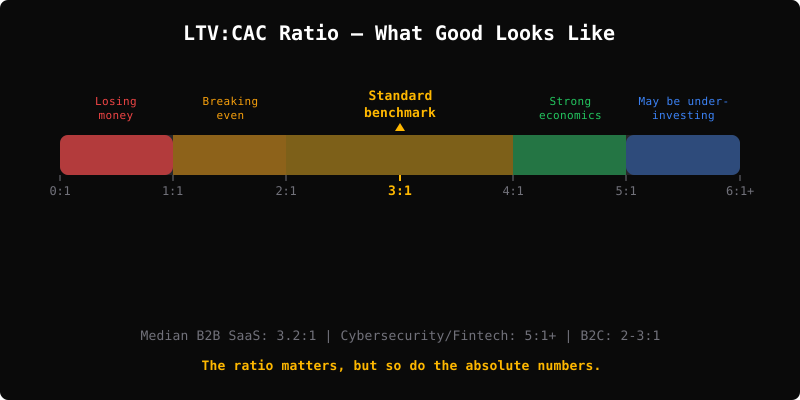
| Ratio | What It Means |
|---|---|
| Below 1:1 | You're losing money on every customer. Unsustainable. |
| 1:1 to 2:1 | Breaking even or barely profitable. Too tight. |
| 3:1 | The standard benchmark. For every $1 spent acquiring, you earn $3. |
| 4:1 to 5:1 | Strong unit economics. Efficient growth. |
| Above 5:1 | Excellent — but also a signal you might be *underinvesting* in growth. |
The median LTV:CAC ratio across B2B SaaS is about 3.2:1. But this varies by industry: cybersecurity and fintech often hit 5:1+ due to high retention and large contract values. B2C subscriptions tend to run lower — 2:1 to 3:1 — because of higher churn and lower price points.
The mistake I see most often: Operators calculate LTV:CAC once, see a healthy ratio, and assume everything is fine. But the ratio can mask problems. A 4:1 ratio from a $200 LTV and $50 CAC is a very different business than a 4:1 ratio from a $20,000 LTV and $5,000 CAC. The absolute numbers matter, not just the ratio.
LTV by Business Type
These are rough ranges, but they give you a sense of scale:
| Business Type | Typical LTV Range |
|---|---|
| B2B SaaS — Enterprise | $50,000 - $500,000+ |
| B2B SaaS — Mid-Market | $10,000 - $80,000 |
| B2B SaaS — SMB | $1,000 - $15,000 |
| B2C Digital Subscription | $100 - $600 |
| Consumer App (Freemium) | $20 - $150 |
| Membership / Community | $200 - $2,000 |
If you're a B2C subscription with an LTV of $300, you can't afford $200 in acquisition costs — even though a 1.5:1 ratio might feel "close enough." You need your acquisition channels to work at $50-$75 CAC, or you need to increase LTV.
CAC Payback Period
Related to LTV:CAC, this measures how long it takes to recoup your acquisition cost:
CAC Payback = CAC ÷ (ARPU × Gross Margin %)
| Payback Period | What It Means |
|---|---|
| Under 6 months | Excellent. Fast return on acquisition spend. |
| 6-12 months | Good. Standard for healthy SaaS. |
| 12-18 months | Acceptable for enterprise with long contracts. |
| Over 18 months | Risky. You need strong retention to justify this. |
Payback period matters because it determines how much cash you need to fund growth. A 6-month payback means you're reinvesting profits from each customer within the same year. An 18-month payback means you're essentially financing your growth for a year and a half before seeing returns.
The Five Levers That Increase LTV
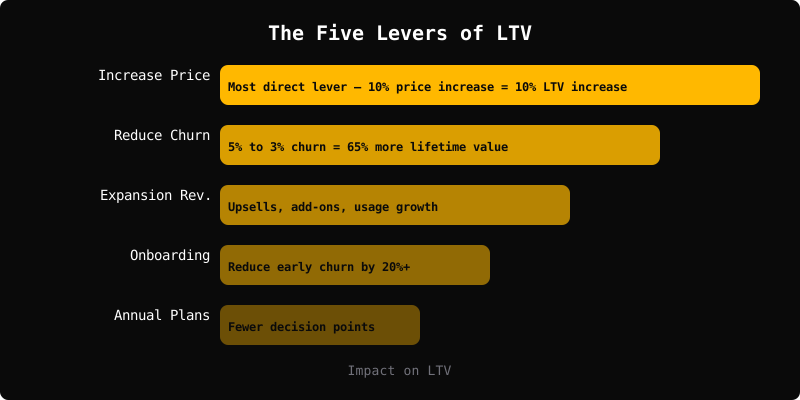
LTV is the output. To change it, you need to change the inputs. There are exactly five ways to make a subscriber worth more:
1. Increase Price
The most direct lever. A 10% price increase on new subscribers, assuming no change in conversion or churn, increases LTV by 10%. That's it. No product changes, no new features, no engineering resources.
Most subscription businesses undercharge. When I ask operators when they last revisited pricing, the answer is usually "when we launched" or "over a year ago." Meanwhile, the product improved, costs went up, and the value delivered is significantly higher than what the price reflects.
The data backs this up: companies that revisit pricing every six months see nearly double the ARPU gains compared to those that revisit annually.
Where to start: Run a willingness-to-pay survey with your current subscribers. The Van Westendorp method — four questions about price acceptability — works well and takes 5 minutes for respondents to complete. You'll almost certainly discover you're undercharging somewhere.
And when you do raise prices: apply it to new subscribers only. Grandfather existing subscribers at their current rate. This eliminates the "people will get angry" risk and lets you test new pricing with zero impact on current revenue.
2. Reduce Churn
Every month a subscriber stays is another month of revenue. Reducing monthly churn from 5% to 3% increases average customer lifetime from 20 months to 33 months — a 65% increase in LTV without changing anything about price or expansion.
I covered churn fixes in depth in my churn rate guide, but the summary:
Involuntary churn (start here):
- Enable ML-driven payment retries (Stripe Smart Retries)
- Build a 3-4 email dunning sequence
- Send card expiration reminders before failures happen
Voluntary churn:
- Add a cancellation flow with pause and downgrade options
- Survey every cancelling subscriber — one question
- Find and fix your #1 reason for cancellation
3. Increase Expansion Revenue
If subscribers spend more over time — through upgrades, add-ons, or increased usage — your LTV goes up without extending the customer lifetime.
A subscriber who starts at $50/month and upgrades to $100/month after 6 months has a very different LTV than one who stays at $50/month for the same duration.
The expansion levers:
- Tiered plans with a clear upgrade path as needs grow
- Usage-based components that scale with the customer's success
- Add-ons and premium features for power users
- Seat-based pricing that grows as their team grows
The best expansion revenue is invisible — it happens because the customer's usage or needs naturally grow, and your pricing structure captures that growth. If expansion requires a salesperson to make a call, you've missed the design opportunity.
4. Improve [Subscription Onboarding](/guides/subscription-onboarding) (Increase Early Retention)
Most churn happens early. If a subscriber doesn't experience meaningful value in their first few sessions, they're likely to cancel within the first 1-3 months.
Improving early retention has an outsized impact on LTV because it extends the lifetime of your most vulnerable subscribers.
At Codecademy (2017-2021), we found that users who completed their first lesson within 24 hours of signing up were dramatically more likely to still be subscribed 6 months later. The product didn't change. The price didn't change. We just made sure people experienced value faster.
Where to focus:
- What's the "aha moment" in your product? How fast do new subscribers reach it?
- Can you shorten the time from signup to first value?
- Are there setup steps that create friction and cause drop-off?
Effective onboarding can reduce early churn by 20% or more. On a 25-month average lifetime, that could add 5+ months.
If your product uses a free trial, the trial design itself is part of onboarding — get it wrong and users churn before they reach the aha moment. See our free trial strategy guide for the key decisions: credit card requirements, trial length, freemium vs. time-bound, and real-world examples.
5. Shift to Annual Plans
Subscribers on annual plans churn at significantly lower rates than monthly subscribers — partly because the commitment is longer, and partly because there are fewer decision points (one renewal per year vs. twelve).
If 30% of your subscribers are on annual plans, moving that to 50% can meaningfully increase your average LTV.
How to do it well:
- Set your annual discount based on your actual monthly retention rate, not an arbitrary percentage. If 95% of monthly subscribers stick around each month, the expected value of a monthly subscriber over 12 months is about 10.5 months. So even a modest annual discount (2 months free, say) makes you more in expected value — and the subscriber feels like they got a deal.
- Offer the annual plan prominently at signup and as an upgrade for existing monthly subscribers.
- Consider a mid-year "switch to annual" campaign for monthly subscribers who've been around for 3+ months (they've already proven they find value).
For real pricing ratios from companies like Noom, Tinder, DataCamp, and Calm — and the formula for pricing annual plans just above average monthly retention — see the annual vs monthly pricing guide.

Common LTV Mistakes
Mistake 1: Calculating LTV Once and Forgetting About It
LTV changes. Your pricing changes. Your churn changes. Your expansion revenue changes. A number you calculated 12 months ago may be wildly off today.
Recalculate quarterly at minimum. Monthly if you're making changes to pricing, packaging, or retention.
Mistake 2: Using Average LTV for All Decisions
Your LTV isn't one number — it's a distribution. Enterprise customers might have 10x the LTV of self-serve customers. Subscribers who come from organic search might have 2x the LTV of those from paid ads.
Segment your LTV by acquisition channel, plan type, and customer size. This tells you where to invest more — and where you're overspending.
Mistake 3: Ignoring Gross Margin
Revenue LTV and profit LTV are different numbers. If you're spending $30/month to serve each customer (hosting, support, infrastructure), a $50/month subscriber isn't worth $50 × lifetime. They're worth $20 × lifetime.
Always calculate LTV with gross margin. The formulas above include this for a reason.
Mistake 4: Assuming LTV:CAC of 3:1 Is Always Good
A 3:1 ratio where CAC is $10 and LTV is $30 is a low-value business. You need massive volume to generate meaningful revenue.
A 3:1 ratio where CAC is $5,000 and LTV is $15,000 is a very different proposition.
The ratio matters, but so do the absolute numbers and the payback period.
Mistake 5: Optimizing Only for Acquisition
This is the big one. Most subscription businesses spend 80% of their energy optimizing the top of the funnel — more traffic, better ads, higher conversion rates. And 20% on everything that happens after someone subscribes.
That's backwards. A 20% improvement in retention has more LTV impact than a 20% improvement in acquisition — because retention compounds over the entire customer lifetime, while acquisition is a one-time event.
If your LTV:CAC ratio is below 3:1, the instinct is to lower CAC. Sometimes the better move is to raise LTV.
When LTV Is the Wrong Metric to Optimize
LTV is the scoreboard for mature subscription businesses. Skip the obsession with it (or weight it lightly) if:
You're pre-product-market-fit. With <6 months of cohort data and high early churn, any LTV number is a guess. Track active paying subscribers and 30/60/90-day retention curves instead. LTV becomes meaningful once your churn curve stabilizes.
Your business is mostly transactional. If most revenue comes from one-time purchases or pay-per-use without a subscription floor, the "lifetime" framing doesn't fit. Use ARPU per active period and repeat-purchase rate instead.
Your ARPU is very low and acquisition is paid. B2C apps at $3-5/month ARPU with paid acquisition need to obsess over CAC payback in weeks, not LTV in years. By the time the LTV math plays out, the cohort is gone.
Your product has a hard endpoint. Learn-to-code (users finish), exam prep (the exam date passes), wedding planning (the wedding happens). For these, LTV is structurally capped — focus on monetizing within the window with annual plans and expansion add-ons rather than chasing a longer lifetime.
You're optimizing too far past the payback horizon. A 36-month LTV looks great in a deck, but if your runway is 18 months, decisions should be driven by 12-month contribution margin, not 36-month theoretical value.
LTV Calculator
Simple LTV
LTV = ARPU ÷ Monthly Churn Rate

Example: $50 ÷ 0.04 = $1,250
LTV with Gross Margin
LTV = (ARPU × Gross Margin %) ÷ Monthly Churn Rate

Example: ($50 × 0.80) ÷ 0.04 = $1,000
LTV with Expansion
LTV = (ARPU × Gross Margin %) ÷ (Monthly Churn Rate − Monthly Expansion Rate)

Example: ($50 × 0.80) ÷ (0.04 − 0.02) = $2,000
Average Customer Lifetime (months)
Lifetime = 1 ÷ Monthly Churn Rate

Example: 1 ÷ 0.04 = 25 months
Calculate LTV:CAC Ratio
LTV:CAC = LTV ÷ CAC

Example: $1,000 ÷ $300 = 3.3:1
Want to run these calculations interactively? Try the LTV Calculator, LTV:CAC Ratio Calculator, or CAC Payback Calculator.
CAC Payback Period (months)
Payback = CAC ÷ (ARPU × Gross Margin %)

Example: $300 ÷ ($50 × 0.80) = 7.5 months
FAQ
What is a good customer lifetime value?
There's no universal "good" LTV — it depends entirely on your acquisition cost. An LTV of $500 is excellent if your CAC is $100 (5:1 ratio) and terrible if your CAC is $400 (1.25:1 ratio). Focus on the LTV:CAC ratio (target 3:1 or above) and the CAC payback period (target under 12 months).
What's the difference between LTV, CLV, and CLTV?
Nothing. Customer Lifetime Value (CLV or CLTV) and Lifetime Value (LTV) refer to the same metric. Different companies use different abbreviations. LTV is the most common shorthand in SaaS and subscription businesses.
Should I calculate LTV on revenue or profit?
Profit (using gross margin). Revenue LTV overstates the value of each customer because it ignores the cost to serve them. For most SaaS businesses with 70-85% gross margins, the difference isn't dramatic. But for businesses with significant COGS (infrastructure-heavy products, services bundled with subscriptions), using revenue LTV can seriously mislead your acquisition math.
How does LTV change with expansion revenue?
Dramatically. If subscribers spend more over time, your effective churn rate drops — and LTV increases disproportionately. In the examples above, adding a 2% monthly expansion rate to a business with 4% churn doubled LTV from $1,000 to $2,000. This is why building upsell and expansion paths is one of the highest-leverage things you can do for your subscription business.
How do I increase LTV without raising prices?
Reduce churn (extend the lifetime), build expansion paths (increase revenue per customer over time), and improve onboarding (reduce early drop-off). Shifting more subscribers to annual plans also increases LTV by reducing churn decision points. Price increases are the fastest lever, but not the only one.
What LTV:CAC ratio should I target?
3:1 is the standard benchmark. Below 3:1, you're spending too much to acquire relative to what customers are worth. Above 5:1, you're likely underinvesting in growth and could afford to spend more aggressively on acquisition. But always look at the absolute numbers and payback period alongside the ratio — context matters.
What to Do Next
LTV is the scoreboard for your subscription business. Every improvement you make — to pricing, packaging, retention, onboarding, or expansion — eventually shows up in this number.
If you want a structured way to find where your biggest LTV opportunities are hiding, I built a free self-assessment that covers all eight revenue leak categories — from pricing and conversion to churn and expansion.
Take the Subscription Revenue Leak Audit →
52 checklist items. 10 minutes. Shows you exactly where you're leaving lifetime value on the table.

Dan Layfield
Dan ran growth at Codecademy, scaling ARR from $10M to $55M before the company was acquired for $525M. He now advises subscription businesses on pricing, retention, and revenue optimization.
Work with Dan →Related Guides
Customer Retention Strategies That Actually Increase Revenue
Skip the vague retention advice. This guide covers the specific strategies, tactics, and benchmarks that actually reduce churn and increase revenue.
18 min readDunning Emails That Actually Recover Revenue
Failed payments cause 20-40% of all churn — and it's the easiest to fix. Get the exact dunning email sequence and timing to recover lost revenue.
23 min readFree Trial Strategy: How to Convert Trial Users into Paid Subscribers
Most free trials fail because length is copied from competitors, not set by time-to-value. How Notion, Superhuman, Headspace, and Calm design trials that actually convert.
Get the playbook every Thursday
Weekly strategies for subscription businesses. Real companies, real numbers, tactics you can steal. From the operator who grew Codecademy from $10M to $50M ARR.