Net Revenue Retention: The Metric That Proves You Can Grow Without More Traffic
Net revenue retention (NRR) shows if your existing subscribers are becoming more valuable. Learn how to calculate, benchmark, and improve it.

Dan Layfield
Growth at Codecademy, $10M → $50M ARR
In This Guide
Most subscription operators chase MRR. The ones that compound chase NRR.
If I could only look at one metric in a subscription business, it would be net revenue retention. Not MRR. Not CAC. Not even churn rate. NRR. The reason: NRR is the only metric that answers the question every subscription operator should be asking — "If I stopped acquiring new customers tomorrow, would my business still grow?" MRR can't tell you that. Churn can't tell you that. Only NRR can.
At Codecademy from $10M to $50M ARR (2017-2021), almost none of the 5x came from getting more traffic. Most of it came from making existing subscribers worth more — through better pricing, smarter packaging, reduced churn, and expansion revenue. That shows up in one number: NRR.
Most operators I talk to don't track it. Or they track gross churn and assume that tells the whole story. It doesn't.
NRR at a Glance
| Gross Revenue Retention (GRR) | Net Revenue Retention (NRR) | |
|---|---|---|
| **What it measures** | What you kept (losses only) | What you kept *plus* what you gained from existing customers |
| **Includes expansion?** | No | Yes |
| **Ceiling** | 100% (you can't keep more than you started with) | No ceiling — Snowflake-class businesses hit 130-160% |
| **Tells you about** | The leak in your bucket | Whether the bucket is net filling or net draining |
| **Best use** | Diagnosing churn / packaging problems | Headline metric for valuation and durability |
| **What "good" looks like** | 90%+ for B2C, 95%+ for B2B SaaS | 100%+ to break even on existing base; 110-120% is strong |
The short answer: Net revenue retention measures whether your existing subscriber base is becoming more valuable or less valuable over time — accounting for churn, downgrades, and expansion revenue. The formula is (Starting MRR − Churn − Contraction + Expansion) ÷ Starting MRR × 100. Above 100% means existing customers are net-growing your revenue with zero new acquisition; below 100% means you're on the acquisition treadmill just to stay flat. Track GRR alongside NRR — GRR tells you how leaky the bucket is; NRR tells you whether what you're adding offsets the leak. The lever that lifts NRR most: build expansion paths into the product so revenue grows as the customer's usage or success grows.
What Is Net Revenue Retention?
Net revenue retention (NRR) — sometimes called net dollar retention (NDR) — measures the percentage of recurring revenue retained from existing customers over a given period, including the effects of churn, downgrades, and expansion.
The key word is net. It's not just about what you lost. It's about what you lost minus what you gained from the customers who stayed.
- NRR above 100%: Your existing customers are becoming more valuable over time. Expansion revenue exceeds losses. You'd grow even with zero new customers.
- NRR of 100%: Flat. What you lose to churn and downgrades is exactly offset by upsells and expansions. You need new customers to grow.
- NRR below 100%: Your existing base is shrinking. You're on a treadmill — acquisition has to outrun contraction just to stay flat.
How to Calculate Net Revenue Retention
The Formula
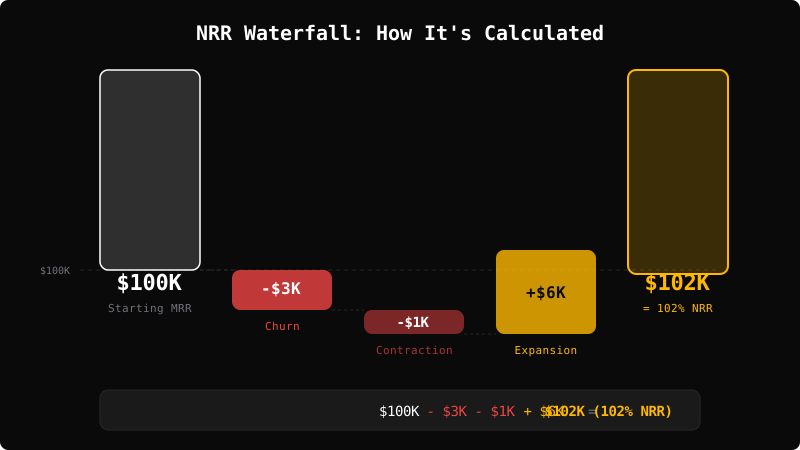
NRR = (Starting MRR − Churn MRR − Contraction MRR + Expansion MRR) ÷ Starting MRR × 100
Where:
- Starting MRR = Monthly recurring revenue at the beginning of the period from the cohort you're measuring
- Churn MRR = Revenue lost from customers who cancelled entirely
- Contraction MRR = Revenue lost from customers who downgraded to a cheaper plan
- Expansion MRR = Revenue gained from existing customers through upgrades, add-ons, or increased usage
Example
Start of month: $100,000 MRR from existing customers.
During the month:
- $3,000 lost to cancellations (churn)
- $1,000 lost to downgrades (contraction)
- $6,000 gained from upsells and plan upgrades (expansion)
NRR = ($100,000 − $3,000 − $1,000 + $6,000) ÷ $100,000 × 100 = 102%
That 102% means your existing subscriber base grew by 2% in a single month — without a single new customer. Over a year, that compounds significantly.
NRR vs. Gross Revenue Retention
These two metrics tell you different things:
Gross Revenue Retention (GRR) only counts losses. No expansion revenue. It answers: "How much of my starting revenue am I keeping?"
GRR = (Starting MRR − Churn MRR − Contraction MRR) ÷ Starting MRR × 100
GRR is always 100% or below. It tells you how leaky your bucket is.
NRR includes expansion. It tells you whether what's flowing in through expansion offsets what's leaking out. You can have a GRR of 92% and an NRR of 115% — meaning you lose 8% of revenue to churn and downgrades each period, but expansions more than make up for it.
Track both. GRR shows the health of your core product (are people staying?). NRR shows the health of your business model (is each customer becoming more valuable?).
Net Revenue Retention Benchmarks
By Performance Tier
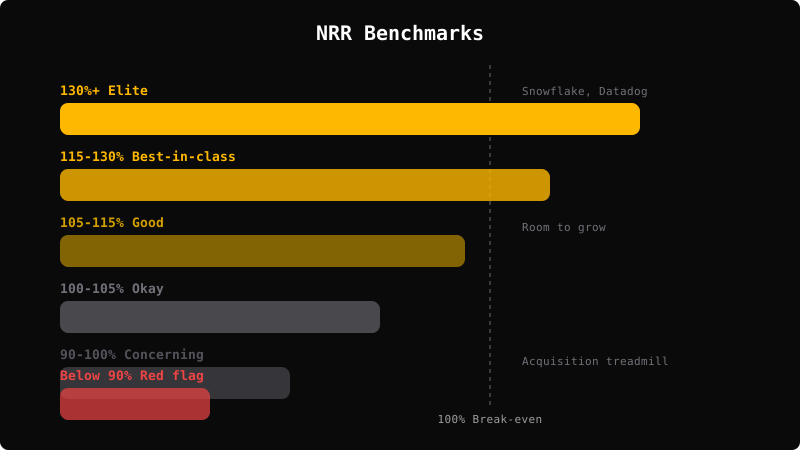
| NRR Range | What It Means |
|---|---|
| 130%+ | Elite. You're Snowflake or Datadog. Usage-based pricing that scales with customer growth. |
| 115-130% | Best-in-class. Strong expansion engine. Investors love this range. |
| 105-115% | Good. Existing base is growing, but there's room to improve expansion. |
| 100-105% | Okay. Roughly breaking even on existing customers. Growth depends entirely on new acquisition. |
| 90-100% | Concerning. Base is slowly shrinking. Acquisition has to outrun contraction. |
| Below 90% | Red flag. Your business model needs work. |
By Company Size
Larger companies tend to have higher NRR because enterprise customers expand more over time (more seats, more usage, more departments adopting):
| Company Size (ARR) | Median NRR | Top Quartile |
|---|---|---|
| $100M+ | 115% | 125%+ |
| $25M-$100M | 108% | 118% |
| $10M-$25M | 104% | 112% |
| $1M-$10M | 98% | 106% |
| Bootstrapped ($3M-$20M) | 104% | 110%+ |
If you're a smaller subscription business sitting at 98% NRR, you're not broken — you're median for your size. But "median" means there's significant upside if you build an expansion engine.
By Customer Segment
Your pricing model and customer type heavily influence NRR:
| Model | Typical NRR | Why |
|---|---|---|
| Usage-based (Snowflake, Twilio) | 120-160% | Revenue grows automatically as customers use more |
| Seat-based B2B SaaS | 105-120% | Teams grow, more seats purchased |
| Flat-rate B2C subscription | 85-100% | Limited expansion paths, higher churn |
| Tiered pricing with add-ons | 100-115% | Expansion through upgrades and add-ons |
This explains why companies like Snowflake have reported NRR as high as 158% (FY23 peak; 125% as of Q4 FY26) — their pricing is designed so that as customers succeed, they spend more. The product's growth is aligned with the customer's growth.
If you're running a flat-rate subscription with no expansion path, an NRR above 100% is structurally difficult. That's not a retention problem. It's a packaging problem.
NRR at Real Subscription Companies
Public companies disclose NRR (sometimes called "net retention rate" or "dollar-based net retention") in their 10-Ks and quarterly earnings. The pattern is consistent: the higher the usage-based or seat-expansion component of pricing, the higher the NRR.
The insider subscription playbook
One tactic that moves the needle — every Thursday
Real companies, real numbers, strategies you can steal. From the operator who grew Codecademy from $10M to $50M ARR.
| Company | Pricing model | Reported NRR | What this tells you |
|---|---|---|---|
| Snowflake | Pure consumption | 125% (Q4 FY26, Jan 31 2026)[^snow] | Down from 158% FY23 peak, but still elite — consumption revenue compounds as customers query more |
| Twilio | Per-message / per-minute usage | 114% DBNE (Q1 2026)[^twlo] | Recovered from sub-100% trough — communication API volume is reaccelerating |
| Datadog | Per-host + product cross-sell | Low-120%'s (trailing 12-mo, Mar 31 2026)[^ddog] | Multi-product land-and-expand still driving expansion |
| Atlassian | Seat + tier (Cloud) | 120%+ Cloud NRR (Q2 FY26, Dec 31 2025)[^team] | Cloud migration + AI seat upsell keeping expansion elite for a seat-based model |
| HubSpot | Seat + tier-based | 103% (Q1 2026, Mar 31 2026)[^hubs] | Mature mid-market base with modest per-customer expansion headroom |
| Asana | Pure seat-based | 96% (trailing 4-Q, Q4 FY26, Jan 31 2026)[^asan] | Seat-based models stay exposed to customer headcount cycles |
Metric definitions vary. Snowflake, Atlassian, and HubSpot disclose "Net Revenue Retention." Datadog and Asana disclose "Dollar-Based Net Retention." Twilio discloses "Dollar-Based Net Expansion." All measure the same underlying concept (expansion minus churn from an existing customer cohort) but use slightly different cohort and time-window math — compare with that caveat.
[^snow]: Snowflake Q4 FY2026 earnings release (8-K), Feb 26 2026. SEC filing. [^twlo]: Twilio Q1 2026 earnings release (8-K), Apr 30 2026. SEC filing. [^ddog]: Datadog Q1 2026 Form 10-Q, period ended Mar 31 2026. SEC filing. [^team]: Atlassian Q2 FY26 shareholder letter, period ended Dec 31 2025. Atlassian discloses "120%+" rather than a precise figure. [^hubs]: HubSpot Q1 2026 earnings call, May 7 2026. HubSpot reports NRR in earnings commentary rather than 10-K body. [^asan]: Asana Q4 FY2026 earnings release, Feb 27 2026. Reported as a trailing four-quarter average.
The takeaway isn't "copy Snowflake's pricing." It's that NRR is a structural property of how you charge, not a tactical retention number. If your pricing doesn't allow revenue to grow with customer success, no retention playbook will get you to elite NRR.
Why NRR Matters More Than You Think
It's the Anti-Acquisition Metric
Most subscription businesses pour energy into the top of the funnel. More traffic. More signups. More ad spend.
NRR measures the opposite: what happens after someone subscribes. Are they becoming more valuable or less valuable over time?
Here's the thing: improving NRR by 10 points often has more revenue impact than a 30-40% increase in new customer acquisition — and it costs a fraction as much. You're working with people who already trust you, already use the product, already pay you.
This is the core thesis of everything I do: most subscription businesses don't have a traffic problem. They have a monetization problem. NRR is how you measure it.
It Compounds
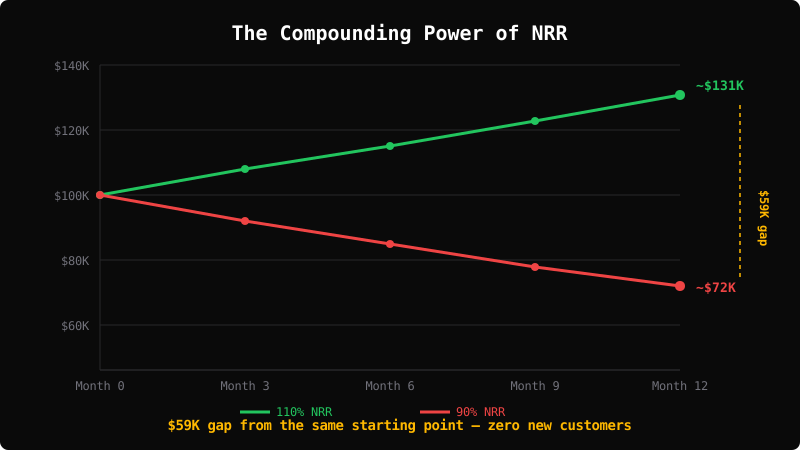
A subscription business with 110% NRR and zero new customers would still grow 10% per period from existing customers alone. After a year, that base is worth ~31% more than where it started.
Now add new customers on top. That's compounding growth from two directions — exactly what the best subscription businesses are doing.
Conversely, a business with 90% NRR is losing 10% of its existing revenue every period. You need to acquire enough new customers to replace that 10% before you can start growing. That's the treadmill.
Investors Use It as a Shortcut
There's a reason NRR has become the headline metric in SaaS valuations. High-NRR companies command premium multiples because they demonstrate sustainable, capital-efficient growth.
An acquirer or investor looking at two businesses — one with 95% NRR spending aggressively on acquisition, and one with 115% NRR spending moderately — will pick the second one every time. The second business grows from within.
If you're ever raising capital, selling, or just want to understand the quality of your revenue, NRR is the number.
The Three Levers of NRR
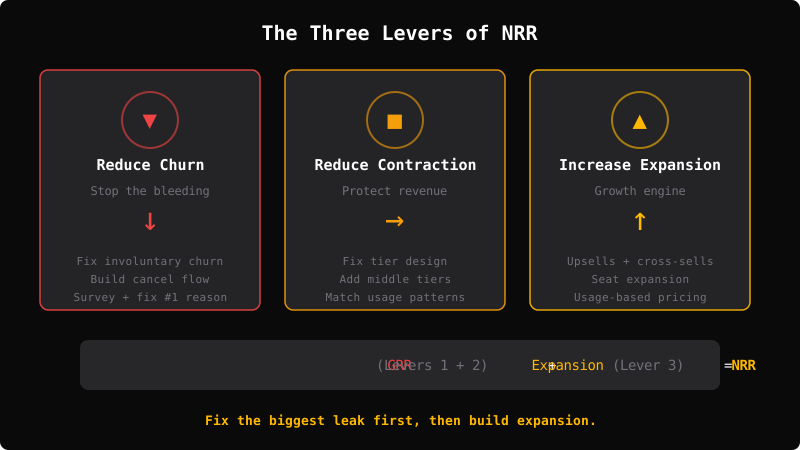
NRR is the net result of three forces. Improving it means pulling one or more of these levers:
Lever 1: Reduce Churn (Stop the Bleeding)
Every cancelled subscriber directly hits your NRR. This is the defensive play.
The biggest quick win: fix involuntary churn. Failed payments, expired cards, declined charges — these account for 20-40% of all subscription churn. These subscribers want to keep paying you.
- Enable ML-driven payment retries (Stripe Smart Retries or equivalent)
- Build a dunning email sequence (3-4 emails over 10-14 days)
- Send card expiration reminders before payments fail
- Set grace periods on App Store and Google Play subscriptions
For voluntary churn, the highest-leverage moves are adding a cancellation flow with pause and downgrade options, and surveying every cancelling subscriber to find your #1 reason for churn.
I covered this in detail in my churn rate guide — start there if churn is your primary problem.
Lever 2: Reduce Contraction (Protect the Revenue)
Contraction happens when existing subscribers downgrade to a cheaper plan. Some contraction is healthy — it's better than cancellation. But if you're seeing significant downgrade volume, your packaging might be off.
Common causes:
- Tiers don't match usage patterns. Customers are paying for features they don't use and eventually realize it.
- No intermediate option. The gap between tiers is too large, so customers who can't justify the high tier drop to the bottom.
- Usage decreased. Seasonal businesses, companies that downsized, teams that changed tools.
The fix is usually in packaging design — making sure your tiers map to how different customer segments actually use the product. If most downgrades go from Tier 3 to Tier 1 (skipping Tier 2 entirely), your middle tier isn't doing its job.
Lever 3: Increase Expansion (The Growth Engine)
This is where NRR goes from "protecting revenue" to "growing revenue." Expansion revenue comes from existing customers paying you more.
There are four main types:
Upsells (plan upgrades): Subscribers move to a higher tier. This requires your tiers to have a natural growth path — as the customer succeeds or their needs grow, the next tier up becomes the obvious choice.
The trigger: usage-based prompts. When a subscriber hits 80% of their plan limit, that's the moment to suggest an upgrade. Not on a random Tuesday. Not in a monthly newsletter. At the exact moment they're experiencing the constraint. For the full playbook on upselling and expansion revenue, start there.
Cross-sells (add-ons): Sell complementary features, services, or products to existing subscribers. A project management tool might sell time tracking as an add-on. A design tool might sell additional storage or asset libraries.
The key: add-ons should feel like natural extensions, not nickel-and-diming. If customers feel surprised by what's not included, you've packaged wrong.
Seat expansion: For per-seat products, growth is automatic when your customer's team grows. This is why seat-based SaaS tends to have strong NRR — expansion happens organically.
If you're seat-based, make it absurdly easy to add seats. Remove friction. Some businesses even auto-provision seats when new team members are detected.
Usage-based growth: If any component of your pricing scales with usage (API calls, data storage, transactions), expansion happens naturally as customers use the product more.
This is why companies like Snowflake and Twilio have posted NRR numbers above 150% at their peaks (Snowflake 158% FY23, Twilio 155% FY22). Their pricing is built so that customer success = revenue growth.
How to Improve Your NRR: The Practical Playbook
Step 1: Know Your Number
Pull your NRR from your billing platform or calculate it manually. Many subscription businesses I talk to have never actually done this.
If your billing tool doesn't surface NRR directly, export your MRR data and calculate it:
- Pick a cohort (e.g., all customers active on January 1)
- Note their total MRR on January 1
- Note the same cohort's MRR on February 1 (including cancellations, downgrades, and expansions)
- Divide February by January. That's your monthly NRR.
Do this for the last 12 months. You want the trend, not just a snapshot.
Step 2: Decompose It
Break your NRR into its three components:
- Gross retention rate (what percentage of starting MRR you kept, excluding expansion)
- Expansion rate (what percentage of starting MRR you added through upsells, cross-sells, usage growth)
- NRR (gross retention + expansion)
This tells you where the opportunity is. If your GRR is 88%, you have a churn/contraction problem — fix the leaks before building expansion. If your GRR is 96% but expansion is only 2%, your retention is solid and the opportunity is in building upsell paths.
Step 3: Fix the Biggest Leak First
Don't try to improve all three levers at once. Find the one with the most upside and focus there.
If GRR is below 90% → Focus on churn reduction. You're leaking too much to overcome with expansion alone. Fix involuntary churn first (fastest), then voluntary churn (biggest impact).
If GRR is 90-95% with low expansion → Your retention is reasonable. Build expansion paths: add a higher tier, introduce add-ons, implement usage-based triggers for upsells.
If GRR is 95%+ with low expansion → Your retention is strong. This is an expansion problem, likely rooted in packaging. You may not have enough tiers, your tiers may not have a clear upgrade path, or you're not surfacing upgrade opportunities at the right moments.
Step 4: Build Expansion Into the Product
The best expansion revenue doesn't come from sales outreach or email campaigns. It comes from the product itself.
- Usage limits that naturally trigger upgrades. "You've used 90% of your storage. Upgrade for 10x more."
- Features visible but gated. Users can see what the next tier includes, creating desire.
- Milestone celebrations that mention the next tier. "You've completed 50 projects — Pro users average 200."
Expansion should feel like a natural progression, not a sales pitch. If your customers are surprised that upgrading is even an option, you haven't made it visible enough.
Step 5: Revisit Pricing and Packaging
If your NRR is structurally limited — say, you sell a single flat-rate plan with no expansion path — no amount of retention tactics will get you above 100%.
Consider:
- Adding tiers that give customers room to grow into
- Introducing a usage-based component so revenue scales with the customer's success
- Creating add-ons for power users who want more
- Adjusting your value metric to one that naturally expands (seats, usage, transactions)
The best NRR structures align your revenue with your customer's growth. When they succeed, you succeed. When their team doubles, your revenue from them doubles too.
When NRR Is the Wrong Metric to Chase
NRR is the durability metric for mature B2B SaaS businesses. It is not the right scoreboard for everyone. Skip the obsession with NRR (or weight it lower) if:
You sell flat-rate B2C subscriptions. A single-plan B2C product (a meditation app, a news subscription, a community membership) has no structural expansion path. Pushing NRR above 100% requires adding tiers, usage-based components, or add-ons — which may not fit the product. Track gross retention as the scoreboard instead.
You're pre-product-market-fit. With <12 months of cohort data, NRR is too noisy to be a useful operating metric. The single large customer that upgrades or cancels swings the number wildly. Track active paying subscribers and 30/60/90-day retention curves until your churn rate stabilizes.
Your business is services-heavy. If 40%+ of revenue is implementation, professional services, or custom dev, NRR is partly measuring the wrong thing — services don't recur the same way. Track recurring vs non-recurring revenue separately.
You're a marketplace or transactional business. GMV growth and take rate matter more than NRR. Trying to compute NRR on transactional revenue produces a noisy number with no actionable lever.
Your subscriber base is under 200 paying customers. Single-customer concentration risk dominates the math. One whale upgrading takes you from 95% to 130% NRR; one whale leaving takes you back. The metric becomes more signal than noise once you have ~500+ paying accounts.
NRR Calculator
Monthly NRR
NRR = (Starting MRR − Churn − Contraction + Expansion) ÷ Starting MRR × 100

Example:
($100,000 − $3,000 − $1,000 + $6,000) ÷ $100,000 × 100 = 102%
Annualized NRR from Monthly
Annual NRR = Monthly NRR ^ 12

Example: 1.02^12 = 1.268 = 126.8% annual NRR
A 102% monthly NRR annualizes to nearly 127%. Small monthly improvements compound fast.
Want to see how NRR and churn interact to shape your growth trajectory? Try the Growth Ceiling Calculator to model different scenarios.
Expansion Rate
Expansion Rate = Expansion MRR ÷ Starting MRR × 100

Example: $6,000 ÷ $100,000 = 6% monthly expansion
Gross Revenue Retention
GRR = (Starting MRR − Churn − Contraction) ÷ Starting MRR × 100

Example: ($100,000 − $3,000 − $1,000) ÷ $100,000 = 96% GRR
FAQ
What's the difference between NRR and NDR?
Nothing. Net Revenue Retention (NRR) and Net Dollar Retention (NDR) are the same metric. Different companies use different terms. NRR is more common today.
What's a good NRR for a small SaaS business?
For businesses under $10M ARR, the median NRR is around 98-104%. Getting above 105% puts you in a strong position. Don't compare yourself to Snowflake's peak 158% (or even its current 125%) — that's a different business model (usage-based pricing at massive scale). Compare against companies your size with similar pricing models.
Can B2C subscription businesses have high NRR?
It's harder but possible. B2C subscriptions tend to have fewer natural expansion paths — you're not adding seats or growing usage the same way. The levers for B2C are tiered plans (basic → premium), add-ons, annual plan upgrades, and price increases for new subscribers. A B2C subscription with NRR above 100% is doing well.
How often should I measure NRR?
Monthly, looking at trailing 12-month averages. A single month's NRR can be noisy — one large customer upgrading or cancelling can swing the number. The trailing average smooths this out and shows the real trend.
Is it possible to have NRR above 100% with high churn?
Yes. If your expansion revenue is strong enough, it can offset significant churn. A business losing 5% of revenue to churn monthly but gaining 8% from expansions has 103% NRR. But this is fragile — you're relying on expansion to cover a big hole. It's better to fix the churn and build expansion. High GRR + high expansion = durable NRR.
What's the relationship between NRR and LTV?
Higher NRR means higher customer lifetime value. If NRR is 110%, each cohort of customers is worth more in year two than year one — and more in year three than year two. The lifetime value calculation fundamentally changes when expansion is factored in. Traditional LTV formulas (revenue ÷ churn rate) undercount the value of expanding customers.
What to Do Next
NRR is the single best measure of whether your subscription business is built to last.
It tells you if your pricing works. It tells you if your packaging has room for customers to grow. It tells you if you're making more from what you already have — or if you're stuck on the acquisition treadmill.
If your NRR is below 100%, the fix isn't more traffic. It's better monetization: reduce churn, minimize downgrades, and build expansion paths that make each customer worth more over time.
If you want to see where else your subscription business might be leaving revenue on the table — pricing, packaging, conversion, retention, and expansion — I built a free self-assessment that covers all of it.
Take the Subscription Revenue Leak Audit →
52 checklist items across 8 revenue leak categories. Takes 10 minutes. Shows you exactly where the gaps are.

Dan Layfield
Dan ran growth at Codecademy, scaling ARR from $10M to $55M before the company was acquired for $525M. He now advises subscription businesses on pricing, retention, and revenue optimization.
Work with Dan →Related Guides
Price Localization: How Subscription Businesses Unlock International Revenue
Learn how to implement price localization for your subscription business — from currency display to full purchasing power parity (PPP) adjustments. Stop losing international customers.
15 min readRecurring Revenue: How to Grow It Without Growing Your Traffic
Stop trying to grow recurring revenue by acquiring more customers. A subscription growth framework: six levers to make more from the subscribers you already have.
31 min readSubscription Metrics: The 10 Numbers That Actually Run Your Business
Most subscription businesses track too many metrics and act on too few. Here are the 10 that matter, how they connect, and what to do when they're off.
Get the playbook every Thursday
Weekly strategies for subscription businesses. Real companies, real numbers, tactics you can steal. From the operator who grew Codecademy from $10M to $50M ARR.