The Subscription Model Guide: From Setup to Monetization
Go beyond "pick a pricing model." This guide covers what actually matters: making your subscription business profitable through pricing, packaging, and retention.

Dan Layfield
Growth at Codecademy, $10M → $50M ARR
In This Guide
- What Is a Subscription Model?
- The Six Subscription Models at a Glance
- Subscription Model Definitions
- The Six Subscription Model Types
- What Real Companies Charge (And What It Tells You)
- Choosing the Right Model
- From Model to Monetization: The Part Most Guides Skip
- The Subscription Business Scorecard
- When a Subscription Model Is the Wrong Choice
- FAQ
- What to Do Next
Most subscription-model guides ask the wrong question. They ask which model should I pick?
The honest answer: the model barely matters. The same product wrapped in tiered, freemium, or hybrid pricing will produce similar revenue if the monetization is dialed in. The model is the wrapper. Pricing, packaging, and retention are the engine. Picking a model is a 30-minute decision. The engine takes years.
I figured this out scaling Codecademy from $10M to $50M ARR. We changed our model more than once. None of those changes mattered as much as fixing pricing, packaging, and the free-to-paid conversion path. The difference between a subscription business that plateaus at $50K ARR and one that scales to $5M isn't the billing software or the payment processor — it's how you monetize whatever model you happen to be running.
This guide covers both: the six models you can choose from, and the monetization work that actually determines whether any of them produces real revenue.
What Is a Subscription Model?
A subscription model is a business model where customers pay a recurring fee — monthly, quarterly, or annually — for ongoing access to a product or service.
The appeal is predictable revenue. Instead of one-time sales where you need to re-acquire customers constantly, subscriptions create a revenue base that compounds over time. Every new subscriber adds to next month's total. That predictability is why subscription businesses consistently trade at higher valuations than one-time-purchase businesses. For a deeper look at the mechanics, see my guide on recurring revenue.
But predictability only works if subscribers stick around. And that's where most subscription businesses fall short — they're so focused on getting the subscription started that they don't think about what makes people stay.
The Six Subscription Models at a Glance
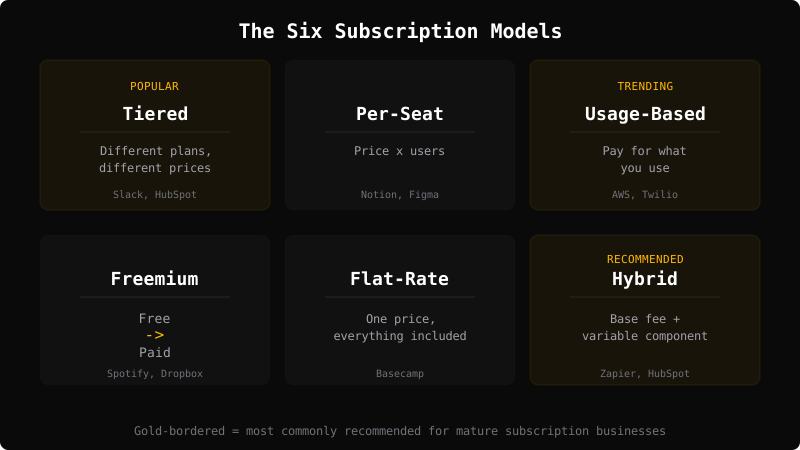
| Model | How customers pay | Expansion mechanic | Best for | Real example |
|---|---|---|---|---|
| **Tiered** | Pick a plan (Starter / Pro / Enterprise) | Upgrade to a higher tier | Differentiated needs across segments | Slack, HubSpot |
| **Per-seat** | Per user per month | Add more users | Collaboration tools, team software | Notion, Figma |
| **Usage-based** | Pay for what you consume | Use more | Infrastructure, dev platforms | AWS, Snowflake (158% NRR) |
| **Freemium** | $0 free tier + paid upgrade | Convert free → paid | High-volume B2C, network effects | Spotify, Dropbox |
| **Flat-rate** | One price, everything in | None — no upgrade path | Simple products, early stage | Basecamp |
| **Hybrid** | Base fee + usage or seats | Both at once | Most mature SaaS | Modern AI products, many B2B SaaS |
The short answer: Most subscription businesses should start tiered with 2-3 plans and migrate toward hybrid (base + usage or base + seats) as they mature. Freemium is an acquisition strategy bolted onto tiered or hybrid — not a model on its own. Skip flat-rate unless you're under 18 months old; it leaves expansion revenue on the table. And whichever model you pick, the work that determines whether you make money happens after you pick it: pricing, packaging, conversion, retention, and expansion.
Subscription Model Definitions
The terms in this guide get used loosely all over the internet. Here's what each one actually means.
Tiered pricing — Multiple plans at different price points, each with different features or capacity. Customers pick the plan that matches their needs. Example: HubSpot Starter ($20/seat/mo) → Professional → Enterprise, with feature differences at each step.
Per-seat pricing — Customers pay per user per month. Revenue scales as their team grows. Example: Notion at $10/seat/mo for Plus, $15/seat/mo for Business.
Usage-based pricing — Customers pay based on consumption: API calls, storage, transactions, tokens. Example: Snowflake charges per credit consumed and posts 158% net revenue retention because customers' usage compounds as they grow.
Freemium — A permanent free tier alongside paid plans. Conversion rates run 2-5% for consumer products and 5-10% for B2B. Example: Spotify converts a large share of monthly actives to Premium — driven by content licensing and network effects.
Flat-rate pricing — One price, one plan, everything included. Example: Basecamp at a single monthly price for the whole product.
Hybrid pricing — Two or more models combined, typically a base subscription plus a usage or per-seat component. Example: many modern AI products charge a base platform fee plus credits or tokens for usage.
MRR (Monthly Recurring Revenue) — The predictable monthly revenue from all active subscriptions. An annual subscriber contributes 1/12th of their annual price to MRR each month.
NRR (Net Revenue Retention) — Revenue from existing customers a year later, including expansion and after subtracting churn and downgrades. Above 100% means the existing base is growing in value without any new acquisition.
The Six Subscription Model Types
1. Tiered Feature-Based
How it works: Multiple plans at different price points, each with different feature sets. The more you pay, the more you get.
Best for: SaaS, digital subscriptions, membership businesses with clearly differentiated user needs.
Examples: Slack (Free → Pro → Business+ → Enterprise), HubSpot (Starter → Professional → Enterprise).
Why it works: Different customers have different needs and different budgets. Tiered pricing captures value from each segment instead of forcing everyone into a one-size-fits-all plan.
The monetization angle: Your tiers determine your entire revenue structure. If most subscribers land on the cheapest tier, your packaging is wrong — not your traffic. Get the tiers right and you've built an upgrade path that grows revenue automatically as customers' needs increase.
2. Per-Seat / Per-User
How it works: Price scales with the number of users on the account.
Best for: Collaboration tools, team productivity software, B2B platforms where more users = more value.
Examples: Notion, Figma, most project management tools.
Why it works: Revenue naturally expands as the customer's team grows. No upsell call required — they just add seats.
The monetization angle: Per-seat pricing creates organic expansion revenue, which directly boosts net revenue retention. But be careful: if your product's value doesn't actually scale linearly with users, per-seat pricing can feel punitive and drive churn. A 3-person team and a 30-person team that both use the product the same way shouldn't pay 10x differently.
3. Usage-Based
How it works: Customers pay based on how much they use — API calls, data storage, transactions processed, messages sent.
Best for: Infrastructure tools, developer platforms, products where usage varies widely between customers.
Examples: AWS, Twilio, Snowflake.
Why it works: Revenue automatically scales with the customer's success. As they use more, they pay more. This aligns your incentives perfectly — you want them to use your product as much as possible.
The monetization angle: Usage-based pricing produces the highest NRR numbers in subscription businesses (Snowflake has hit 158% NRR). But pure usage-based pricing creates bill unpredictability, which some customers hate. The trend is hybrid: base subscription fee + usage-based component. About 43% of SaaS companies now use a hybrid approach.
4. Freemium
How it works: A free tier with limited features or capacity, plus paid tiers that unlock more.
Best for: Products with high volume potential, network effects, or products where the free version demonstrates clear value.
Examples: Spotify (free ad-supported → Premium), Dropbox (2GB free → paid storage), Slack (limited history → full archive).
Why it works: Removes the barrier to entry completely. Users experience the product before paying, which builds trust and demonstrates value.
The monetization angle: Freemium conversion rates are typically 2-5% for B2C and 5-10% for B2B. That sounds low, but on a large free user base, even small conversion rate improvements produce significant revenue. The key is that your free tier should deliver enough value to hook users but naturally bump them against limits that make upgrading obvious. If free users never feel a reason to upgrade, your free tier is too generous. For the trial-design version of this problem — credit card vs. no-card, trial length, what to unlock — see our free trial strategy guide.
The insider subscription playbook
One tactic that moves the needle — every Thursday
Real companies, real numbers, strategies you can steal. From the operator who grew Codecademy from $10M to $50M ARR.
5. Flat-Rate
How it works: One price, one plan, everything included.
Best for: Simple products, tools aimed at a single customer segment, early-stage products still figuring out their market.
Examples: Basecamp (one plan, flat price).
Why it works: Dead simple to understand and sell. No tier confusion. No pricing page decisions.
The monetization angle: Flat-rate pricing leaves money on the table in two directions. Power users who'd happily pay more can't. Casual users who'd buy a cheaper version won't. Your expansion revenue potential is nearly zero — there's no upgrade path. Flat-rate works early, but most businesses outgrow it. When you find yourself with subscribers whose usage varies wildly, it's time to move to tiers or usage-based.
6. Hybrid
How it works: Combines two or more models — typically a base subscription plus a usage-based or per-seat component.
Best for: Most mature subscription businesses. Provides revenue predictability (base fee) with expansion upside (usage or seats).
Examples: Many modern SaaS products combine a platform fee with per-seat or per-usage charges. AI products often charge a base fee plus credits or tokens for usage.
Why it works: Captures the best of both worlds. Customers get a predictable base price. You get expansion revenue as they grow.
The monetization angle: Hybrid is where the industry is heading. The base fee provides MRR stability. The variable component provides expansion. If you're building a new subscription product today, consider hybrid from the start — it's much easier to build expansion into the model upfront than to retrofit it later.
What Real Companies Charge (And What It Tells You)
Prices checked May 15, 2026 against each company's official pricing page (USD, monthly billing where available). Pricing pages change often — verify before quoting in a sales conversation.
| Company | Model | Entry price | Top tier | What it tells you |
|---|---|---|---|---|
| Slack | Tiered + per-seat | Pro: $8.75/seat/mo (monthly) or $7.25/seat/mo (annual) ([source](https://slack.com/pricing), May 15 2026) | Business+: $18/seat/mo (monthly) / $15/seat/mo (annual); Enterprise+: custom ([source](https://slack.com/pricing), May 15 2026) | The monthly-vs-annual gap (~17%) is the seat-discount lever pulling customers onto annual contracts. The Pro-to-Business+ jump (2x) is where Slack monetizes the "we need SSO and compliance" moment — that's the upgrade trigger, not features. |
| Notion | Per-seat | Plus: $10/member/mo (monthly billing) ([source](https://www.notion.com/pricing), May 15 2026) | Business: $20/member/mo; Enterprise: custom ([source](https://www.notion.com/pricing), May 15 2026) | Pure per-seat with a clean 2x step from Plus to Business. No usage component, no surprise charges — expansion is entirely a function of headcount growth at the customer. Simple to forecast, but you live and die by seat sprawl. |
| Snowflake | Usage-based | $0 base, pay per credit consumed ([source](https://www.snowflake.com/pricing/), May 15 2026) | Enterprise commit deals (custom) | 158% NRR — usage compounds as customers grow. The trade-off: bill unpredictability creates procurement friction, which is why most usage-based businesses now layer a base platform fee on top (hybrid). |
| Spotify | Freemium + tiered | Free (ad-supported) → Premium Individual: $12.99/mo ([source](https://www.spotify.com/us/premium/), May 15 2026) | Premium Family: $21.99/mo (up to 6 accounts); Premium Duo: $18.99/mo ([source](https://www.spotify.com/us/premium/), May 15 2026) | Family plan at $21.99 for 6 accounts ($3.67/person) is the highest-NRR product Spotify ships — group plans lower the effective price per ear while raising blended ARPU per household. Student at $6.99 is acquisition pricing for a generational cohort. |
| HubSpot | Tiered (seat + contact-tier hybrid) | Marketing Hub Starter: $20/seat/mo (annual billing, 1,000 contacts) ([source](https://www.hubspot.com/pricing/marketing), May 15 2026) | Marketing Hub Professional: $890/mo (3 seats, 2,000 contacts); Enterprise: $3,600/mo (5 seats, 10,000 contacts) ([source](https://www.hubspot.com/pricing/marketing), May 15 2026) | The 45x spread from Starter ($20/mo) to Enterprise ($3,600/mo) is pure value-based pricing tied to contact count, not seat count. HubSpot expands revenue via the *contact tier* — every marketing list that grows triggers a true-up. That's a more powerful lever than seats for marketing software. |
The pattern: every mature subscription business sits in tiered, per-seat, usage-based, or some hybrid of the three. Pure flat-rate doesn't appear at scale. Pure freemium doesn't either — freemium always sits on top of a tiered or hybrid paid structure underneath.
Choosing the Right Model
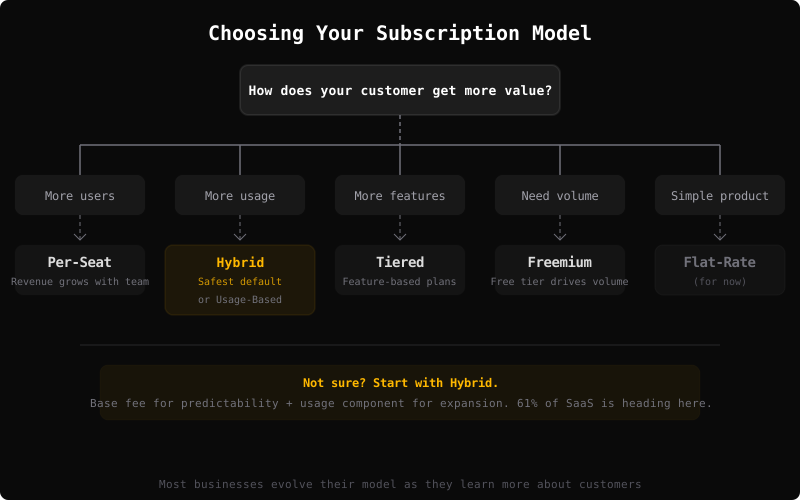
The model you choose affects every downstream monetization decision. Here's how to decide:
| If... | Consider... |
|---|---|
| Your product has clearly different user segments | Tiered feature-based |
| Value scales directly with team size | Per-seat |
| Usage varies 10x+ between customers | Usage-based or hybrid |
| You need massive top-of-funnel volume | Freemium |
| Your product is simple with one clear use case | Flat-rate (for now) |
| You want both predictability and expansion | Hybrid |
The question to ask: "What's the natural way my customers get more value from this product over time?" If it's more users → per-seat. More usage → usage-based. More features → tiered. If there's no natural expansion path, you'll need to create one through packaging.
From Model to Monetization: The Part Most Guides Skip
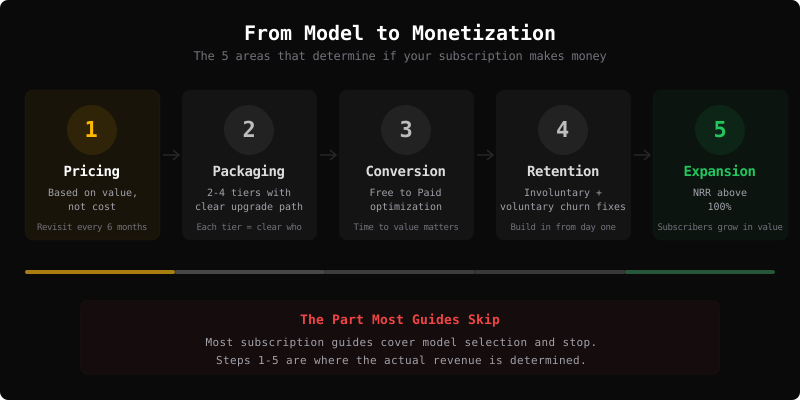
Picking a model is the beginning. Here's what actually determines whether your subscription business makes money.
Get Pricing Right From the Start
Most subscription businesses price based on competitors or gut feeling. Neither reflects what your customers would actually pay.
Before launch (or as soon as possible after), research willingness to pay. The Van Westendorp method is the most practical approach — four questions, 100+ responses, and you'll have a data-backed price range.
Key principles:
- Price on value, not cost. What your product costs to build has nothing to do with what customers will pay.
- Revisit every six months. Your product improves. Your market shifts. Your prices should follow.
- Grandfather existing subscribers. Test new prices on new signups only. Zero risk to current revenue.
Design Packaging That Converts and Expands
Your tiers should do two things: make it easy for customers to start paying, and make it natural for them to pay more over time.
2-4 tiers, each with a clear "who":
- Starter: Individual users, testing the water, price-sensitive. Low barrier.
- Pro/Growth: Active users, growing needs. This should be where most subscribers land.
- Business/Enterprise: Larger organizations, advanced needs. Premium price, premium value.
Highlight your recommended plan. A "Most Popular" badge pushes 10-20% more subscribers toward the middle tier.
And make sure there's a clear upgrade trigger — a moment where the subscriber naturally hits the limits of their current plan and the next tier solves the problem. If subscribers never bump against limits, your tiers are too generous. If they complain about limits constantly, your tiers are too stingy.
Nail Free-to-Paid Conversion (If You Have a Free Tier)
Freemium is an acquisition strategy, not a monetization strategy. The monetization happens at the conversion point.
Benchmarks:
- B2B SaaS free trial: 15-25% conversion
- B2B SaaS freemium: 5-10% conversion
- B2C freemium: 2-5% conversion
What moves conversion:
- Time to value. Users need to experience core value in their first session. Not their first week. Their first session.
- Smart upgrade prompts. Trigger at moments of value or friction — when they hit a limit while doing something they care about. Not on day 5 because your marketing automation said so.
- Understand non-converters. Survey free users who don't upgrade. Their reasons are specific and actionable.
The trial experience is where most of the conversion battle is won or lost. Credit card vs. no-card, trial length, what gets unlocked — those decisions usually matter more than the price.
Build Retention Into the Business
Subscriber retention isn't something you add later. It should be designed into the model from day one.
Involuntary churn prevention: Set up payment recovery (Smart Retries, dunning emails, card expiration reminders) before your first subscriber hits a billing cycle. This is infrastructure, not optimization.
Voluntary churn reduction: Add a cancellation flow with pause and downgrade options. Survey cancelling subscribers. Know your #1 reason for cancellation and work on it continuously.
Annual plan incentives: Offer annual billing priced based on your actual monthly retention data — not an arbitrary discount. Annual subscribers churn at significantly lower rates and give you guaranteed revenue.
Build an Expansion Engine
The best subscription businesses don't just retain subscribers. They make subscribers worth more over time.
This is the difference between a subscription business that grows linearly (add customers → add revenue) and one that compounds (add customers + existing customers expand → accelerating revenue).
Expansion levers:
- Usage-based pricing components that scale naturally
- Clear tier upgrade paths for growing customers
- Add-ons and premium features for power users
- Seat-based growth for team products
Track net revenue retention as your north star. Above 100% means your existing subscriber base is growing in value — even before you count new subscribers.
The Subscription Business Scorecard
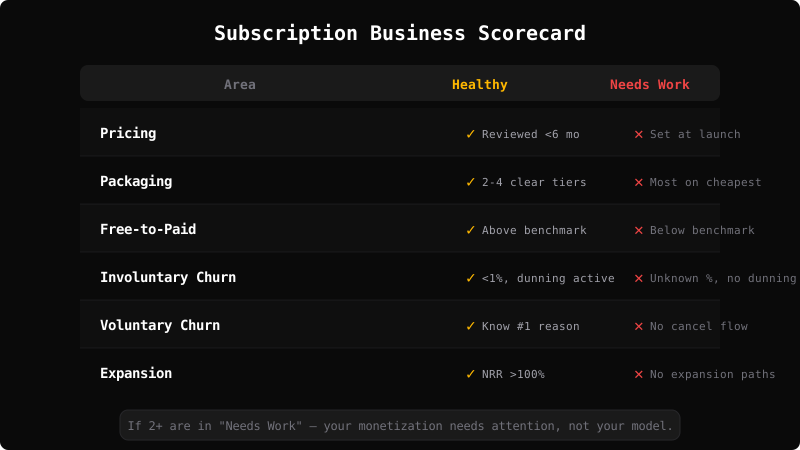
Here's a quick diagnostic for where your subscription business stands:
| Area | Healthy | Needs Work |
|---|---|---|
| **Pricing** | Reviewed in last 6 months, based on willingness-to-pay data | Set at launch, based on competitors or gut feeling |
| **Packaging** | 2-4 clear tiers, most subscribers on mid-tier, clear upgrade path | One plan or too many plans, most subscribers on cheapest tier |
| **Free-to-Paid** | Above benchmark for your type, time-to-value under 1 session | Below benchmark, users churning before experiencing value |
| **Involuntary Churn** | Below 1%, Smart Retries enabled, dunning sequence active | Unknown percentage, default retry settings, no dunning |
| **Voluntary Churn** | Know #1 reason, cancellation flow with alternatives, below benchmark | No cancellation flow, no data on why subscribers leave |
| **Expansion** | NRR above 100%, active upsell paths, add-ons available | No expansion paths, NRR below 100%, flat revenue per subscriber |
If more than two of those fall in the "Needs Work" column, your subscription model isn't the problem. Your monetization is.
When a Subscription Model Is the Wrong Choice
Subscriptions get pitched as the answer to every revenue question. They aren't. Four situations where forcing a subscription costs you more than it earns:
Your product solves a one-time problem. Tax prep, wedding planning, moving services, immigration paperwork. The user has a defined event, gets through it, and the value stops. Stretching that into a recurring charge feels like a trap and produces fast, angry churn. Charge a one-time fee and build the next acquisition motion instead.
Your purchase cadence is naturally slow. Furniture, mattresses, appliances, durable goods. Subscription mattress companies have struggled for this exact reason — nobody needs a new mattress every month. If the natural repurchase cycle is years, a monthly subscription is fighting the user's actual behavior.
Your unit economics require concentrated revenue upfront. Hardware-first products often need the full purchase price at sale to fund the next unit. Stretching that into a monthly subscription turns a healthy gross margin into a cash flow problem. Hardware + service subscriptions can work, but the hardware itself usually needs to be paid for upfront.
Your market is small enough to count by hand. If you have 200 potential customers globally, a $50K annual contract or a high-ticket one-time license usually beats $500/mo subscription overhead. Enterprise sales motions outperform subscription motions at very small market sizes — the operational cost of billing infrastructure starts to dwarf the volume benefit.
FAQ
What type of subscription model is best for a new business?
Start with the simplest model that captures your core value. For most businesses, that's tiered pricing with 2-3 plans. Avoid complexity early — you can always add usage-based components or add-ons later once you understand how customers use your product. The worst mistake is overengineering pricing before you have subscribers to learn from.
Can I change my subscription model later?
Yes, and you probably should. Most subscription businesses evolve their model as they learn more about their customers. Grandfather existing subscribers on the old model and roll out changes to new signups. The data from the transition will tell you if the new model is better.
How do I know if my pricing is right?
Run a willingness-to-pay survey with current subscribers. If the acceptable price range is significantly above your current price (it usually is), you're undercharging. Other signals: conversion rate is very high (price isn't a barrier because it's too low), competitors charge more for less, your LTV:CAC ratio is above 5:1.
What's the biggest mistake new subscription businesses make?
Focusing all energy on acquisition and ignoring monetization. Getting 1,000 subscribers means nothing if your pricing is wrong, half of them churn in 3 months, and there's no path for the remaining ones to spend more. Build the monetization foundation — pricing, packaging, retention, expansion — alongside your acquisition strategy, not after.
Should I offer a free tier?
Only if you have a large addressable market and a clear conversion path from free to paid. Freemium is an acquisition strategy that works at volume. If you're targeting a niche market with hundreds (not millions) of potential customers, a free trial with a time limit is usually better than a permanent free tier.
What are the disadvantages of a subscription business model?
The main disadvantages are: (1) Revenue recognition lag — you earn revenue over time rather than upfront, which creates cash flow pressure in the early stages. (2) Churn is existential — if subscribers leave faster than you acquire them, the business shrinks. Unlike one-time purchases where each sale is independent, subscription businesses must continuously earn the right to charge. (3) High upfront investment — you often need to invest in product, infrastructure, and content before revenue materializes. (4) Customer fatigue — subscription fatigue is real; consumers are increasingly selective about recurring commitments. (5) Pricing complexity — getting pricing, packaging, and plan structure right is harder than setting a one-time price. That said, the advantages (predictable recurring revenue, compounding growth, higher valuations) generally outweigh the disadvantages when the model is well-executed.
How do subscription valuations work?
Subscription businesses are typically valued on a multiple of ARR. The multiple depends on growth rate, NRR, gross margin, and market. Customer lifetime value is the fundamental unit that drives valuation math. High-growth SaaS with strong NRR might trade at 10-20x ARR. Slower-growth subscription businesses at 3-6x ARR. The key driver is the quality and predictability of the revenue — which comes back to retention, expansion, and pricing.
What to Do Next
If you already have a subscription business running, the highest-leverage move isn't changing your model — it's optimizing what you have. Most subscription businesses have significant revenue sitting untapped in pricing, packaging, retention, and expansion.
I built a free diagnostic that helps you find exactly where those gaps are.
Take the Subscription Revenue Leak Audit →
52 checklist items across 8 revenue leak categories. Takes 10 minutes. Most operators who go through it discover they're leaving 15-30% of potential revenue on the table — and the fixes don't require more subscribers.

Dan Layfield
Dan ran growth at Codecademy, scaling ARR from $10M to $55M before the company was acquired for $525M. He now advises subscription businesses on pricing, retention, and revenue optimization.
Work with Dan →Related Guides
Subscription Onboarding: How to Drive Activation in the First 7 Days
Most subscription onboarding is theater. The metric that moves LTV is time to first value — how Superhuman, Headspace, and Notion get users to their "aha moment" fast.
15 min readUpselling in Subscription Businesses: The Revenue You're Leaving on the Table
The best subscription businesses pull 30-40% of new ARR from existing customers. Learn the triggers, timing, and tactics that actually convert.
18 min readUsage-Based Pricing: The Model That's Changing Subscriptions
61% of SaaS companies now use usage-based pricing. Learn how to implement it, what metric to charge on, and when to go hybrid.
Get the playbook every Thursday
Weekly strategies for subscription businesses. Real companies, real numbers, tactics you can steal. From the operator who grew Codecademy from $10M to $50M ARR.