Value-Based Pricing for Subscription Businesses: A Practitioner's Guide
Most subscription businesses set pricing once and forget it. Learn how to price based on what customers actually value — with frameworks and steps to do it right.

Dan Layfield
Growth at Codecademy, $10M → $50M ARR
In This Guide
- Three Pricing Approaches at a Glance
- What Value-Based Pricing Actually Means
- Why Subscription Businesses Specifically Need This
- Step 1: Research What Your Customers Would Actually Pay
- Step 2: Understand Your Value Metric
- Step 3: Design Your Tiers
- Step 4: Set the [Annual Plan Discount](/guides/annual-vs-monthly-pricing) (Using Math, Not Guessing)
- Step 5: Test and Roll Out
- When Value-Based Pricing Doesn't Apply
- The Pricing Mistakes to Avoid
- FAQ
- What to Do Next
Most subscription operators price by copying a competitor. Then they wonder why they're undercharging.
The pattern is the same in almost every subscription business I work with: they set their price once — based on a competitor's pricing page, a gut feeling, or what "felt right" at the time — and never touch it again. The product got better. The costs went up. The value delivered to customers increased. But the price stayed exactly where it was two years ago.
This is the single most common way subscription businesses leave money on the table. Not churn. Not conversion. Pricing. Per Patrick Campbell's ProfitWell Report "Pricing for Bottom Line Growth" — analyzing data from nearly 5,000 subscription companies — companies that revisit pricing every six months see nearly double the ARPU gains of those that revisit annually or less often. And yet most operators I talk to haven't changed their pricing since they launched.
When I ran growth at Codecademy from $10M to $50M ARR (2017-2021), pricing was one of the first things we tackled. Not because we thought we were charging too little (we did think that, but everyone thinks that). Because we had no evidence our pricing was right. We'd never tested it. We'd never asked customers what they'd pay. We'd priced based on vibes.
Sound familiar?
This guide is the practical version of what I've learned about pricing subscription businesses — the research methods, the frameworks, and the specific steps to set prices based on what your customers actually value.
Three Pricing Approaches at a Glance
| Cost-Plus | Competitor-Based | Value-Based | |
|---|---|---|---|
| **Starting point** | Your costs | Competitor pricing pages | What customers would pay |
| **Anchored to** | Your gross margin target | The market's prior decisions | Customer-perceived value |
| **Risk if wrong** | Leave money on the table | Anchor to a market-wide mistake | Slower to set; needs research |
| **Best when** | Commodity products, regulated industries | Mature, crowded markets | Differentiated subscription products |
| **What it ignores** | Customer's willingness to pay | Your unique value | Your floor (still need to clear costs) |
| **Typical outcome** | Underpricing by 30-50% | Whole-market underpricing | Captures the willingness-to-pay range |
The short answer: Value-based pricing means setting your price based on what your customers actually value — not what it costs you to deliver (cost-plus) and not what your competitors charge (competitor-based). The practical method is a Van Westendorp price-sensitivity survey: four questions to 100+ existing subscribers that reveal the acceptable price range, the optimal price point, and how much room you have to move. Then design 2-4 tiers around customer types (not feature stacks), set annual discounts using monthly retention data instead of arbitrary percentages, and grandfather existing subscribers when you change prices. Review every six months — businesses that treat pricing as a recurring discipline consistently outgrow those that set it once.
What Value-Based Pricing Actually Means
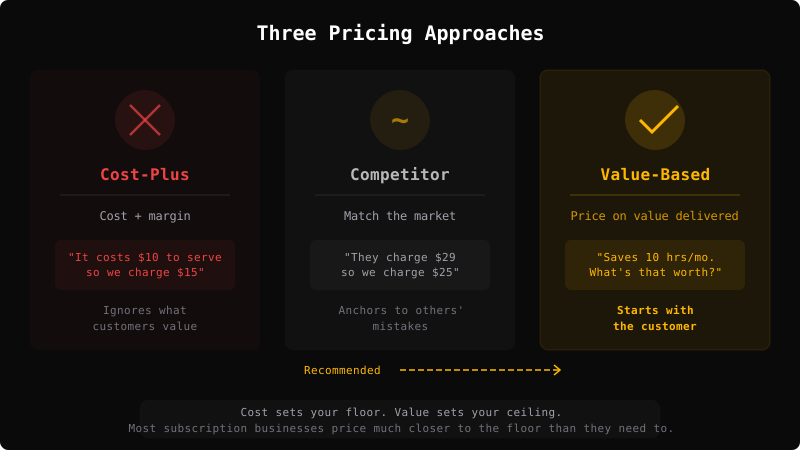
Most pricing strategies fall into three categories:
Cost-plus pricing: Calculate your costs, add a margin. "It costs us $10 to serve each user, so we charge $15."
Competitor-based pricing: Look at what competitors charge and price in the same range. "They charge $29/month, so we charge $25/month."
Value-based pricing: Price based on the value your product delivers to the customer. "Our product saves the average customer 10 hours per month. What's that worth to them?"
Cost-plus pricing has nothing to do with how much customers value your product. Your costs are your problem, not theirs.
Competitor-based pricing tells you what the market is used to — but it also means you're anchoring to someone else's (possibly wrong) pricing decision. If every competitor undercharges, you're all leaving money on the table together.
Value-based pricing is the only approach that starts with the customer. What problem are you solving? How painful is it? What's the alternative? What would they pay to make it go away?
This is harder than copying a competitor's pricing page. But it's how you find the price that actually reflects what you're worth.
Why Subscription Businesses Specifically Need This
Subscription pricing is different from one-time pricing because of two dynamics:
The Compounding Effect
A 15% price increase on a subscription doesn't just earn you 15% more this month. It earns you 15% more every month, for the entire customer lifetime. On a subscriber with a 25-month average lifetime, a $10/month price increase adds $250 to their lifetime value. Multiply by your subscriber base, and the numbers get big fast.
This is why pricing is the highest-leverage thing you can change in a subscription business. Nothing else compounds the same way.
The Ongoing Value Exchange
Subscribers re-evaluate your product every billing cycle. They're not making one purchase decision — they're making a recurring one. Your price needs to stay justified against the ongoing value you deliver.
This actually works in your favor. If your product keeps getting better — more features, better reliability, more integrations — your value increases over time. A price increase that reflects that added value isn't a penalty. It's fair.
Step 1: Research What Your Customers Would Actually Pay
Before changing any prices, you need data. Not opinions. Not what you think customers would pay. What they'd actually pay.
The Van Westendorp Method
This is the most practical willingness-to-pay research method for subscription businesses. Four questions. Takes 5 minutes for respondents.
The four questions:
- At what price would this be so cheap that you'd question the quality? (Too cheap)
- At what price would this be a great deal — a bargain? (Cheap / good value)
- At what price would this start to feel expensive, but you'd still consider it? (Expensive but acceptable)
- At what price would this be so expensive that you wouldn't consider buying it? (Too expensive)
Send this to your existing subscribers. You want at least 100 responses for meaningful results — more if you plan to segment by customer type or plan tier.
How to Read the Results
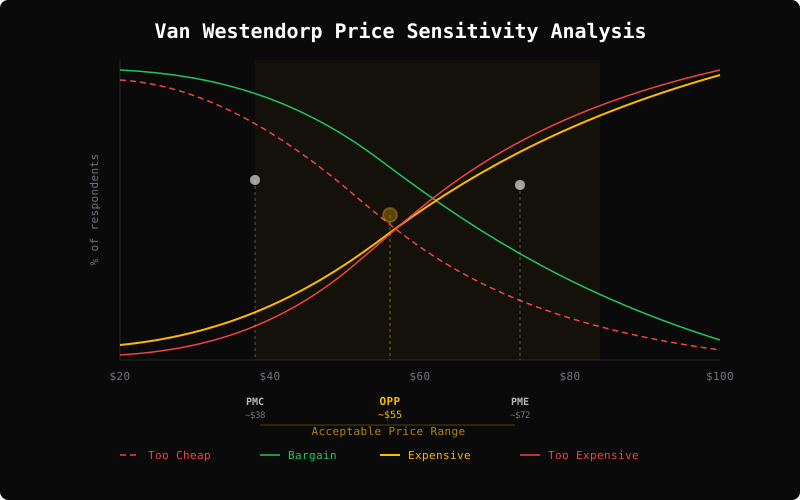
Plot the responses as cumulative curves. The intersections tell you:
- Point of Marginal Cheapness (PMC): Where "too cheap" and "expensive" curves cross. Below this, you're leaving perceived value on the table.
- Point of Marginal Expensiveness (PME): Where "too expensive" and "cheap" curves cross. Above this, you're pushing customers away.
- Optimal Price Point (OPP): Where "too cheap" and "too expensive" cross. The price with the least resistance.
- Acceptable Price Range: The range between PMC and PME. You have room to move within this range.
What You'll Usually Find
In my experience working with subscription businesses, the results almost always show the same thing: you're undercharging. The acceptable price range sits 20-40% above current pricing.
This makes sense. Most founders price conservatively when they launch — the product is new, confidence is low, and the fear of charging "too much" is real. But as the product matures, the price doesn't follow.
The insider subscription playbook
One tactic that moves the needle — every Thursday
Real companies, real numbers, strategies you can steal. From the operator who grew Codecademy from $10M to $50M ARR.
Van Westendorp shows you the gap between where you are and where the market says you could be.
How to Run the Survey
Who to ask: Current subscribers. They use the product, understand the value, and their answers are grounded in experience. Avoid asking prospects who've never used your product — they'll anchor on competitors or guess.
How to send it: Simple email survey. Typeform, Google Forms, or SurveyMonkey all work. Keep it short — the four Van Westendorp questions, plus 2-3 segmentation questions (plan tier, company size, use case).
When to do it: Quarterly is ideal. Every six months at minimum. Pricing isn't a one-time decision — it's a living part of your business.
Sample size: 100+ for general insights. 100+ per segment if you're segmenting by customer type.
Step 2: Understand Your Value Metric
Your value metric is the unit you charge on — the thing that scales with the customer's usage or success.
Common value metrics:
- Per seat/user (Slack, Notion, most B2B SaaS)
- Per usage (Twilio per API call, AWS per compute hour)
- Per feature tier (Basic/Pro/Enterprise with different capabilities)
- Per outcome (per transaction processed, per lead generated)
- Flat rate (one price, everything included)
How to Choose the Right One
The best value metric has three properties:
It scales with value. As the customer gets more value, the metric grows — and so does revenue. Per-seat pricing works when more seats = more value. Usage pricing works when more usage = more value.
It's easy to understand. Customers should immediately grasp what they're paying for. "Per user per month" is clear. "Per compute unit" is not — unless your customers are engineers.
It's predictable enough. Customers need to be able to estimate their bill. Pure usage-based pricing can create bill shock, which drives churn. Hybrid models (base fee + usage) give predictability with upside.
The Metric Most Businesses Get Wrong
Per-seat pricing is the default because it's simple. But it's often the wrong metric.
If your product is valuable because of what it does — not how many people use it — then per-seat pricing misaligns your revenue with your value. A 3-person team and a 30-person team might get identical value from your product, but the 30-person team pays 10x more.
Ask yourself: "Does adding another seat genuinely deliver proportionally more value to this customer?" If the answer is no, per-seat might be costing you customers who would happily pay more on a different metric.
The trend in 2025-2026 is hybrid pricing: a base platform fee for predictability, plus a usage-based component that scales. About 43% of SaaS companies now combine subscription with usage-based components, and that number is growing.
Step 3: Design Your Tiers
If you offer multiple plans (and most subscription businesses should), each tier needs to serve a specific customer segment.
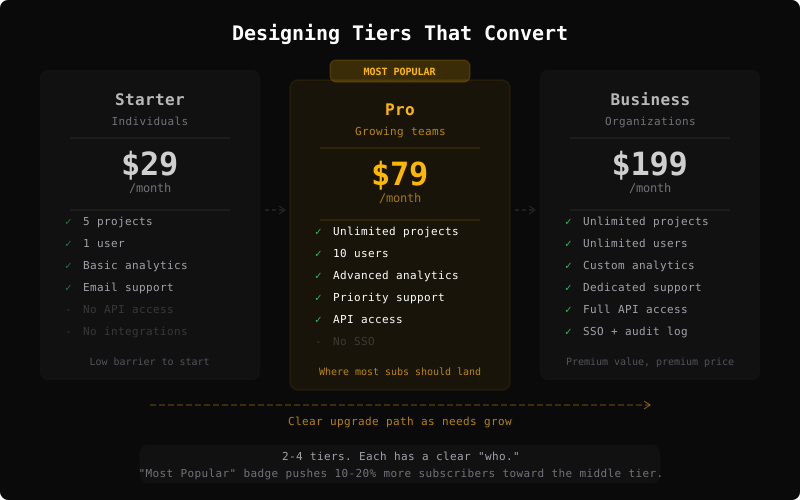
The Sweet Spot: 2-4 Tiers
Research shows that too many tiers create decision paralysis — more than 4 options can reduce conversion by up to 40%. Too few tiers (just one plan) leave money on the table from both directions: customers willing to pay more can't, and customers who'd buy a cheaper version won't.
Each Tier Needs a Clear "Who"
Don't design tiers by stacking features. Design them by naming the customer:
| Tier | Who It's For | Why They Choose It |
|---|---|---|
| Starter | Individual or small team, testing the product | Low price, basic features, easy to start |
| Pro | Growing team, active user, needs more | More capacity, advanced features, worth the jump |
| Business/Enterprise | Larger org, high-value use case | Full capabilities, support, integrations |
If you can't name who each tier is for, the tiers are wrong.
Feature Gating vs. Usage Limits
Two ways to differentiate tiers:
Feature gating: Higher tiers unlock features lower tiers don't have. Works when specific features are clearly more valuable to larger or more advanced customers.
Usage limits: All tiers have the same features, but higher tiers allow more usage (more projects, more storage, more API calls). Works when the product's value scales with volume.
The best packaging often combines both: some features gated to higher tiers, plus higher usage limits as you move up.
The "Most Popular" Anchor
Always visually highlight your recommended tier. This is basic pricing page psychology, but it's missing from a surprising number of subscription businesses.
The recommended tier should be the one you want most customers to choose — typically the middle option. Highlighting it creates an anchor and makes the decision easier. Businesses that add a "Most Popular" badge typically see 10-20% higher conversion on that tier.
Step 4: Set the [Annual Plan Discount](/guides/annual-vs-monthly-pricing) (Using Math, Not Guessing)
Most subscription businesses offer an annual plan at a 15-20% discount because "that's what everyone else does."
That's not a strategy. It's copying.
Your annual discount should be based on your actual monthly retention rate. Here's the math:
The Expected Value Calculation
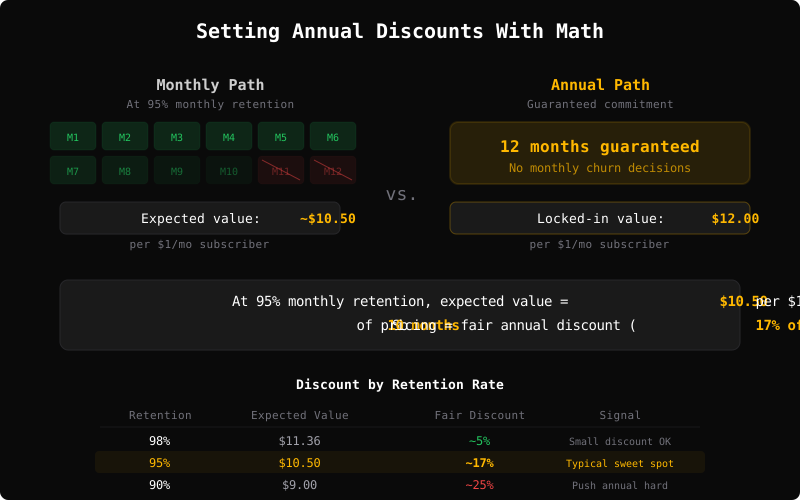
If 95% of your monthly subscribers stick around each month, the expected revenue from a monthly subscriber over 12 months is:
$1 × (0.95^0 + 0.95^1 + 0.95^2 + ... + 0.95^11) = ~$10.50
Not $12. About $10.50. Because not all monthly subscribers make it to month 12.
This means you can offer an annual plan at 10 months' worth of pricing and still come out ahead on expected value — while giving the subscriber a 17% discount and locking in the commitment.
Adjust Based on Your Retention
| Monthly Retention | Expected 12-Month Value | Breakeven Annual Discount |
|---|---|---|
| 98% | ~$11.36 | ~5% |
| 95% | ~$10.50 | ~12.5% |
| 92% | ~$9.56 | ~20% |
| 90% | ~$9.00 | ~25% |
| 85% | ~$7.65 | ~36% |
If your monthly retention is 98%, a 15% annual discount is too generous — you're giving away revenue you would've earned anyway. If your retention is 85%, a 15% discount is a steal — you should be pushing annual plans much harder, because the guaranteed 12 months is worth significantly more than the uncertain monthly path.
The principle: lower monthly retention = offer bigger annual discounts, because guaranteed revenue is worth more. Higher monthly retention = smaller discounts are fine, because monthly subscribers are already likely to stick around.
For a deeper breakdown of this approach — including real pricing data from Noom, Tinder, DataCamp, and Headspace — see the annual vs monthly pricing guide.
Step 5: Test and Roll Out
Grandfather Existing Subscribers
When you change pricing, apply new prices to new subscribers only. Existing subscribers keep their current rate.
This does three things:
- Eliminates the "people will get angry" risk
- Lets you test new pricing with zero impact on current revenue
- Creates a natural A/B test — new cohorts at new prices vs. old cohorts at old prices
Eventually (12-18 months later), you can migrate existing subscribers with notice. But starting with new-only eliminates risk entirely.
How to Test Price Changes
The simple approach: Change the price for all new subscribers and measure conversion rate, trial-to-paid rate, and early churn. If conversion drops slightly but revenue per subscriber increases more, you're ahead.
The more rigorous approach: A/B test the pricing page. Show different prices to different visitors and measure conversion and downstream LTV. This requires enough traffic to reach statistical significance, so it's more practical for higher-volume businesses.
Pricing page A/B tests require careful statistical planning — even small conversion rate differences translate to large revenue impacts. Run your numbers through the MDE calculator to see how long you'll need to test before drawing conclusions.
What to measure:
- Conversion rate (did it drop?)
- Revenue per subscriber (did it increase?)
- Net revenue impact (conversion × price — did total revenue go up?)
- 30/60/90-day retention of new-price cohorts (are they churning faster?)
A small conversion drop with a larger ARPU increase is a win. If your conversion drops 5% but ARPU increases 25%, you're making significantly more money.
How Often to Revisit
Every six months. Not annually. Not "when we get around to it."
The market changes. Your product changes. Your customers' willingness to pay changes. A pricing review every six months doesn't mean you change prices every six months — it means you check whether your prices still reflect the value you deliver.
Put it on the calendar. Make it a recurring event. The businesses that treat pricing as an ongoing discipline consistently outperform those that set it once and forget.
When Value-Based Pricing Doesn't Apply
Value-based pricing is the right approach for most differentiated subscription products. It's not the right approach for everyone. Skip it (or weight it lightly) if:
Your product is a true commodity. If customers genuinely can't tell yours apart from three competitors and pick on price alone, value-based research will tell you the "value" is roughly equal to the cheapest competitor's price. Use competitor pricing as the anchor and compete on margin or distribution instead.
You're in a regulated industry with mandated pricing. Healthcare subscriptions, insurance products, and certain financial services have regulatory floors and ceilings that constrain what you can charge regardless of willingness-to-pay. Run the research, but expect the regulated band to dominate the answer.
You're pre-product-market-fit. With <100 paying customers, you don't have enough Van Westendorp respondents to get a stable signal. Pick a defensible launch price (within market range) and test as you grow. Pricing research becomes more useful once you have a representative base.
Your contract values are six figures and negotiated. Enterprise SaaS at $100K+ ACVs prices per-deal through sales conversations, not pricing pages. Value-based principles still apply (the conversation is about the customer's value), but a published Van Westendorp survey doesn't fit.
You sell to public-sector or procurement-led buyers. Government RFPs and procurement-driven enterprise deals reward lowest-bid pricing, not value-based premium. The exception is sole-source or specialty contracts where value pricing returns.
The Pricing Mistakes to Avoid
Pricing Based on Competitors
Competitor pricing tells you what the market is used to seeing. It doesn't tell you what your product is worth. If all your competitors are undercharging (common in early markets), you'll undercharge too.
Use competitor pricing as a reference point, not a formula. Your price should be based on the value you deliver, which may be very different from what they deliver.
Pricing Based on Costs
Your costs have nothing to do with what customers will pay. A product that costs $2/month to serve could be worth $200/month to the right customer. Cost-plus pricing leaves that $198 on the table.
Costs set your floor. Value sets your ceiling. Most subscription businesses price much closer to the floor than they need to.
Offering Too Many Tiers
Three tiers is the sweet spot for most subscription businesses. Two is sometimes fine. Four is occasionally justified. Five or more creates confusion and slows down the purchase decision.
If you need more than four tiers, you probably have multiple products trying to share a pricing page.
Using Arbitrary Annual Discounts
If your annual discount isn't tied to your monthly retention data, it's a guess. And it's probably too generous. Do the math (see Step 4 above).
Avoiding Price Increases Because of Fear
The fear of raising prices is almost always worse than the reality. With grandfathering (existing subscribers keep their rate), the risk to current revenue is zero. You're only testing with new subscribers.
In my experience, conversion rate drops are usually much smaller than expected, and the revenue per subscriber gain more than compensates. But you won't know until you test.
FAQ
How do I know if I'm undercharging?
Run a willingness-to-pay survey (Van Westendorp method) with your existing subscribers. If the "acceptable price range" sits significantly above your current price — which it almost always does — you're undercharging. Other signals: customers never complain about price, you win deals too easily, and your LTV:CAC ratio is unusually high (above 5:1 may mean you're leaving money on the table).
Won't raising prices increase [churn](/guides/churn-rate)?
If you grandfather existing subscribers (new prices for new subscribers only), it won't affect current churn at all. For new subscribers, a modest price increase rarely moves churn meaningfully — people who value your product will pay the updated price. If a price increase causes significant churn, the issue isn't price — it's that the product isn't delivering enough perceived value. That's useful information.
How much should I raise prices?
Start with what the data says. A Van Westendorp survey will show you the acceptable range. In the absence of data, a 10-20% increase for new subscribers is a reasonable test — large enough to see revenue impact, small enough to limit downside risk. You can always raise again in six months.
What is a value metric and why does it matter?
A value metric is the unit you charge on — per user, per usage, per feature tier. The right value metric aligns your revenue with the value customers receive, so as they get more value, you earn more revenue. The wrong metric creates misalignment: customers who get enormous value pay the same as those who barely use the product.
How often should I change pricing?
Review every six months. That doesn't mean you change prices every six months — it means you check whether your pricing still reflects the value you deliver. If the market moved, your product improved, or your costs changed, it might be time for an adjustment. Businesses that treat pricing as a living discipline consistently outgrow those that set it once.
Should I show my pricing publicly?
For self-serve products (most B2C and SMB SaaS), yes. Hiding pricing creates friction and drives away buyers who want to know what they're getting into. For enterprise or high-touch sales, "Contact us" is standard because pricing is negotiated based on deal size. For mid-market, consider showing lower tiers publicly and using "Contact us" for enterprise. Match the buying behavior of your target customer.
What to Do Next
If you haven't revisited your pricing in the last year, that's your highest-leverage move right now. Run a Van Westendorp survey with your existing subscribers. You'll almost certainly discover room to increase.
But pricing is only one of eight places subscription businesses leak revenue. If you want the full picture — pricing, packaging, conversion, checkout, retention, and expansion — I built a free self-assessment that covers all of it.
Take the Subscription Revenue Leak Audit →
52 checklist items across 8 revenue leak categories. Takes 10 minutes. Pricing is Leak #1 for a reason — it's the most powerful lever. But it's not the only one. For a look at how pricing feeds into your recurring revenue growth, that's the next piece of the puzzle.

Dan Layfield
Dan ran growth at Codecademy, scaling ARR from $10M to $55M before the company was acquired for $525M. He now advises subscription businesses on pricing, retention, and revenue optimization.
Work with Dan →Related Guides
Subscription Win-Back: How to Reactivate Lapsed Subscribers
Most subscription businesses ignore win-back. Lapsed subscribers cost 5-7x less to reactivate than acquiring net-new — and Recurly says 1 in 4 new subs are returns.
18 min readAnnual Churn Rate: Formula, Benchmarks, and How to Calculate It
If you multiply monthly churn by 12 you overstate annual churn by ~50%. Here's the right formula, real-company benchmarks, and the conversion math operators get wrong.
20 min readAnnual vs Monthly Pricing: How to Set Your Annual Subscription Discount
Most annual subscription pricing is set backwards. Here's how to price annual plans using retention data, with real ratios from Noom, Tinder, and Headspace.
Get the playbook every Thursday
Weekly strategies for subscription businesses. Real companies, real numbers, tactics you can steal. From the operator who grew Codecademy from $10M to $50M ARR.