ARR (Annual Recurring Revenue): The Number That Defines Your Subscription Business
ARR is the metric investors, operators, and acquirers care about most. Learn how to calculate it correctly, avoid common mistakes, and grow it.

Dan Layfield
Growth at Codecademy, $10M → $50M ARR
In This Guide
- ARR at a Glance
- What Is Annual Recurring Revenue (ARR)?
- ARR vs. MRR: When to Use Which
- The ARR Waterfall: How ARR Actually Moves
- How to Calculate ARR Correctly
- ARR Growth Rate Benchmarks
- ARR and Valuation: What Your ARR Is Worth
- The Levers to Grow ARR
- When ARR Is the Wrong Metric
- ARR at Real Subscription Companies
- Common ARR Mistakes
- ARR Calculator
- FAQ
- What to Do Next
Most subscription operators report ARR as a single headline number. MRR times 12. Slap it in the board deck. Done.
That's vanity ARR. The number that goes in the deck and means almost nothing.
Real ARR is a system underneath one summary number. It has four components that move independently. It has gotchas that make smart people report the wrong number. And it has a direct, quantifiable relationship with what your company is actually worth — but only if the number is clean.
I grew Codecademy from $10M to $50M in ARR between 2017 and 2021. When we hit $10M, the board cared about growth rate. By $25M, they cared about the quality of the ARR — how much was new vs. expansion, what the churn looked like underneath. By $50M, the conversation was entirely about efficiency: how much does each dollar of new ARR cost to acquire?
The number means different things at different stages. This guide covers all of it — the definition (briefly), the components (deeply), the calculation gotchas (the part most guides skip), the benchmarks, and the levers you actually pull to grow it.
ARR at a Glance
| Vanity ARR | Real ARR | |
|---|---|---|
| **What it is** | MRR × 12, no decomposition | MRR × 12 *plus* the New / Expansion / Churn / Contraction waterfall underneath |
| **What it answers** | "How big are we?" | "Why are we that big, and is it durable?" |
| **What investors do with it** | Discount it during diligence | Use it to set the multiple |
| **What it includes** | Sometimes setup fees, services, overages | Only contractually recurring revenue |
| **Common failure mode** | Inflated by 10-30% with non-recurring revenue | Honest, scrub-proof, and harder to grow |
The short answer: ARR is the annualized value of your contractually recurring revenue. The formula is MRR × 12, but the formula is the easy part — what matters is the waterfall (New + Expansion − Churn − Contraction) underneath the headline. Two businesses can post the same ARR and be worth very different multiples; what determines the gap is the quality of the ARR, not the size. Track the components, scrub out one-time fees, and use ARR for strategy while you use MRR for operations.
What Is Annual Recurring Revenue (ARR)?
ARR is the annualized value of your recurring subscription revenue. It measures how much predictable, repeating revenue your business generates on a yearly basis.
ARR = MRR x 12
Where MRR (Monthly Recurring Revenue) is the total recurring revenue earned from active subscriptions in a given month.
If your MRR is $100,000, your ARR is $1.2M.
That's the textbook definition. But let me emphasize the word recurring — because that single word is where most of the confusion lives. ARR only counts revenue you can reasonably expect to receive again next year. Subscription fees, yes. One-time setup charges, no. Professional services, no. Implementation fees, no. That variable overage charge that spikes in December, probably not.
The reason ARR matters — and the reason investors, acquirers, and operators all fixate on it — is predictability. A business earning $5M from one-time sales could earn $0 next year. A business earning $5M in ARR has a reasonable expectation of earning something close to $5M again, minus whatever churn takes away, plus whatever expansion adds.
That predictability is the entire value proposition of the subscription model. ARR is how you measure it.
For a deeper look at how recurring revenue works operationally — the levers that grow it, the framework for prioritizing them — see my recurring revenue guide. This article goes deeper on ARR specifically: how it breaks apart, what the benchmarks look like, and how it drives valuation.
ARR vs. MRR: When to Use Which
Both metrics measure the same thing — recurring revenue. The difference is the lens.
MRR is the operational metric. It's granular. You use it to track month-to-month changes, spot trends early, and measure the impact of specific initiatives. "We launched the new pricing page in March and MRR growth jumped from 4% to 7%." That's an MRR conversation.
ARR is the strategic metric. It's the big picture. You use it for benchmarking against peers, reporting to investors, planning headcount, and thinking about valuation. "We're at $8M ARR growing 80% year-over-year." That's an ARR conversation.
| MRR | ARR | |
|---|---|---|
| **Best for** | Day-to-day operations | Strategic planning and reporting |
| **Granularity** | Monthly changes | Annual trajectory |
| **Used by** | Operators, product, growth | Executives, investors, board |
| **Sensitive to** | Monthly fluctuations | Long-term trends |
| **When it matters** | Measuring specific initiatives | Fundraising, valuation, benchmarking |
My recommendation: Track MRR operationally. Report ARR externally. Most subscription businesses should have both numbers readily available, because you'll use MRR in your weekly growth meeting and ARR in your board deck.
One important nuance: if you sell primarily annual contracts, MRR x 12 can be misleading. A customer who pays $12,000 upfront for an annual plan contributes $1,000/month to MRR — but that revenue has already been collected. When annual contracts dominate your mix, ARR calculated from contract values (rather than MRR x 12) gives a more accurate picture. More on this in the calculation gotchas section below.
The ARR Waterfall: How ARR Actually Moves
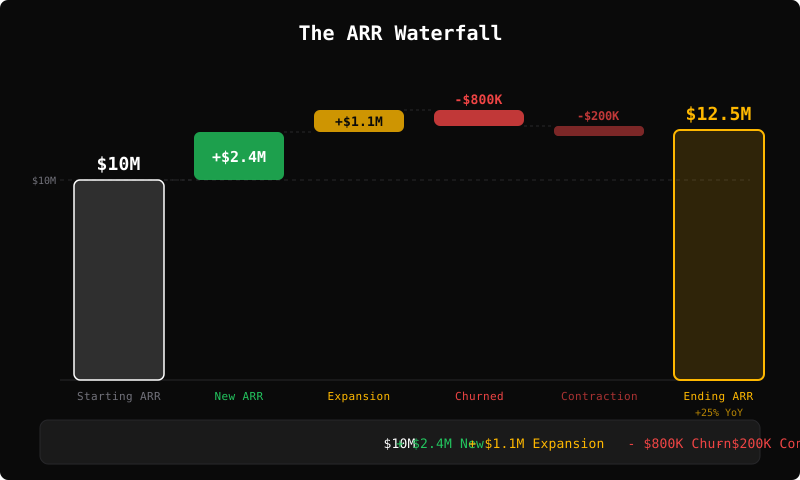
Here's where most ARR guides stop: "ARR = MRR x 12." That's true but useless for actually managing a business. Because ARR isn't a single number that goes up or down. It's the net result of four forces pulling in different directions.
Net New ARR = New ARR + Expansion ARR - Churned ARR - Contraction ARR
These four components are the ARR waterfall. Understanding them individually is the difference between knowing your ARR and knowing why it is what it is.
New ARR
Revenue from brand-new customers acquired during the period. This is the number your sales and marketing teams are directly responsible for. If a new customer signs a $24,000/year contract, that's $24,000 of New ARR.
New ARR is the most expensive component to grow. Every dollar of New ARR requires customer acquisition cost — sales, marketing, onboarding. At Codecademy, our CAC for a new subscriber was multiples of what it cost to expand an existing one. That's true for nearly every subscription business.
Expansion ARR
Additional revenue from existing customers. Upgrades to higher tiers, add-on purchases, seat expansions, increased usage — all Expansion ARR.
This is the component that separates good subscription businesses from great ones. When we grew Codecademy from $10M to $50M, a significant share of that growth came from making existing subscribers worth more — better pricing, smarter packaging, clearer upgrade paths. That's Expansion ARR.
The best subscription businesses generate 30-40% of their new ARR from expansion. If you're below 20%, you're over-relying on acquisition. For more on building expansion paths, see my upselling guide and net revenue retention guide.
Churned ARR
Revenue lost from customers who cancelled entirely. This is the destructive force in the waterfall — the hole in the bucket.
A churned customer doesn't just reduce this month's ARR. They reduce every future month's ARR. The compounding cost of churn is brutal: a 5% monthly churn rate means you lose roughly 46% of a cohort's revenue in a year. I covered the full math and the specific fixes in my churn rate guide.
Contraction ARR
Revenue lost from customers who downgraded but didn't leave. They moved from an expensive plan to a cheaper one, reduced seats, or decreased usage.
Contraction is better than churn — you kept the customer — but it's still a drag on growth. Significant contraction usually signals a packaging problem: customers are paying for more than they need and eventually realize it.
Reading the Waterfall
The power of the waterfall is diagnostic. The same net number can tell very different stories:
Scenario A: $500K Net New ARR
- New: $800K, Expansion: $200K, Churn: $400K, Contraction: $100K
Scenario B: $500K Net New ARR
- New: $400K, Expansion: $350K, Churn: $150K, Contraction: $100K
Both businesses added $500K in net new ARR. But Scenario B is far healthier — lower churn, stronger expansion, less dependent on expensive new acquisition. An investor looking at these two businesses would value Scenario B significantly higher.
When we crossed $25M ARR at Codecademy, the board stopped asking "how much ARR did we add?" and started asking "where did it come from?" That's the right question. The waterfall gives you the answer.
How to Calculate ARR Correctly
The formula is simple. Getting the number right is not. Here are the gotchas that trip up even experienced operators.
Gotcha 1: Including One-Time Revenue
This is the most common mistake. One-time setup fees, implementation charges, professional services, consulting engagements, hardware sales, data migration fees — none of these are recurring. They don't belong in ARR.
It's tempting to include them, especially early on when every dollar counts. But ARR is supposed to measure predictable, repeating revenue. A $50,000 implementation fee is revenue, but it's not recurring. Including it inflates your ARR and misleads anyone — including you — who's using that number to make decisions.
Rule of thumb: If you wouldn't expect to receive this payment again next year from the same customer without a new engagement, it's not ARR.
Gotcha 2: Multi-Year Contracts
A customer signs a 3-year contract for $300,000. What's the ARR?
$100,000. You annualize it — divide the total contract value by the number of years. Not $300,000 (that's total contract value, or TCV). Not $25,000 (that would be MRR).
Multi-year contracts are great for cash flow and retention, but they don't accelerate ARR the way people think. The ARR contribution is the annual slice.
Gotcha 3: Usage Overages and Variable Revenue
If your pricing has a usage-based component, things get tricky. A customer on a $2,000/month plan who consistently pays $3,000 because of overages — what's the ARR?
The conservative answer: ARR from the committed contract value ($24,000). The overages are variable and unpredictable — they could drop to zero next month.
The practical answer: if a customer has consistently paid $3,000/month for 6+ months, some operators annualize the trailing average. But be transparent about the methodology. Investors will ask, and "we include variable usage in ARR" will get scrutiny.
My take: Include only committed, contractual minimums in ARR. Track usage upside separately. If you're raising capital or preparing for an acquisition, clean ARR is worth more than inflated ARR — because the buyer will scrub it anyway.
Gotcha 4: Free Trials and Discounted Periods
A customer on a 30-day free trial contributes $0 to ARR. A customer on a "first 3 months at 50% off" promotion contributes the discounted rate to ARR during the promotional period, then the full rate after.
Don't count trial users as ARR. Don't count promotional pricing at full rate. Your ARR should reflect what people are actually paying, not what they might pay later.
Gotcha 5: Annual Plans and MRR x 12
If 80% of your customers are on annual plans, multiplying MRR by 12 can be misleading — because MRR for annual plans is calculated by dividing the annual payment by 12, which smooths out the timing of when the cash actually arrives.
This isn't wrong, but it creates a disconnect between ARR (the metric) and cash (what's in the bank). A customer who paid $12,000 upfront in January shows $1,000 MRR for 12 months. The ARR is $12,000. But from a cash perspective, you received all of it in January.
The insider subscription playbook
One tactic that moves the needle — every Thursday
Real companies, real numbers, strategies you can steal. From the operator who grew Codecademy from $10M to $50M ARR.
For most purposes, the standard MRR x 12 approach works fine. Just be aware that ARR and cash are different things — especially when planning hiring or expenses.
Gotcha 6: Churned But Not Gone
When exactly does a churned customer leave your ARR? When they cancel? When their contract ends? When their last prepaid period expires?
The standard: ARR decreases when the customer's subscription actually ends, not when they submit a cancellation. If a customer cancels in March but their annual plan runs through September, they're still ARR until September.
This matters more than it sounds. I've seen businesses undercount ARR by removing customers at cancellation notice rather than contract end, and overcount by keeping churned customers whose contracts already expired.
The Clean ARR Test
If you're unsure whether your ARR is calculated correctly, ask yourself: "If every customer renewed at their current terms, and no new customers signed up, would this number hold for 12 months?"
If the answer is yes, your ARR is clean. If there's revenue in there that requires a new purchase, a new engagement, or a usage spike to materialize — it's not clean ARR.
ARR Growth Rate Benchmarks
Growth rate is where context matters most. A 50% growth rate at $2M ARR means something very different than 50% at $50M ARR. Here's what the data shows for subscription businesses at each stage.
By ARR Stage
| ARR Stage | Median Growth Rate | Top Quartile | Elite |
|---|---|---|---|
| $1M-$2.5M | 80-100% | 150%+ | 200%+ |
| $2.5M-$5M | 60-80% | 100-120% | 150%+ |
| $5M-$10M | 50-70% | 80-100% | 120%+ |
| $10M-$25M | 40-60% | 70-90% | 100%+ |
| $25M-$50M | 30-50% | 50-70% | 80%+ |
| $50M-$100M | 25-40% | 40-60% | 60%+ |
| $100M+ | 20-30% | 30-40% | 50%+ |
The pattern is clear: growth rates naturally decline as you scale. The denominator gets bigger. And that's fine — because the absolute dollars added per year keep growing even as the percentage shrinks.
Going from $5M to $10M (100% growth) requires adding $5M. Going from $50M to $75M (50% growth) requires adding $25M — five times the absolute growth at half the percentage. When we took Codecademy from $10M to $50M ARR between 2017 and 2021, the yearly percentage growth rate dropped over that stretch, but the dollars we added each year kept climbing.
The T2D3 Framework
You'll hear "T2D3" in VC circles. It stands for Triple, Triple, Double, Double, Double — a growth trajectory that takes a company from roughly $2M to $100M+ ARR in about five years:
- Year 1: $2M → $6M (triple)
- Year 2: $6M → $18M (triple)
- Year 3: $18M → $36M (double)
- Year 4: $36M → $72M (double)
- Year 5: $72M → $144M (double)
T2D3 is aspirational. Very few companies actually achieve it. But it's useful as a reference point — if you're at $10M and growing 60% per year, you're roughly on track. If you're at $10M and growing 20%, you're behind the curve for venture-scale outcomes (though potentially building a very healthy, profitable business).
Growth Rate Isn't Everything
I want to push back on the obsession with growth rate, because I've seen it lead to bad decisions.
At Codecademy, there were moments where we could have juiced the growth rate by doing things that would hurt long-term — aggressive discounting to pull forward annual renewals, counting revenue that was borderline recurring, spending inefficiently on acquisition to hit a number.
The growth rate that matters is sustainable growth rate. Revenue that sticks. Customers who renew. Expansion that compounds. A business growing 60% with 95% gross retention is worth far more than one growing 100% with 80% retention — because the second business is on a treadmill, replacing churned customers just to keep moving.
ARR and Valuation: What Your ARR Is Worth
This is where ARR becomes very real. The value of a subscription business is, at its core, a multiple of its ARR. Your ARR determines what investors will pay for a piece of your company and what acquirers will pay for the whole thing.
Revenue Multiples by Growth and Scale
| ARR Growth Rate | Typical Revenue Multiple (Private) |
|---|---|
| 60%+ | 7x-12x ARR |
| 40-60% | 5x-8x ARR |
| 20-40% | 3x-6x ARR |
| Below 20% | 2x-4x ARR |
These are rough ranges for private SaaS companies as of 2025-2026. Public SaaS multiples have compressed from the 2021 highs (when median multiples hit 15x+) to a more grounded 6-8x range.
What Investors Actually Look At
Growth rate gets you the meeting. But the quality of your ARR determines the multiple. Here's what moves it up or down:
Multiplier boosters (higher multiple):
- Net revenue retention above 110%. This tells investors your existing base grows on its own. NRR is the single strongest predictor of durable growth. See my NRR guide for how to calculate and improve it.
- Gross retention above 90%. Low churn proves the product is sticky.
- Expansion ARR above 30% of total new ARR. Growth isn't dependent solely on expensive new acquisition.
- Efficient growth. Measured by the "burn multiple" (net burn / net new ARR). Lower is better.
Multiplier killers (lower multiple):
- High customer concentration. If your top 3 customers represent 40% of ARR, that's risky.
- High gross churn. Even if NRR looks good, high churn offset by expansion is fragile.
- Non-recurring revenue mixed in. Investors will scrub your ARR. If they find one-time fees in there, the multiple drops.
- Heavy discounting. Lots of annual discounts at 30-40% off suggest the full price doesn't hold.
The Rule of 40
Investors use the Rule of 40 as a health check: your ARR growth rate plus your profit margin should exceed 40%.
- Growing 60% with -20% margins? 60 + (-20) = 40. You're on the line.
- Growing 30% with 15% margins? 30 + 15 = 45. Healthy.
- Growing 80% with -50% margins? 80 + (-50) = 30. Burning too fast.
The Rule of 40 rewards balanced businesses. You can be high-growth and unprofitable, or moderate-growth and profitable — either can work. But high-burn and moderate-growth is a red flag.
When Codecademy passed $25M ARR, the Rule of 40 became a regular part of board conversations. It forced us to think about growth and efficiency together, not in isolation.
The Levers to Grow ARR
There are only three ways to grow ARR. Every tactic, strategy, and initiative falls into one of these buckets:
1. Acquire New Customers (New ARR)
This is the obvious one. More customers = more ARR. It's also the most expensive and most competitive lever.
The levers here are marketing (content, SEO, paid, partnerships), sales (inbound, outbound, product-led), and conversion optimization (free trial conversion, onboarding, pricing page design).
I'm not going to dwell on acquisition because every other guide on the internet covers it. The more interesting question for most subscription businesses is: are you making enough from the customers you already have?
2. Expand Existing Customers (Expansion ARR)
Get existing customers to pay you more. Upgrades, add-ons, seat expansion, usage growth.
This is the highest-ROI lever. No acquisition cost. You're selling to people who already trust you, already use the product, already have their credit card on file. The success rate for upselling an existing customer is 60-70%, compared to 5-20% for acquiring a new one.
At Codecademy, expansion revenue was the most neglected lever when I started. Pricing hadn't been revisited in a long time. There was no clear upgrade path from the base plan. No add-ons. No usage-based component. When we fixed those things — added tiers that mapped to different user types, introduced features that created natural upgrade triggers, and revisited pricing based on willingness-to-pay data — expansion ARR became a meaningful growth engine.
For the tactical playbook on building expansion revenue, see my upselling guide.
3. Retain Existing Customers (Reduce Churned + Contraction ARR)
Every customer you retain is ARR you don't have to replace. Reducing churn doesn't show up as "growth" in the traditional sense, but it has the same effect — and it's cheaper.
The math: if you have $10M ARR and reduce annual gross churn from 15% to 10%, you just "created" $500K in ARR that would have otherwise disappeared. That $500K required zero acquisition spend.
Retention improvements also compound forward. Every future cohort of customers stays longer, which means every dollar of New ARR you add is worth more.
For the complete retention playbook — involuntary churn fixes, cancellation flows, the specific tactics that actually move the number — see my churn rate guide.
Prioritization: Where to Focus First
Most subscription businesses default to lever 1 (more acquisition) because it feels like the most direct path. But for most businesses between $1M and $25M ARR, the highest ROI comes from levers 2 and 3.
Here's my prioritization framework:
- First, plug the leaks. Fix involuntary churn. Add a cancellation flow. Get gross retention above 90%.
- Second, build expansion. Revisit packaging and pricing. Create upgrade paths. Make it easy for customers to spend more as their needs grow.
- Third, scale acquisition. Now every new customer enters a system that retains them longer and grows their value over time.
This is the order I followed at Codecademy. It's the order I recommend to every subscription business I work with. If you want to see where your specific gaps are across all three levers, the Revenue Leak Audit walks through it systematically.
When ARR Is the Wrong Metric
ARR is the right scoreboard for most subscription businesses — but not all of them. Skip the obsession with ARR (or supplement it heavily) if:
Your revenue is mostly services or implementation. If 40%+ of your top line is professional services, custom dev, or one-time setup work, ARR will radically understate the business. Track total revenue alongside ARR and be honest about the mix.
You're a transactional or marketplace business. If you make money per transaction (Stripe, Shopify Plus on usage tiers, Uber-style platforms), GMV and take rate matter more than ARR. Trying to annualize variable transaction volume produces a number that swings with macro conditions.
Your usage component is the majority of revenue. Pure usage-based companies (Snowflake, Twilio, Datadog) report ARR but heavily emphasize NRR and consumption growth because the "annualized" piece is the most volatile. If usage is >50% of bill, lean on net revenue retention as the primary metric.
You're pre-product-market-fit. At <$1M ARR with high early-cohort churn, the ARR number is too noisy to be a useful operating metric. Track active paying customers and weekly trends instead — ARR will give you false confidence on a base that hasn't stabilized.
Your customers are on multi-year prepaid plans with no renewal data. If you've never had a renewal cycle complete, your ARR is theoretical. Wait for the first full renewal before treating ARR as the headline number.
ARR at Real Subscription Companies
The point of this table isn't to benchmark against the biggest names — it's to show what the ARR waterfall looks like at scale. Each of these companies separates ARR from total revenue, breaks out NRR, and reports growth rate distinct from the absolute number.
None of these companies report a single "ARR" headline number in their 10-Ks. They report subscription/product revenue, total revenue, and (most of them) a net revenue retention rate. The table below uses each company's most recent annual filing.
| Company | Most Recent Reported Revenue (Subscription / Product / Total) | NRR | What This Tells You |
|---|---|---|---|
| Snowflake | Product revenue $4,472.3M; total revenue $4,683.9M (FY2026, ended Jan 31, 2026)[^snow] | 125%[^snow] | Pure consumption pricing; ARR understates the trajectory |
| Datadog | Revenue $3,427.2M (FY2025, ended Dec 31, 2025)[^ddog] | ~120%[^ddog] | Multi-product cross-sell drives the expansion engine |
| HubSpot | Subscription revenue $3,063.9M; total revenue $3,131.3M (FY2025, ended Dec 31, 2025)[^hubs] | 103.5%[^hubs] | Seat + tier expansion in a mature mid-market base |
| Atlassian | Subscription revenue $4,930.6M; total revenues $5,215.3M (FY2025, ended June 30, 2025)[^team] | Not disclosed[^team] | Mostly self-serve seat expansion; ARR closely tracks total revenue. Atlassian does not publish an NRR figure in its 10-K |
| Asana | Total revenues $790.8M (FY2026, ended Jan 31, 2026)[^asan] | 97% (Core $5K+ customers); 96% ($100K+ customers)[^asan] | Pure seat-based, exposed to layoffs cycle |
A note on the metric: none of these companies report a single "ARR" line. Snowflake reports product revenue (consumption-based, not contractually recurring); Datadog, HubSpot, Atlassian, and Asana report subscription or total revenue. NRR is disclosed annually in each company's 10-K (or not, in Atlassian's case). Figures above are from each company's most recent 10-K filed with the SEC.
[^snow]: Snowflake FY2026 10-K (filed March 20, 2026; fiscal year ended Jan 31, 2026). Product revenue and net revenue retention rate disclosed in "Key Business Metrics" and "Results of Operations" sections. [^ddog]: Datadog FY2025 10-K (filed Feb 18, 2026; fiscal year ended Dec 31, 2025). "As of December 31, 2025, our trailing 12-month dollar-based net retention rate was about 120%." [^hubs]: HubSpot FY2025 10-K (filed Feb 11, 2026; fiscal year ended Dec 31, 2025). Subscription revenue and Net Revenue Retention (103.5%) in MD&A. [^team]: Atlassian FY2025 10-K (filed Aug 15, 2025; fiscal year ended June 30, 2025). Subscription and total revenues from consolidated statements of operations. Atlassian does not disclose a net retention or net dollar retention rate in its 10-K. [^asan]: Asana FY2026 10-K (filed March 13, 2026; fiscal year ended Jan 31, 2026). Dollar-based net retention rates disclosed for "Core customers" (annual spend ≥ $5,000) and customers spending ≥ $100,000 annually; total revenues from consolidated statements of operations.
The pattern across all of these: ARR alone doesn't tell the story. NRR + ARR together does. A company at $1B ARR with 130% NRR is on a different trajectory than one at $1B ARR with 95% NRR, even though the headline matches.
Common ARR Mistakes
These are the errors I see most often — from early-stage founders inflating their numbers to experienced operators who've been tracking the wrong thing for years.
Mistake 1: Vanity ARR
Vanity ARR is when you report the number that sounds best rather than the number that's real. Including one-time revenue, counting trials, annualizing a single good month — all versions of the same mistake.
The problem with vanity ARR isn't that it makes you look good externally. It's that it makes you make bad decisions internally. If you think you're at $3M ARR but $500K of that is non-recurring, your growth rate, your unit economics, and your hiring plan are all based on a lie.
Be honest with yourself about the number. Investors and acquirers will normalize it anyway. Better to know the real number and make good decisions than to find out during due diligence that you're 15% smaller than you thought.
Mistake 2: Committed ARR vs. Live ARR
Committed ARR includes signed contracts that haven't started yet. Live ARR only counts active, billing subscriptions.
Both numbers are useful, but they mean different things. If you signed a $100K deal in December that starts in March, it's Committed ARR in December but not Live ARR until March.
The gap between committed and live matters most for businesses with long implementation cycles. If you're consistently signing deals that take 3-6 months to go live, your Committed ARR could be 20-30% higher than your Live ARR at any given time. That's not inflated — it's real revenue in the pipeline. Just be clear about which number you're reporting.
Mistake 3: Including Non-Recurring Revenue
This bears repeating because it's so common. If it doesn't recur, it's not ARR:
- Setup fees: Not ARR
- Implementation services: Not ARR
- One-time training: Not ARR
- Hardware sales: Not ARR
- Consulting projects: Not ARR
- Variable overage charges (without committed minimums): Not ARR
I've seen companies include professional services in their ARR because "customers buy them every year." That's still not ARR. Repeat revenue is not the same as recurring revenue. Recurring means it happens automatically — the subscription renews. Repeat means the customer chooses to buy again, which they might not.
Mistake 4: Not Tracking Components Separately
If you only track total ARR, you're flying blind. You might be growing 40% overall, but if 90% of new ARR is from acquisition and expansion is flat while churn is rising — you're building on a fragile foundation.
Track the waterfall. Every month, know your New ARR, Expansion ARR, Churned ARR, and Contraction ARR. This is how you diagnose problems before they show up in the headline number.
Mistake 5: Confusing ARR with Revenue
ARR is a forward-looking metric. It tells you what your business would earn over the next 12 months if nothing changed. It's not what you actually earned in the past 12 months.
Revenue (as reported in your financials) is backward-looking. It's what you actually collected. The two numbers diverge when you have seasonal patterns, mid-year price changes, mid-period signups, or significant churn.
This distinction matters most when talking to finance teams and auditors. ARR is an operating metric. Revenue is an accounting metric. Both are important. They're not the same thing.
ARR Calculator
Basic ARR
ARR = MRR x 12

Example: $83,333 MRR x 12 = $1,000,000 ARR
ARR from Annual Contracts
ARR = Sum of all active annual contract values

Example:
  50 customers at $12,000/year = $600,000
  20 customers at $24,000/year = $480,000
  5 customers at $60,000/year = $300,000
  Total ARR = $1,380,000
Net New ARR
Net New ARR = New ARR + Expansion ARR - Churned ARR - Contraction ARR

Example:
  New: $200,000
  Expansion: $80,000
  Churn: $60,000
  Contraction: $20,000
  Net New ARR = $200,000
ARR Growth Rate
ARR Growth Rate = (Current ARR - ARR 12 Months Ago) / ARR 12 Months Ago x 100

Example: ($1,500,000 - $1,000,000) / $1,000,000 x 100 = 50% YoY growth
ARR Per Customer
ARR Per Customer = Total ARR / Number of Active Customers

Example: $1,500,000 / 150 customers = $10,000 per customer
Quick Reference: ARR Run Rate
If you just closed a month with $120,000 in recurring revenue:
ARR Run Rate = $120,000 x 12 = $1,440,000

Caution: Run rate assumes the current month is representative.
A strong December doesn't mean every month will look like December.
FAQ
What is a good ARR growth rate?
It depends entirely on your stage. At $1M-$5M ARR, 60-100% growth is typical for well-performing companies. At $10M-$25M, 40-60% is strong. At $50M+, 25-40% is solid. The absolute dollars matter more than the percentage as you scale. A company growing 30% from $50M ($15M added) is adding more than a company growing 100% from $5M ($5M added). Compare your growth rate to companies at a similar stage, not to the headline numbers from companies three stages ahead of you.
Is ARR the same as revenue?
No. ARR is a forward-looking operating metric — it tells you what your subscriptions would earn over the next 12 months at the current rate. Revenue is a backward-looking accounting metric — it tells you what you actually earned and recognized in a given period. They're related but not identical, especially if your business has seasonality, mid-year price changes, or a mix of monthly and annual plans.
How do investors value ARR?
Through revenue multiples. A company at $10M ARR valued at $60M is trading at a 6x revenue multiple. The multiple depends on growth rate, retention (NRR), efficiency, and market. As of 2025-2026, private SaaS companies typically trade at 3x-10x ARR, with high-growth companies (60%+) commanding the upper end. The median for public SaaS has settled around 6-8x after the 2021 bubble. The single biggest driver of a premium multiple isn't growth rate alone — it's the combination of growth plus retention (high NRR) that demonstrates durable, capital-efficient growth.
What's the difference between ARR and annualized run rate?
They sound similar but are different. ARR counts only recurring subscription revenue. Annualized run rate takes your most recent period's total revenue (including one-time fees, services, etc.) and multiplies by 12. Annualized run rate is almost always higher than ARR because it includes non-recurring revenue. When someone says "ARR," make sure you know which definition they're using — the distinction matters in investor conversations.
When should I start tracking ARR?
From day one. Even if your ARR is $10K, knowing the number — and its components — builds the muscle of tracking the right things. I've seen founders at $2M ARR who can't tell you their churn rate, their expansion rate, or where their growth is coming from. They just know the total went up. That's like knowing your weight went up without knowing whether it's muscle or fat. Start tracking the waterfall early, and you'll make better decisions at every stage.
How does ARR relate to customer lifetime value?
ARR tells you how much your entire customer base generates per year. Customer lifetime value tells you how much a single customer is worth over their entire relationship with you. They're connected: higher retention and expansion increase both numbers. But LTV is per-customer, ARR is company-wide. Use ARR to understand your business. Use LTV to understand your unit economics — especially the LTV:CAC ratio, which tells you whether your growth is sustainable.
Can a company have high ARR but be in trouble?
Absolutely. ARR is a snapshot. If churn is 10% per month and you're growing through aggressive, unprofitable acquisition, the ARR number might look great today but the business is unsustainable. This is why the waterfall matters — you need to see what's happening underneath. High ARR with deteriorating retention, rising CAC, and low expansion is a ticking clock. High ARR with strong retention, efficient acquisition, and growing expansion is a compounding machine.
What's the ARR threshold for fundraising?
It varies by stage: pre-seed companies might have $0-$100K ARR, seed rounds typically happen at $100K-$500K ARR, Series A at $500K-$2M ARR, and Series B at $5M-$15M ARR. But these are ranges, not rules. What matters more than the absolute number is the trajectory and the quality of the ARR. A company at $800K ARR growing 200% with 95% gross retention will raise more easily than one at $2M growing 30% with 85% retention.
What to Do Next
If you're tracking ARR as a single number, start breaking it into the waterfall: New, Expansion, Churn, and Contraction. That decomposition will show you exactly where your growth is coming from — and where the opportunities are hiding.
For most subscription businesses, the biggest opportunity isn't acquiring more customers. It's making more from the ones you already have: reducing churn, building expansion paths, and optimizing pricing and packaging so every subscriber has room to grow.
I built a free self-assessment that walks through exactly these areas — pricing, packaging, conversion, retention, and expansion. It shows you where revenue is leaking and what to fix first.
Take the Subscription Revenue Leak Audit →
52 checklist items across 8 revenue leak categories. Takes 10 minutes. Most businesses that go through it find they're leaving 15-30% of potential revenue on the table.

Dan Layfield
Dan ran growth at Codecademy, scaling ARR from $10M to $55M before the company was acquired for $525M. He now advises subscription businesses on pricing, retention, and revenue optimization.
Work with Dan →Related Guides
Subscription Cancellation Flow: Save 15-25% of Subscribers (With Examples)
Design a subscription cancellation flow that saves 15-25% of subscribers who try to leave. Includes real examples, exit survey templates, and save offer strategies.
22 min readChurn Rate: What It Really Costs You (And How to Fix It)
Your churn rate is costing you more than you think. Learn the formulas, benchmarks, and specific fixes that actually recover lost revenue.
16 min readCustomer Lifetime Value: The Number That Should Be Running Your Business
Customer lifetime value (LTV) tells you what a subscriber is actually worth. Learn how to calculate it, benchmark it, and increase it.
Get the playbook every Thursday
Weekly strategies for subscription businesses. Real companies, real numbers, tactics you can steal. From the operator who grew Codecademy from $10M to $50M ARR.