Price Localization: How Subscription Businesses Unlock International Revenue
Learn how to implement price localization for your subscription business — from currency display to full purchasing power parity (PPP) adjustments. Stop losing international customers.

Dan Layfield
Growth at Codecademy, $10M → $50M ARR
In This Guide
- What Is Price Localization?
- The Business Case: Why This Matters for Revenue
- 6 Business Benefits of Price Localization
- Three Levels of Price Localization
- Benchmark PPP Discounts by Region
- Beyond PPP: Price to Your Customer's Earning Power, Not the Country's Average
- How to Determine Price Points by Region
- Implementation Approaches
- When NOT to Localize Pricing
- Common Mistakes (and How to Avoid Them)
- Real Company Examples
- The Fairness Question
- Implementation Roadmap
- FAQ
- What to Do Next
Most subscription businesses set international prices the same way: they take their US price, let Stripe convert the currency, and call it "global pricing." That's backwards. A $29 USD price isn't "global" — it's a US price translated into someone else's wallet. The right price in Jakarta isn't $29 converted to rupiah. It's a different number entirely, and the businesses that figure this out grow meaningfully faster internationally.
When I was at Codecademy — where we grew the business from $10M to $50M ARR serving learners in 190+ countries — our pricing was originally set for the US market. For years we didn't think much about what that price meant in Jakarta or Sao Paulo or Lagos. When we finally looked at the data — conversion rates by country, trial-to-paid by region, churn by geography — the picture was stark. We converted well in the US, UK, and a handful of wealthy markets. Everywhere else, the funnel fell apart at the moment the price appeared.
Here's what that actually looks like. A potential subscriber in Brazil sees $29, does the conversion in their head, realizes it's 20% of their weekly salary, and closes the tab. A developer in India sees the same price and thinks, "I'll find the free alternative." A customer in Nigeria doesn't even get that far — the price is so disconnected from local purchasing power that it feels like it was never meant for them.
That's not a conversion problem. That's a pricing architecture problem. And it's costing you revenue in every market outside your home country.
The fix wasn't complicated. But it required us to think about pricing differently — not as one number, but as a system that adapts to the market it's in. For any subscription business with meaningful international traffic, it's one of the highest-leverage monetization moves you can make.
What Is Price Localization?
Price localization means adjusting your pricing for different geographic markets. It goes beyond currency conversion — it accounts for local purchasing power, competitive dynamics, payment preferences, and what a fair price actually looks like in each region.
Key Terms
- Price localization — adjusting the actual price by market (Spotify charges $11.99/mo in the US, ~$1.80/mo in India).
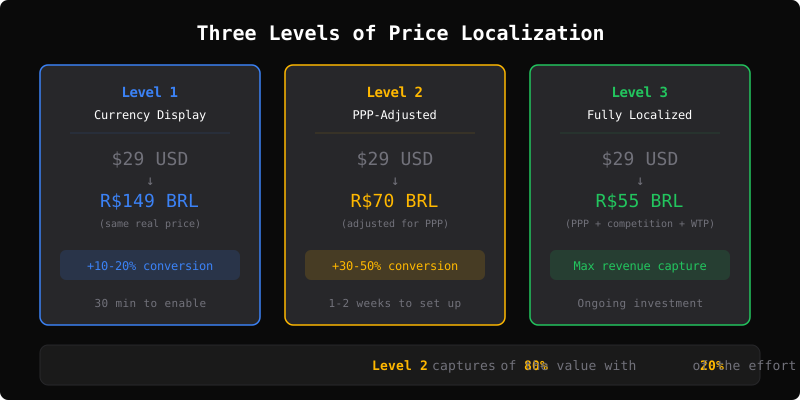
- Currency localization — displaying the same price in local currency (showing R$149 instead of $29 in Brazil). Same real price, lower cognitive load.
- Purchasing power parity (PPP) — an economic measure of what a unit of currency buys locally. A Big Mac costs $5.79 in the US versus $2.62 in India (The Economist Big Mac Index, Jan 2026) — India ~55% cheaper.
- Geo-pricing — synonym for price localization; the term most billing platforms (Stripe, Paddle, Chargebee) use.
The spectrum runs from simple to sophisticated:
| Level | What It Means | Impact |
|---|---|---|
| **Level 1: Currency display** | Show prices in the visitor's local currency, converted from your base price | Reduces friction; conversion lift of 10-20% |
| **Level 2: PPP-adjusted pricing** | Adjust the actual price based on purchasing power parity in each market | Unlocks markets where your base price is unaffordable; 30-50%+ conversion lift in emerging markets |
| **Level 3: Fully localized pricing** | Set independent price points per market based on PPP, local competition, payment methods, and willingness-to-pay research | Maximum revenue capture per market; requires the most operational investment |
In my consulting work, most subscription businesses I see are at Level 0 — one price in one currency. Even moving to Level 1 makes a meaningful difference. But the real unlock is Level 2 or 3. If more than 20% of your traffic is international, that unlock is one of the highest-impact monetization moves available to you.
The Business Case: Why This Matters for Revenue
Let me make this concrete with some math.
Say you're a subscription business with 100,000 monthly visitors. 60% of that traffic is from the US. 40% is international — split across India, Brazil, Southeast Asia, Eastern Europe, Latin America, and Africa.
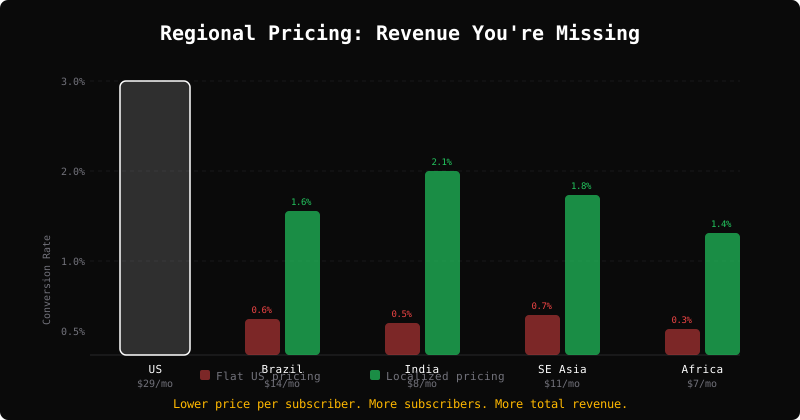
Your US conversion rate is 3%. Your international conversion rate is 0.8%. Not because those visitors are less interested — but because your $29/month price represents a fundamentally different ask in Mumbai than it does in San Francisco.
If you localize pricing and lift international conversion to even 2% (still below your US rate), here's what happens:
- Before: 40,000 international visitors x 0.8% = 320 subscribers/month
- After: 40,000 international visitors x 2% = 800 subscribers/month
That's 480 additional subscribers per month. Even if they're paying 40-60% less than US price, you've added significant MRR that didn't exist before. At an average localized price of $14/month, that's $6,720 in new monthly recurring revenue — from traffic you already had.
This isn't theoretical. Companies that implement localized pricing consistently report:
- Materially higher international conversion rates (Paddle reports that merchants who localize across 4+ regions meaningfully outperform those who don't)
- Up to 2x faster growth compared to global flat pricing
- Meaningful churn rate reduction in price-sensitive markets, because subscribers feel the price is fair relative to their income
The math is even better for subscription businesses because of the compounding effect. Each additional international subscriber pays you every month. Over a 12-month average customer lifetime value, those 480 extra subscribers at $14/month represent over $80,000 in additional revenue — from a pricing change, not an acquisition change.
6 Business Benefits of Price Localization
Once you actually do this, the second-order benefits stack up faster than the conversion math suggests.
1. Captures revenue from traffic you already have
You don't need a single new visitor. The international users hitting your pricing page today are already qualified — they got there on purpose. Localized pricing converts the ones currently bouncing on price. Zero acquisition spend, pure margin recovery.
2. Unlocks markets that were structurally priced out
This is the part most operators miss. The choice in India isn't "$29 versus $7." It's "$7 versus $0." Those users were never going to pay your US price. Localization doesn't discount existing customers — it creates new ones in segments your pricing had silently excluded.
3. Reduces international churn
A subscriber paying a price that feels fair relative to their income stays longer. A subscriber paying a price that feels insulting churns the moment their card declines. Perceived fairness shows up in retention curves, especially in price-sensitive markets.
4. Increases LTV via local payment methods
Going local on price usually forces you to go local on payment. UPI in India, PIX in Brazil, mobile money in Sub-Saharan Africa — these payment rails have dramatically lower involuntary churn than international credit cards being charged in a foreign currency. Fewer failed payments = higher LTV, independent of price.
5. Creates competitive moats in emerging markets
Spotify's lead in India came from pricing, not product. By the time competitors decided India was strategic, Spotify already owned the price-conscious segment and the playlists they'd built. First-mover advantage in emerging markets is mostly a pricing decision, not a product one.
6. Compounds with content marketing
Every localized price unlocks a localized acquisition channel. SEO content, partnerships, creator deals, paid search — they all become viable in a market once the conversion math at the bottom of the funnel works. A localized price isn't just a checkout change; it's the unlock for an entire regional GTM motion.
Three Levels of Price Localization
Level 1: Currency Display
This is the easiest win. Show prices in the visitor's local currency instead of forcing them to do mental math.
When a Brazilian visitor sees "$29/month" they have to:
- Know the current USD-BRL exchange rate
- Do the math in their head
- Process whether that amount makes sense for them
When they see "R$149/month" — even if it's the same price — the cognitive load drops. They can instantly evaluate the price against their mental model of what things cost.
The data supports this. Simply displaying local currency (even without changing the underlying price) can increase conversion by 10-20% and lift ARPU by up to 40%, according to Stripe's data on presentment currency.
Implementation: Most billing platforms support multi-currency display out of the box. Stripe, Paddle, and Chargebee all handle currency conversion automatically. The price stays the same in real terms — you're just reducing the friction of a foreign currency.
Limitation: Currency display alone doesn't solve the purchasing power problem. R$149/month might be the correct conversion of $29, but it's still unaffordable for most of the Brazilian market. You've made the price easier to read, not easier to pay.
Level 2: Purchasing Power Parity (PPP) Adjustments
This is where real revenue unlocks happen. You adjust the actual price — not just the currency — to reflect what that amount means in the local economy.
Purchasing power parity measures how much a unit of currency can buy in different countries. The Big Mac Index is the famous illustration: a Big Mac costs $5.79 in the US but $2.62 in India (The Economist, Jan 2026) — ~55% cheaper. The same product, the same company, drastically different prices — because McDonald's understands that pricing must reflect local economic reality.
For subscription businesses, PPP-adjusted pricing means a subscriber in India might pay 60-70% less than a US subscriber. Not because they're getting a worse product, but because $29/month in India represents a fundamentally different economic commitment than $29/month in the US.
How to calculate PPP adjustments:
The World Bank publishes PPP conversion factors for every country. The raw version is just a ratio of one country's PPP factor to the US PPP factor, applied to your base price. But raw PPP produces prices that are sometimes too low to be sustainable. Most subscription businesses apply PPP with a floor:
The PPP Pricing Formula:
Local Price = MAX(US Price × (Local PPP / US PPP), Minimum Viable Price)
Worked example: If your US price is $29 and you're pricing for India (PPP ratio ≈ 0.30), the raw formula gives $29 × 0.30 = $8.70. Round to a local-friendly number ($9) and verify it's above your minimum viable price (typically $5-7 for a digital subscription). Final India price: $9/month — a 69% discount that reflects the actual economic ask.
Your minimum viable price is the lowest you can charge and still cover variable costs plus a reasonable margin. For a digital subscription with near-zero marginal cost, this floor can be quite low.
Level 3: Fully Localized Pricing
This is what Spotify, Netflix, and other global-scale subscription businesses do. Each market gets its own pricing that considers:
- Purchasing power parity
- Local competitor pricing
- Payment method availability and preferences
- Market-specific willingness-to-pay research
- Local regulatory requirements (VAT, digital services taxes)
- Strategic importance of the market for growth
At this level, you're not applying a formula — you're running pricing as a per-market strategy. The price in Japan might be higher than raw PPP suggests because the market is competitive and consumers are used to paying premium prices for digital subscriptions. The price in Nigeria might be lower than PPP suggests because mobile money is the primary payment method and monthly budgets for digital services are extremely tight.
When to use Level 3: When international revenue represents more than 30% of your business and you have dedicated resources for international growth. For most subscription businesses, Level 2 (PPP-adjusted) captures 80% of the value with 20% of the effort.
Benchmark PPP Discounts by Region
Here's a practical reference table for PPP-adjusted pricing. These ranges reflect what major subscription companies typically apply and what the economic data supports.
| Region | Typical Discount Off US Price | PPP Ratio (approx.) | Example: $29 US Price |
|---|---|---|---|
| **US / Canada** | 0% (baseline) | 1.0 | $29 |
| **Western Europe (UK, Germany, France)** | 0-10% | 0.85-1.0 | $26-29 |
| **Japan / Australia / South Korea** | 0-15% | 0.80-0.95 | $25-29 |
| **Eastern Europe (Poland, Romania, Czech Republic)** | 30-45% | 0.45-0.65 | $16-20 |
| **Latin America (Brazil, Mexico, Colombia)** | 40-55% | 0.35-0.55 | $13-17 |
| **Southeast Asia (Indonesia, Philippines, Vietnam)** | 50-65% | 0.30-0.45 | $10-14 |
| **India** | 60-75% | 0.25-0.35 | $7-11 |
| **Sub-Saharan Africa (Nigeria, Kenya, South Africa)** | 60-80% | 0.20-0.35 | $6-11 |
| **Egypt / Pakistan / Bangladesh** | 70-85% | 0.15-0.25 | $4-9 |
Important notes on this table:
- These are starting points, not rules. Your actual pricing should be validated against conversion data in each market.
- South Africa is an outlier in Sub-Saharan Africa — its purchasing power is significantly higher than Nigeria or Kenya, so treat it separately.
- China is deliberately excluded. Pricing for China involves regulatory, payment, and market-access complexities that go beyond PPP. If China is a target market, it deserves its own strategy.
- The ranges are wide because PPP is one input, not the only input. Local competition, payment method friction, and market maturity all affect the right price.
Beyond PPP: Price to Your Customer's Earning Power, Not the Country's Average
PPP, GDP, and the Big Mac Index all collapse a country to one number. Your buyer is almost never the country average. The better unit of analysis is the relative earning power of the customers you're actually targeting in each market.
When we localized prices at Codecademy, we sorted countries by GDP and bucketed them. It worked, but it was crude. Looking back, I would have based the methodology on the relative purchasing power of our target users, not the country overall. Some lower-GDP countries had high-paying engineering jobs. Some higher-GDP countries didn't. What actually matters is what the price feels like to your ideal buyer.
The insider subscription playbook
One tactic that moves the needle — every Thursday
Real companies, real numbers, strategies you can steal. From the operator who grew Codecademy from $10M to $50M ARR.
The cleanest proxy I've found is your price as a percentage of your target persona's local annual salary. A $1,995/year Reforge membership is 1.3% of a US marketing manager's salary, 2.1% of an Israeli marketing manager's salary, and 10.7% of an Argentinian marketing manager's salary. Same product, same dollar price, three completely different asks.
| Country | Marketing Mgr. salary | Reforge as % of salary | What it feels like |
|---|---|---|---|
| United States | $154,266/yr | **1.3%** | Same monthly bill as a fancy gym |
| Israel | $95,600/yr | **2.1%** | Materially more expensive, but in reach if the buyer values it |
| Argentina | $18,524/yr | **10.7%** | Multiple months of rent — structurally out of reach |
(Salaries from SalaryExpert; Reforge price from reforge.com.)
At 10.7% of income, you don't have a conversion problem in Argentina — you have a pricing architecture problem. The price was never meant for that buyer.
Rule of thumb: Aim for the localized price to land at 1-3% of the target persona's annual salary in every market. 5%+ is "materially expensive." Past ~10% is structurally unaffordable, regardless of country.
Use PPP as a sanity check. Use earning power as the decision.
So what do you do with this information? Pull the salary for your target buyer in your top 5 international markets. Calculate your current price as a % of that salary. Anywhere it's above 5%, your conversion rate is telling you exactly what's wrong.
How to Determine Price Points by Region
Method 1: PPP Index Approach
The World Bank publishes annual PPP conversion factors. Here's the process:
- Get the PPP factor for your target country from the World Bank's International Comparison Program data
- Calculate the ratio: Divide the country's PPP factor by the US PPP factor
- Apply to your base price: Multiply your US price by the ratio
- Set a floor: Never go below your minimum viable price (typically 15-25% of your US price for digital products)
- Round to local-friendly numbers: $11.47 becomes $11 or $12. In India, Rs 899 is better than Rs 937.
Method 2: Big Mac Index (Quick and Dirty)
The Economist's Big Mac Index is a surprisingly useful proxy for subscription pricing. It's updated twice a year, covers 70+ countries, and reflects actual market pricing rather than just economic statistics.
The logic: if a Big Mac costs ~55% less in India than in the US (The Economist Big Mac Index, Jan 2026), your subscription probably should too. It's not precise, but it gives you a reasonable starting point in 15 minutes instead of a week of economic analysis.
Method 3: Competitor Analysis per Market
Look at what Spotify, Netflix, YouTube Premium, and other global subscription services charge in each target market. These companies have invested millions in regional pricing research — you can borrow their conclusions.
How Major Subscription Companies Price by Country
| Company | US Price | India Price | Discount | Signal |
|---|---|---|---|---|
| Spotify Premium | $11.99/mo | ~$1.80/mo ([Spotify India](https://www.spotify.com/in-en/premium/)) | ~85% | Aggressive PPP discount; bet on market share over per-user revenue |
| Netflix Standard | $19.99/mo (US, May 2026) [[Source](https://help.netflix.com/en/node/24926)] | ₹499/mo ≈ $5.21 (Standard, India, May 2026) [[Source](https://www.netflix.com/in/)] | ~74% | India Standard is ~3.8× cheaper than US Standard — but the real signal is the India-only Mobile plan at ₹149/mo (~$1.56), a tier US viewers can't buy at any price |
| YouTube Premium | $13.99/mo (US, May 2026; rising to $15.99 in June 2026) [[Source](https://www.youtube.com/premium)] | ₹149/mo ≈ $1.56 (India, May 2026) [[Source](https://www.youtube.com/premium/restricted)] | ~89% | ~9× cheaper in India. Google priced this against a market that mostly wouldn't pay anything for ad-removal — the absolute price point matters more than the discount math |
| Disney+ / JioHotstar | $18.99/mo (Disney+ Premium ad-free, US, May 2026) [[Source](https://help.disneyplus.com/article/disneyplus-price)] | ₹149/mo ≈ $1.56 (JioHotstar Super monthly, India, May 2026) [[Source](https://www.hotstar.com/in/subscribe)] | ~92% | India isn't a discount of the US product — it's a different product (cricket + local content) sold under a different brand at ~12× lower price. Geo-pricing taken to its logical end: separate P&L, separate strategy |
| Duolingo Super | $12.99/mo monthly or ~$7.00/mo on the annual plan (US, May 2026) [[Source](https://www.duolingo.com/super)] | ~₹99/mo ≈ $1.03 monthly equivalent (India, App Store / Play Store, May 2026) [[Source](https://www.duolingo.com/super)] | ~92% vs US monthly | ~10–12× cheaper. Duolingo prices through the app stores rather than its own checkout, which means it inherits Apple/Google's regional pricing matrix automatically — no custom pricing engineering required |
For Spotify specifically, the rough numbers across other emerging markets are: Brazil ~$3.50/month (71% off), Nigeria ~$1.04/month (91% off), Turkey ~$2.32/month (₺99/mo as of May 2026, ~81% off; Spotify TR). Verify against current pricing pages — Spotify has revised pricing across most of these markets in the last two years.
If these companies — with their armies of pricing analysts — set prices at these levels, that's strong market signal for what consumers in those regions can and will pay.
Method 4: Willingness-to-Pay Research by Market
If a specific market is strategically important (large traffic volume, high potential), run a willingness-to-pay survey specifically for that market. The Van Westendorp method works the same way — you just need enough responses from that geography.
This is the most precise approach but requires investment. Reserve it for your top 3-5 international markets.
Method 5: Earning Power Method (Recommended)
The method I'd use if I were doing this again at Codecademy. Six steps:
- Download users per country. Count real, recent, high-intent users — drop dormant cohorts.
- Find the best proxy for persona purchasing power. Pull the average annual salary for your target buyer's job title in each country (SalaryExpert, Glassdoor, Levels.fyi for technical roles). Add competitor pricing as a secondary input.
- Sort countries by "your annual price as a % of that persona's salary." Drop countries with too few users.
- Group into 3-5 tiers, not per-country. Tier 1 = US + Western Europe; Tier 2 = Eastern Europe, Australia, Canada; Tier 3 = India, most of South America, Africa, Southeast Asia.
- Set relative price between tiers so each lands in roughly the same "% of persona salary" band — aim for 1-3% per tier. This is more art than science.
- Ship it, then measure ARPU and conversion by tier over months, not weeks. Announce a price drop publicly when you make one.
Use the other four methods as inputs. Use this one as the decision.
The Practical Recommendation
For most subscription businesses, here's what I'd actually do:
- Start with the Big Mac Index or competitor analysis for a quick first pass
- Validate with PPP data from the World Bank to ensure your numbers are in the right range
- Set prices in 4-6 regional tiers (not per-country) to keep operational complexity manageable
- Measure conversion by region for 3-6 months
- Refine based on data — if conversion is still low in a tier, the price is still too high for that market
Implementation Approaches
Approach 1: IP-Based Detection
The most common approach for web-based subscription businesses. Detect the visitor's country via their IP address and display the corresponding regional price.
How it works:
- Visitor hits your pricing page
- Your server (or a client-side service) looks up their IP and determines country
- You display the price for that region
- At checkout, the billing platform charges in the local currency at the localized price
Pros: Seamless experience. No action required from the visitor. Works for most traffic.
Cons: VPN users can game it (more on this below). IP geolocation isn't 100% accurate — corporate VPNs, expats, and travelers can get wrong pricing.
Tools: MaxMind GeoIP, Cloudflare's geolocation headers, Vercel's geo middleware — all provide country-level detection with high accuracy.
Approach 2: Billing Platform Native Features
Most modern billing platforms have built-in price localization:
| Platform | Localization Features | Best For |
|---|---|---|
| **Stripe** | Adaptive Pricing (automatic localized pricing in 150+ countries, ML-powered); multi-currency checkout; Price objects per currency | Businesses on Stripe wanting automated localization |
| **Paddle** | Full merchant of record with built-in geo-pricing; handles local tax, currency, and payment methods automatically | SaaS businesses wanting hands-off international sales tax/VAT |
| **Chargebee** | Multi-currency pricing; regional price overrides per plan; supports different prices per country | Subscription businesses needing granular control |
| **FastSpring** | Full merchant of record; automatic geo-pricing with PPP adjustments; local payment methods | Digital products and software |
| **Stripe + ParityDeals/Pariparrot** | Add-on tools that calculate PPP discounts and apply them to Stripe checkout, with VPN protection built in | Indie/small SaaS wanting PPP pricing without custom code |
My recommendation for most subscription businesses: If you're on Stripe, start with Stripe's Adaptive Pricing. It handles currency localization automatically and uses ML to optimize prices by market. If you need deeper PPP-based discounts beyond currency conversion, add a tool like ParityDeals or build custom regional pricing tiers using Stripe's Price objects (one Price per currency/region per product).
If international sales tax complexity is a concern, Paddle or FastSpring as a merchant of record handles all of that for you — pricing, tax, and compliance in one layer.
Approach 3: Manual Regional Tiers
The simplest approach that still captures most of the value. Group countries into 4-6 pricing tiers:
Example tier structure:
| Tier | Countries | Discount | Monthly Price (if US = $29) |
|---|---|---|---|
| **Tier 1** | US, Canada, UK, Western Europe, Australia, Japan | 0% | $29 |
| **Tier 2** | Eastern Europe, Southern Europe, Middle East, South Korea | 25-35% | $19-22 |
| **Tier 3** | Latin America, Southeast Asia, China, Turkey | 45-55% | $13-16 |
| **Tier 4** | India, Sub-Saharan Africa, South Asia, Egypt | 65-75% | $7-10 |
Why this works: Four tiers are operationally simple — four price points to manage, four cohorts to analyze. You capture the majority of the PPP benefit without the complexity of per-country pricing.
Implementation: Detect country via IP or billing address, map to tier, display tier price. Most billing platforms support this with regional pricing rules or coupon codes applied at checkout.
When NOT to Localize Pricing
Localized pricing isn't always the right move. Skip it (or deprioritize it) in these cases:
Your international traffic is under 10%. Fix the traffic problem first. Pricing optimization on tiny international volume is rounding error — you'll spend a sprint of engineering work to capture an extra $500/month. Grow the funnel before optimizing the bottom of it.
You sell exclusively B2B enterprise. Enterprise pricing is negotiated, not self-serve. Adding regional self-serve pricing creates more multi-office complications than it solves — your US-based buyer will absolutely notice that their India office "could pay less" and ask for the discount. Keep enterprise on contract; localize only on self-serve plans.
Your unit economics are already thin. If your gross margin is 30% in the US, a 60% discount in India means you lose money on every Indian subscriber. PPP only works when your marginal cost is near zero. Fix margin first.
Your product is regulated or licensed per region. Some categories — financial services, healthcare data, age-restricted content, certain media — have per-country licensing or compliance costs that swamp PPP economics. The right India price might be higher than the US price, not lower, once licensing is included.
Common Mistakes (and How to Avoid Them)
Mistake 1: VPN Arbitrage
This is the concern every business raises first: "Won't people just use a VPN to pretend they're in India and get the cheap price?"
The short answer: yes, some will try. But the risk is far smaller than you think, and there are practical mitigations.
The reality check: The number of customers who will (a) know regional pricing exists, (b) find a VPN, (c) connect to a specific country, (d) go through your checkout flow, and (e) do this every month — is a tiny fraction of your customer base. For most subscription businesses, VPN arbitrage is a rounding error compared to the revenue gained from legitimate international pricing.
Practical mitigations:
Verify against billing address. The simplest and most effective check. If the visitor's IP says India but their credit card billing address is in California, charge the US price. Most billing platforms expose the card's country of origin.
Use VPN detection. Services like MaxMind, IPQualityScore, and the PPP pricing tools (ParityDeals, Pariparrot) include VPN/proxy detection. Flag suspicious sessions and default to the highest-tier price.
Lock pricing to the country at signup. Set the subscriber's pricing tier based on their initial purchase location and payment method country. Don't let it change if they later appear from a different region.
Accept some leakage. This might be controversial, but I think it's the right mindset. If 2% of your subscribers game the system and you gain 30% more international revenue, you're way ahead. Don't over-optimize for fraud prevention at the cost of conversion friction for legitimate international customers.
Mistake 2: Cannibalizing High-Value Markets
The fear: "If I offer a lower price in India, won't my US customers find out and be upset?"
The reality: Your US customers are not price-shopping your Indian pricing page. They're not checking VPN tools to save $15/month. B2C subscribers especially — they sign up, use the product, and don't think about pricing in other countries.
For B2B, this can be more of a concern with multinational companies. An enterprise customer in the US might notice their India office pays less. The fix: enterprise/B2B plans are priced by contract, not by self-serve regional pricing. Localization applies to your self-serve plans. Enterprise is negotiated.
Transparency helps. Some companies (notably Basecamp and several indie SaaS tools) publicly explain their regional pricing: "We adjust prices based on local purchasing power so our product is accessible worldwide." Most customers respect this. Fairness is a better framing than secrecy.
Mistake 3: Over-Discounting
Applying raw PPP ratios can produce prices that are too low — below what the market would actually pay, or below what's sustainable for your business.
The fix:
- Set a price floor at 15-25% of your US price. Even in the lowest-income markets, digital products have a minimum perceived value. Going too low can actually hurt — it signals low quality.
- Don't discount wealthy segments in lower-PPP countries. India has a massive middle and upper-middle class that can and will pay closer to global rates. Your tier pricing shouldn't assume everyone in a country has the same purchasing power.
- Start conservative (smaller discounts) and increase if conversion data shows the price is still too high. It's much easier to lower prices than to raise them.
Mistake 4: Ignoring Payment Methods
You can localize the price perfectly and still lose the sale because you don't accept the payment method customers actually use.
- Brazil: Boleto bancario and PIX are widely preferred. Many consumers don't have international credit cards.
- India: UPI is dominant for digital payments. Credit card penetration is low outside the affluent segment.
- Southeast Asia: GrabPay, GCash, bank transfers vary by country.
- Africa: Mobile money (M-Pesa in Kenya, MTN Mobile Money in West Africa) is how most digital payments happen.
If your checkout only accepts Visa and Mastercard, you're losing a significant chunk of potential subscribers in these markets — regardless of the price. Paddle, FastSpring, and Stripe (with local payment methods enabled) can handle most of these.
Mistake 5: Set-and-Forget
Exchange rates fluctuate. Economies change. Your $10 price for Brazil might have been right when the BRL was at 5.0 to the dollar, but it's a different effective price when the BRL moves to 5.8.
Stale regional pricing silently erodes net revenue retention as exchange rates shift.
Review regional pricing every 6 months. Check:
- Have exchange rates shifted meaningfully?
- Are conversion rates by region changing?
- Have competitors adjusted their regional pricing?
- Are new markets emerging that deserve their own tier?
This is the same "pricing is a living discipline" principle from value-based pricing — it just applies per-region instead of globally.
Real Company Examples
Spotify
Spotify is the gold standard for subscription price localization. They charge approximately $11.99/month in the US, but as low as $1.04/month in Nigeria — a 91% reduction. Their prices in India ($1.80/month), Turkey ($2.32/month as of May 2026), and Brazil (~$3.50/month) are all calibrated to local purchasing power.
What they get right: They don't just adjust the price — they adjust the product offering. In India, Spotify launched with a mobile-only "Mini" plan at even lower price points, recognizing that many Indian users are mobile-first and have limited data budgets.
The result: India is now one of Spotify's largest markets by user count. They traded per-subscriber revenue for massive market share, and the scale economics work because marginal cost per stream is near zero.
Netflix
Netflix pioneered the mobile-only plan ($2-3/month in India, launched 2019) specifically for price-sensitive markets. They also vary their standard plan pricing dramatically by country — from ~$1.61/month in Pakistan to $19.99/month in the US for the standard plan.
What they get right: Netflix doesn't just discount — they create market-specific tiers. The mobile-only plan doesn't exist in the US because the US market doesn't need it. But in India, where mobile is the primary screen and affordability is the primary barrier, it unlocks a massive segment.
The lesson for smaller subscription businesses: You don't necessarily need to offer the exact same product at a lower price. Consider whether a lighter version of your product — fewer features, mobile-only, limited usage — makes sense as a localized offering.
Codecademy: A Case Study in International Pricing
I can speak to this one directly. Our core subscription was priced for the US market at $19.99/month at the time, and international conversion lagged the US badly across the 190+ countries we served.
The timeline: through 2017-2018 we ran a single US price globally. We rolled out region-specific pricing in 2018-2019 using a GDP-bucket approach — sort every country by GDP per capita, cut into 5 buckets, raise prices in the top two, hold the middle two, drop the bottom one. In retrospect (and the reason I now recommend the earning-power method above), the GDP approach was fine but not great. It moved the business forward — but persona-pay would have moved it further.
When we analyzed the data before the move, the pattern was clear: countries with lower purchasing power had high engagement with free content but dramatically lower paid conversion. The price wasn't wrong for the US. It was wrong for everywhere else.
The solution wasn't complex. We implemented regional pricing tiers that brought the effective price down significantly in key markets like India, Brazil, and Southeast Asia. The result was a meaningful lift in international paid subscribers without any meaningful cannibalization of US revenue.
The key insight: these weren't "discounted" users. They were users we would never have converted at the US price. The choice wasn't "$19.99 vs. $7.99." The choice was "$7.99 vs. $0."
Notion
Notion offers a notable approach for individual users: a 50% discount for users who can verify they're students or educators, and they've experimented with regional pricing adjustments. For teams and business plans, pricing varies by market.
Indie SaaS / Creator Tools
Many smaller subscription businesses use tools like ParityDeals or Pariparrot to add PPP-based discounts automatically. The typical implementation: a banner appears on the pricing page saying "It looks like you're visiting from [Country]. We offer purchasing power parity pricing — get X% off." The customer clicks to apply the discount, and VPN detection runs in the background.
This approach is popular because it's transparent, easy to implement (often a single script tag), and lets the business choose how much of the PPP adjustment to pass through.
The Fairness Question
Price localization raises a legitimate question: is it fair to charge different prices for the same product?
My take: it's the most fair approach. Charging the same price globally is only "fair" if you define fairness as equal dollar amounts. But $29/month is not the same ask to someone earning $80,000/year as it is to someone earning $8,000/year.
Airlines, hotels, movie theaters, and software companies have all understood this for decades — the same product at different price points, based on context. Student discounts, senior discounts, geographic pricing — these are all forms of the same principle: price based on ability to pay, not just willingness to pay.
For subscription businesses specifically, price localization is the intersection of fairness and business strategy. You're not giving away your product. You're pricing it so that people in every market can afford to pay something — and "something" is infinitely more than "nothing."
The alternative is a single global price that works for wealthy markets and prices out everyone else. That's not fair either. It's just simpler.
Implementation Roadmap
Here's the order I'd recommend for a subscription business implementing price localization for the first time.
Phase 1: Quick Wins (Week 1-2)
Audit your international traffic. Check your analytics for traffic by country. Identify the top 10-15 countries outside your home market. If international traffic is less than 10% of total, price localization matters less (focus on growing international traffic first).
Enable local currency display. If your billing platform supports it (most do), turn on presentment currency. This takes minutes and gives you an immediate conversion lift.
Check your conversion rates by country. Compare conversion rates in your home market vs. top international markets. A large gap (e.g., 3% US vs. 0.5% India) signals a pricing problem, not a product problem.
Phase 2: Regional Pricing Tiers (Week 3-6)
Define 4-6 pricing tiers using the PPP benchmark table above as a starting point.
Implement IP-based detection to serve the right price to the right visitor. Use billing address verification at checkout to prevent obvious arbitrage.
Set up regional pricing in your billing platform. In Stripe, create Price objects for each tier/currency. In Paddle or Chargebee, configure regional pricing rules.
Add VPN detection if you're offering discounts greater than 40% off your base price. For discounts under 40%, the arbitrage incentive is usually too small to worry about.
Phase 3: Measure and Optimize (Month 2-6)
Track conversion by region as your primary success metric. You should see meaningful lifts in the regions where you've reduced pricing.
Monitor revenue per region. Conversion x price = revenue. The goal is more total regional revenue, even at a lower per-subscriber price.
Watch for cannibalization signals. If US conversion suddenly drops or you see unusual VPN patterns, investigate. (In my experience, this almost never happens at scale.)
Adjust tiers based on data. If conversion in Tier 3 countries didn't improve much, the price might still be too high. If Tier 4 conversion is very high but revenue is minimal, you might be priced too low.
Phase 4: Optimize (Month 6+)
- Add local payment methods for your highest-potential markets.
- Consider market-specific plans (mobile-only, limited features) for very price-sensitive regions.
- Run willingness-to-pay surveys in your top 3-5 international markets.
- Review and adjust every 6 months based on exchange rate movements and conversion data.
FAQ
What is price localization?
Price localization is the practice of adjusting your product's pricing for different geographic markets. It ranges from simply displaying prices in local currencies (cosmetic localization) to fully adjusting price points based on local purchasing power, competitive landscape, and market conditions. For subscription businesses, it means a subscriber in India might pay $7-10/month for the same product that costs $29/month in the US — reflecting the difference in what that amount means in each economy.
How is price localization different from currency conversion?
Currency conversion shows your base price in a different currency. If your product is $29 USD, it shows as approximately R$150 BRL in Brazil. The price is the same in real terms. Price localization changes the actual price — maybe R$70 BRL in Brazil — to reflect local purchasing power. Currency conversion reduces friction. Price localization opens markets.
Won't people use VPNs to get the cheaper price?
Some will try, but it's a much smaller problem than most businesses fear. Practical mitigations include verifying against billing address country, using VPN detection services, and locking pricing tier at signup. The revenue gained from legitimate international pricing almost always dwarfs any losses from VPN arbitrage. Don't let the fear of 2% abuse prevent you from capturing 30%+ more international revenue.
How much should I discount for different regions?
Use PPP data as a starting point. Typical discounts range from 0-10% in Western Europe to 60-80% in South Asia and Sub-Saharan Africa. The benchmark table in this guide provides ranges by region. Start conservative (smaller discounts), measure conversion, and adjust. You can always increase discounts later — raising prices in a region is harder.
What's the minimum viable approach to price localization?
Enable local currency display in your billing platform (takes 30 minutes) and create 3-4 regional pricing tiers based on PPP data. Use IP detection to serve the right price and billing address verification to prevent arbitrage. This covers 80% of the benefit with minimal operational complexity.
Does price localization affect my [subscription model](/guides/subscription-model)?
Your model stays the same — tiers, features, and packaging don't need to change. What changes is the price attached to each plan in each region. Some businesses go further and offer region-specific plans (like Netflix's mobile-only tier in India), but that's an optimization, not a requirement.
Should I be transparent about regional pricing?
I recommend it. A brief note on your pricing page ("We adjust prices based on local purchasing power to make our product accessible worldwide") builds trust and preempts complaints. Several well-known SaaS companies take this approach. Secrecy invites suspicion; transparency invites respect.
How often should I review regional pricing?
Every 6 months. Exchange rates shift, economies change, and your conversion data will tell you which regions need adjustment. Markets with volatile currencies (Turkey, Argentina, Nigeria) may need more frequent reviews.
What tools support price localization?
Stripe (Adaptive Pricing + multi-currency), Paddle (built-in geo-pricing as merchant of record), Chargebee (regional price overrides), FastSpring (automatic geo-pricing), and add-on tools like ParityDeals and Pariparrot (PPP pricing with VPN protection for Stripe users). Most modern billing platforms have the infrastructure — you just need to configure it.
Will price localization cannibalize my US/premium market revenue?
In my experience: no. US customers don't shop your Indian pricing page. For self-serve subscriptions, regional pricing is invisible to customers outside that region. For B2B enterprise, use negotiated contracts instead of self-serve regional pricing to avoid any multi-office complications.
What to Do Next
If more than 20% of your traffic comes from outside your home market and you're charging one price globally, price localization is likely the single highest-impact change you can make — higher than most acquisition channels, higher than most conversion optimization tactics.
Start with the quick wins: local currency display and 3-4 regional pricing tiers. Measure for a few months. The data will tell you how much further to go.
But pricing — even localized pricing — is only one of the places subscription businesses leak revenue. If you want to see the full picture across pricing, packaging, conversion, checkout, retention, and expansion, I built a free diagnostic that covers all of it.
Take the Subscription Revenue Leak Audit -->
52 checklist items across 8 revenue leak categories. Takes 10 minutes. Price localization is a powerful lever — but it's one of many. The audit shows you which ones matter most for your business.

Dan Layfield
Dan ran growth at Codecademy, scaling ARR from $10M to $55M before the company was acquired for $525M. He now advises subscription businesses on pricing, retention, and revenue optimization.
Work with Dan →Related Guides
Recurring Revenue: How to Grow It Without Growing Your Traffic
Stop trying to grow recurring revenue by acquiring more customers. A subscription growth framework: six levers to make more from the subscribers you already have.
31 min readSubscription Metrics: The 10 Numbers That Actually Run Your Business
Most subscription businesses track too many metrics and act on too few. Here are the 10 that matter, how they connect, and what to do when they're off.
18 min readThe Subscription Model Guide: From Setup to Monetization
Go beyond "pick a pricing model." This guide covers what actually matters: making your subscription business profitable through pricing, packaging, and retention.
Get the playbook every Thursday
Weekly strategies for subscription businesses. Real companies, real numbers, tactics you can steal. From the operator who grew Codecademy from $10M to $50M ARR.