Subscription Metrics: The 10 Numbers That Actually Run Your Business
Most subscription businesses track too many metrics and act on too few. Here are the 10 that matter, how they connect, and what to do when they're off.

Dan Layfield
Growth at Codecademy, $10M → $50M ARR
In This Guide
- The 10 Subscription Metrics at a Glance
- What Each Subscription Metric Means
- Why Most Metrics Dashboards Fail
- The Subscription Metrics Hierarchy
- The 10 Metrics, In Detail
- What Real Subscription Companies' Metrics Look Like
- Which Metrics Matter Most at Each Stage
- When These Metrics Don't Apply (And What to Track Instead)
- How These Metrics Connect: The Subscription Metrics Map
- The Metrics Dashboard That Actually Works
- Common Mistakes I See With Subscription Metrics
- FAQ
- What to Do Next
Most subscription businesses track 30 metrics and act on 3. That's the actual problem — not a missing metric nobody has heard of, but a dashboard that gives you information without direction.
When I ran growth at Codecademy from $10M to $50M in ARR, we didn't discover anything exotic. We got very clear about which numbers mattered at our stage, how they connected, and what specific action to take when one was off. That's the whole game.
This guide isn't a glossary. It's a practitioner's guide to the 10 metrics that actually drive subscription businesses, how they fit together, and what to do when each one tells you something is wrong.
The 10 Subscription Metrics at a Glance
| Metric | Layer | What It Answers | Healthy Range |
|---|---|---|---|
| **MRR / ARR** | Scoreboard | How much recurring revenue do we have? | Growth rate, not absolute (see below) |
| **NRR** | Scoreboard | Is our existing base growing or shrinking? | 100%+ minimum, 115%+ best-in-class |
| **Churn Rate** | Lever | How fast are we losing subscribers? | <1%/mo B2B enterprise, <5%/mo B2C |
| **LTV** | Lever | What is each subscriber worth? | LTV:CAC ratio 3:1+ |
| **Expansion Revenue %** | Lever | Are existing subscribers spending more? | 15%+ strong, 30%+ best-in-class |
| **ARPU** | Lever | Revenue per subscriber, trend over time? | Flat or rising — never declining |
| **CAC** | Input | What does it cost to get a subscriber? | Channel-dependent; pair with payback |
| **CAC Payback Period** | Input | How long until that cost is recovered? | Under 12 months for healthy SaaS |
| **Trial Conversion Rate** | Input | How well do we convert free to paid? | 40-60% card required, 15-30% no card |
| **Quick Ratio** | Verdict | Are we adding more revenue than we're losing? | 2.0+ healthy, 4.0+ elite |
The short answer: Focus on the layer that matches your stage — early-stage on trial conversion and first-month churn, growth-stage on LTV:CAC and payback, scale-stage on NRR and expansion. Ignore the rest until you can name the specific action a metric would trigger.
What Each Subscription Metric Means
Quick reference. Each metric is covered in depth below.
- MRR (Monthly Recurring Revenue): Total predictable subscription revenue in a given month. If you have 500 subscribers paying $20/month, your MRR is $10,000.
- ARR (Annual Recurring Revenue): MRR multiplied by 12. The same business above has $120,000 ARR.
- NRR (Net Revenue Retention): Percentage of revenue retained from existing customers, including churn, downgrades, and expansion. 115% means your existing base is growing 15% even before new acquisition.
- Churn Rate: Percentage of subscribers (or revenue) lost in a period. A 5% monthly churn rate means you lose 5 of every 100 subscribers each month.
- LTV (Customer Lifetime Value): Total revenue you expect from one subscriber across their entire relationship. At $20/month and 20-month average lifetime, LTV is $400.
- CAC (Customer Acquisition Cost): Total sales and marketing spend divided by new subscribers in the same period. Spend $10,000 to acquire 100 subscribers? CAC is $100.
- CAC Payback Period: How many months it takes to recover CAC from a subscriber's gross margin. $100 CAC, $20 ARPU, 80% margin = 6.25 months.
- ARPU (Average Revenue Per User): Total MRR divided by active subscribers. $10,000 MRR / 500 subscribers = $20 ARPU.
- Trial Conversion Rate: Percentage of trial users who become paid. 100 trials, 40 convert = 40%.
- Expansion Revenue %: Share of MRR coming from existing subscribers spending more (upgrades, add-ons, usage). 30%+ is best-in-class.
- Quick Ratio: (New MRR + Expansion MRR) / (Churned MRR + Contraction MRR). A single number for growth efficiency. 4.0+ is elite.
Why Most Metrics Dashboards Fail
Before we get into the metrics, a quick note on why tracking everything is almost as bad as tracking nothing.
The problem with a 30-metric dashboard is that it gives you information without direction. MRR went up 3%. Churn went up 0.2%. Trial conversion went down 1%. ARPU is flat. CAC increased. Which of these matters most? Which ones are causing the others? Where do you spend your time?
If you can't answer those questions instantly, your dashboard is decoration.
The fix is understanding the hierarchy — knowing that some metrics are inputs and others are outputs, that some matter more at certain stages, and that the relationships between metrics tell you more than the numbers themselves.
The Subscription Metrics Hierarchy
Here's how I think about it: subscription metrics exist in layers.
Layer 1: The Scoreboard (outcomes) These are the numbers that tell you if the business is winning or losing. You don't optimize them directly — they're the result of everything else.
- MRR / ARR — Total recurring revenue
- Net Revenue Retention (NRR) — Is your existing base growing or shrinking?
Layer 2: The Levers (drivers) These are the metrics you actually act on. When the scoreboard looks wrong, these tell you why.
- Churn Rate — How fast you're losing subscribers
- Customer Lifetime Value (LTV) — What each subscriber is worth
- Expansion Revenue % — Are existing subscribers spending more?
- ARPU — Revenue per subscriber
Layer 3: The Inputs (acquisition) These feed the machine. Important, but secondary to what happens after someone subscribes.
- CAC — What it costs to get a subscriber
- CAC Payback Period — How long until that cost is recovered
- Trial Conversion Rate — How well you convert free to paid
Layer 4: The Verdict
- Quick Ratio — Puts it all together: growth efficiency in one number
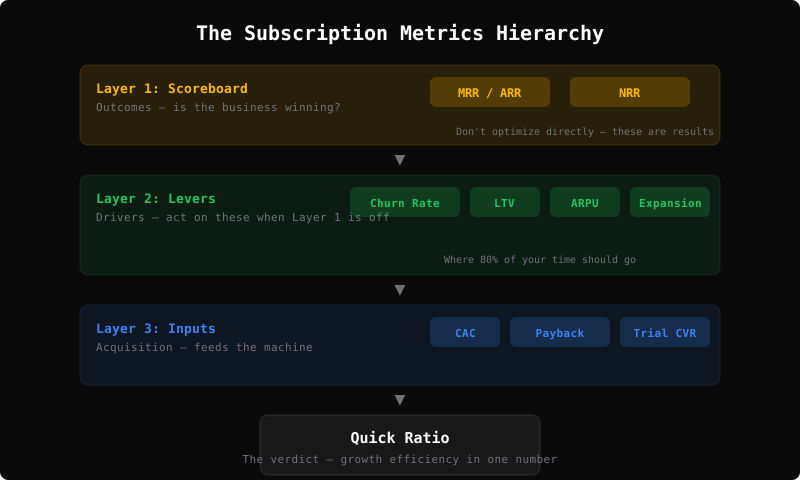
This hierarchy matters because it tells you where to focus. If NRR is dropping, don't go tinker with your ad spend. The problem is in Layer 2. If MRR is growing but CAC payback is stretching, the problem is in Layer 3.
Most operators I talk to spend 80% of their time on Layer 3 — acquisition — and 20% on everything else. That's backwards. The compounding value in subscription businesses lives in Layers 1 and 2.
The 10 Metrics, In Detail
1. MRR and ARR (Monthly / Annual Recurring Revenue)
What it is: The predictable revenue your business generates from active subscriptions each month (MRR) or year (ARR).
Why it matters: MRR is the heartbeat of a subscription business. It's the number you check first. But on its own, it's incomplete — a rising MRR can mask serious problems underneath (rising churn offset by aggressive acquisition, for example).
How to calculate it:
MRR = Sum of all active subscription revenue in a given month
ARR = MRR x 12
Sounds simple. It's not, because MRR has components:
| MRR Component | Definition |
|---|---|
| New MRR | Revenue from brand-new subscribers this month |
| Expansion MRR | Additional revenue from existing subscribers (upgrades, add-ons) |
| Contraction MRR | Revenue lost from downgrades |
| Churned MRR | Revenue lost from cancellations |
| Reactivation MRR | Revenue from previously churned subscribers who came back (typically driven by [win-back campaigns](/guides/win-back-campaigns)) |
Net New MRR = New MRR + Expansion MRR + Reactivation MRR − Contraction MRR − Churned MRR
This decomposition is critical. If your MRR grew $10K this month, that could be $15K new + $5K expansion − $10K churn. Or it could be $12K new + $1K expansion − $3K churn. Same growth, very different businesses. The first is masking a serious churn problem with expensive acquisition. The second is healthy.
Benchmarks:
MRR benchmarks are less about absolute numbers and more about growth rate:
| Stage | Monthly MRR Growth Rate |
|---|---|
| Pre-product/market fit | Variable, not meaningful yet |
| Early growth ($10K-$100K MRR) | 15-20%+ |
| Scaling ($100K-$1M MRR) | 10-15% |
| Established ($1M+ MRR) | 5-10% |
What to do when it's off:
If MRR growth is slowing, don't immediately pour more into acquisition. Decompose it first. Is churned MRR growing? Is new MRR declining? Is expansion MRR flat? The decomposition tells you where the problem lives.
For a deeper look at how recurring revenue works and how to grow it without more traffic, see my recurring revenue guide.
2. Churn Rate
What it is: The percentage of subscribers (or revenue) lost during a given period.
Why it matters: Churn is the single most important metric in a subscription business. Everything else — LTV, NRR, MRR growth — is downstream of how well you retain subscribers. A 1-percentage-point reduction in monthly churn can increase customer lifetime by years.
How to calculate it:
Customer Churn Rate = (Customers lost during period / Customers at start of period) x 100
Revenue Churn Rate = (MRR lost to cancellations + downgrades) / MRR at start of period x 100
Track both, but make decisions based on revenue churn. Losing 50 subscribers on a $9/month plan is a very different problem than losing 5 on a $500/month plan.
Benchmarks:
| Business Type | Monthly Churn | Annual Equivalent |
|---|---|---|
| B2B SaaS (Enterprise) | 0.5-1% | 6-12% |
| B2B SaaS (Mid-Market) | 1-2% | 12-22% |
| B2B SaaS (SMB) | 3-5% | 31-46% |
| B2C Subscription | 4-6% | 39-54% |
| Consumer Digital Media | 6-8%+ | 54-64%+ |
What to do when it's off:
First: figure out how much of your churn is involuntary (payment failures) vs. voluntary (active cancellations). Industry-wide, involuntary churn accounts for 20-40% of total churn. These are subscribers who want to keep paying you — and fixing this is the highest-ROI move in subscription monetization.
I wrote a full guide on how to calculate and fix your churn rate — including the dunning email sequence, smart retries, cancellation flows, and cohort analysis. Start there.
3. Net Revenue Retention (NRR)
What it is: The percentage of revenue retained from existing customers over a period, including churn, downgrades, and expansion. Sometimes called Net Dollar Retention (NDR).
Why it matters: If I could only look at one metric in a subscription business, it would be NRR. It answers the most important question: "If I stopped acquiring new customers tomorrow, would my business still grow?"
NRR above 100% means your existing base is getting more valuable over time. Below 100%, it's shrinking. This is the difference between a business that compounds and one that's on a treadmill.
How to calculate it:
NRR = (Starting MRR - Churn MRR - Contraction MRR + Expansion MRR) / Starting MRR x 100
Benchmarks:
| NRR Range | What It Means |
|---|---|
| 130%+ | Elite. Usage-based pricing that scales with customers. Snowflake printed 178% at IPO. |
| 115-130% | Best-in-class. Strong expansion engine. Investors love this. (Snowflake 126%, Datadog ~120% in 2025.) |
| 105-115% | Good. Existing base growing, room to improve expansion. |
| 100-105% | Okay. Breaking even on existing customers. Growth requires new acquisition. |
| 90-100% | Concerning. Base is slowly shrinking. |
| Below 90% | Red flag. Business model needs work. |
What to do when it's off:
NRR is a composite, so decompose it:
- Low NRR + high churn = Retention problem. Fix the leaks before building expansion. Start with involuntary churn fixes, then voluntary.
- Low NRR + low expansion = Packaging problem. Your tiers don't give customers room to grow. Add upgrade paths, usage-based components, or add-ons.
- Low NRR + high contraction = Value perception problem. Customers are downgrading because they're paying for more than they use. Revisit how your tiers map to actual usage patterns.
My full net revenue retention guide covers the three levers in detail.
4. Customer Lifetime Value (LTV)
What it is: The total revenue you expect to earn from a subscriber over their entire relationship with your business.
Why it matters: LTV is the financial summary of your subscriber relationship. It tells you how much you can afford to spend on acquisition, whether your pricing works, and if your retention efforts are paying off. It connects everything.
How to calculate it:
Simple LTV = ARPU / Monthly Churn Rate
LTV with Gross Margin = (ARPU x Gross Margin %) / Monthly Churn Rate
LTV with Expansion = (ARPU x Gross Margin %) / (Monthly Churn Rate - Monthly Expansion Rate)
Benchmarks:
| Business Type | Typical LTV Range |
|---|---|
| B2B SaaS — Enterprise | $50,000 - $500,000+ |
| B2B SaaS — Mid-Market | $10,000 - $80,000 |
| B2B SaaS — SMB | $1,000 - $15,000 |
| B2C Digital Subscription | $100 - $600 |
| Consumer App (Freemium) | $20 - $150 |
What to do when it's off:
LTV is an output of five inputs: price, churn rate, expansion revenue, onboarding effectiveness, and plan mix (monthly vs. annual). When LTV is too low, the fix is in one of those five — and the fix is almost never "get more traffic."
At Codecademy, the single biggest LTV driver wasn't pricing — it was subscription onboarding. Users who hit their "aha moment" in the first session stayed dramatically longer. The subscription price didn't change. Their lifetime did.
For the full breakdown of all five levers, see my customer lifetime value guide.
5. Customer Acquisition Cost (CAC)
What it is: The total cost to acquire one new paying subscriber — including marketing spend, sales costs, and the overhead behind them.
Why it matters: CAC determines whether your growth is sustainable. It's the other half of the LTV equation. You can have the best LTV in your category, but if it costs $2,000 to acquire a subscriber worth $500, the math doesn't work.
The insider subscription playbook
One tactic that moves the needle — every Thursday
Real companies, real numbers, strategies you can steal. From the operator who grew Codecademy from $10M to $50M ARR.
How to calculate it:
CAC = Total Sales & Marketing Spend / New Customers Acquired (in same period)
Include everything: ad spend, content creation costs, sales team compensation, tools, and the relevant portion of overhead. Most businesses undercount CAC because they exclude things like the salary of the person managing the ads or the cost of the CRM.
Benchmarks:
| Channel / Model | Typical CAC Range |
|---|---|
| Organic/SEO (B2B SaaS) | $50 - $300 |
| Paid acquisition (B2B SaaS) | $200 - $2,000+ |
| Self-serve (B2C) | $10 - $80 |
| Sales-assisted (Mid-Market) | $500 - $5,000 |
| Enterprise (sales-led) | $5,000 - $50,000+ |
What to do when it's off:
High CAC isn't always a problem — it depends on the LTV it produces. A $2,000 CAC that generates a $15,000 LTV is excellent. A $100 CAC that generates a $150 LTV is concerning.
When CAC is genuinely too high:
- Segment by channel. Your blended CAC hides enormous variation. Organic search might deliver subscribers at $30 CAC while paid social costs $400. Know the channel-level numbers.
- Look at payback period, not just the ratio. A $1,000 CAC with a 6-month payback is fine. A $1,000 CAC with a 24-month payback is a cash flow problem even if LTV eventually covers it.
- Consider whether the real fix is LTV, not CAC. If your CAC is $200 and LTV is $400 (2:1), the instinct is to lower CAC. But raising LTV to $600 through better retention or expansion gets you to 3:1 without touching acquisition at all.
6. CAC Payback Period
What it is: How many months it takes to recoup the cost of acquiring a subscriber.
Why it matters: LTV:CAC tells you if the unit economics work eventually. Payback period tells you if you have the cash to get there. A 3:1 LTV:CAC ratio with a 24-month payback requires a lot of capital to fund growth. The same ratio with an 8-month payback is self-funding.
How to calculate it:
CAC Payback Period = CAC / (ARPU x Gross Margin %)
Example: CAC of $600, ARPU of $100/month, gross margin of 80%.
$600 / ($100 x 0.80) = 7.5 months.
Benchmarks:
| Payback Period | Assessment |
|---|---|
| Under 6 months | Excellent. Fast capital return. Scale aggressively. |
| 6-12 months | Good. Standard for healthy SaaS. |
| 12-18 months | Acceptable for enterprise with long contracts and high LTV. |
| Over 18 months | Risky. Need very strong retention and deep pockets. |
What to do when it's off:
Payback period is a function of three things: CAC, ARPU, and gross margin. The fastest fix is usually ARPU — not because raising prices is easy, but because most subscription businesses undercharge.
Also: check if annual subscription plans could help. A subscriber who pays upfront for a year effectively has a payback period of month one. If you're running 30% annual plan adoption, pushing that to 50% can dramatically shift your blended payback.
7. ARPU (Average Revenue Per User)
What it is: The average monthly revenue generated per active subscriber.
Why it matters: ARPU is a leading indicator of pricing health. Flat ARPU in a business that's adding features and value means you're undercharging. Declining ARPU usually means you're acquiring cheaper customers or seeing downgrade pressure. Rising ARPU means your pricing and expansion strategy is working.
How to calculate it:
ARPU = Total MRR / Total Active Subscribers
Benchmarks:
ARPU varies so widely by business type that cross-industry benchmarks aren't useful. What matters is the trend and the segments:
| Segment | What to Watch |
|---|---|
| By acquisition channel | Are certain channels bringing in lower-ARPU customers? |
| By cohort | Is ARPU for newer cohorts higher or lower than older ones? |
| Over time | Is your average subscriber paying more or less than 12 months ago? |
What to do when it's off:
If ARPU is flat or declining:
- When did you last revisit pricing? If the answer is "at launch" or "over a year ago," you're almost certainly undercharging. Your product improved. Your costs went up. Your price should reflect that.
- What's your plan mix? If most subscribers are on the cheapest tier, that's either a packaging problem (the value jump to the next tier isn't clear) or a positioning problem (you're attracting the wrong customers).
- Are you offering expansion paths? If there's no way for a subscriber to spend more — no higher tier, no add-ons, no usage-based component — ARPU is structurally capped.
8. [Trial Conversion Rate](/guides/free-trial-strategy)
What it is: The percentage of free trial users who convert to paid subscribers.
Why it matters: This is the hinge point between acquisition and monetization. You can drive millions of trial signups, but if 2% convert and your competitor converts 8%, they'll outgrow you with a quarter of the traffic. Trial conversion is where most subscription businesses have the biggest untapped opportunity.
How to calculate it:
Trial Conversion Rate = (Trial users who became paid subscribers / Total trial starts) x 100
Benchmarks:
| Trial Type | Typical Conversion Rate |
|---|---|
| Free trial, credit card required | 40-60% |
| Free trial, no credit card required | 15-30% |
| Freemium (free tier to paid) | 2-5% |
| Reverse trial (full access, then downgrade) | 10-20% |
The credit card / no credit card distinction explains most of the variance. Credit card required trials convert dramatically higher because they filter for intent. No-card trials generate more signups but lower conversion. Neither approach is categorically better — it depends on your market and funnel.
What to do when it's off:
Low trial conversion is almost always an onboarding problem, not a product problem. The subscriber signed up — they were interested. Something happened between signup and conversion that didn't deliver enough value.
At Codecademy, we found that the first session experience was everything. Users who completed a meaningful lesson in their first visit converted at a dramatically higher rate than those who didn't. The product was the same. The difference was whether they reached the "aha moment" before they left.
Ask yourself: What's the one thing a trial user needs to experience to understand the value? How quickly do they get there? What's in the way?
9. Expansion Revenue Percentage
What it is: The percentage of your total MRR that comes from existing subscribers spending more — through upgrades, add-ons, increased usage, or additional seats.
Why it matters: Expansion revenue is what separates subscription businesses that compound from those that grind. The average subscription business generates about 10% of revenue from expansion. The best generate 30%+. That gap represents an enormous amount of revenue sitting on the table.
How to calculate it:
Expansion Revenue % = Expansion MRR / Total MRR x 100
Or, for a period-specific view:
Monthly Expansion Rate = Expansion MRR / Starting MRR x 100
Benchmarks:
| Expansion Revenue % | Assessment |
|---|---|
| Under 5% | Minimal expansion. Likely no upgrade paths. |
| 5-15% | Moderate. Some upsells happening, room to grow. |
| 15-30% | Strong. Active expansion engine. |
| 30%+ | Best-in-class. Pricing aligned with customer growth. |
What to do when it's off:
Low expansion revenue is almost always a packaging problem, not a sales problem. If subscribers have no path to spend more, no amount of email campaigns or sales calls will fix it.
The fix is structural:
- Add tiers with a clear upgrade path that maps to how customers' needs evolve
- Introduce usage-based components so revenue scales naturally with customer success
- Build add-ons for specific power-user needs
- Use seat-based pricing if your product is used by teams
The best expansion revenue is invisible — it happens because the customer's usage naturally grows and your pricing captures that growth. If expansion requires a salesperson to make a call, you've missed the design opportunity.
For tactical detail on upselling in subscription businesses, including triggers, timing, and the specific tactics that convert, see my full guide.
10. Quick Ratio
What it is: A single number that captures your subscription business's growth efficiency by comparing the revenue you're adding to the revenue you're losing.
Why it matters: Quick Ratio is the metric that puts it all together. It tells you whether your business is growing efficiently or just running on a treadmill. A high Quick Ratio means your growth is durable. A low one means you're working hard just to stay in place.
How to calculate it:
Quick Ratio = (New MRR + Expansion MRR) / (Churned MRR + Contraction MRR)
Example: $20K new MRR + $5K expansion MRR / $8K churned MRR + $2K contraction MRR = 2.5
Benchmarks:
| Quick Ratio | Assessment |
|---|---|
| 4.0+ | Excellent. Strong growth efficiency. Best-in-class. |
| 2.0-4.0 | Good. Healthy growth with manageable losses. |
| 1.0-2.0 | Okay. Growing, but working hard for it. Losses are high relative to gains. |
| Below 1.0 | Shrinking. You're losing more revenue than you're adding. |
Mamoon Hamid from Kleiner Perkins popularized 4.0 as the benchmark for healthy SaaS, but most early-stage businesses operate between 1.5 and 3.0. Don't panic if you're below 4.0 — but know where the leaks are.
What to do when it's off:
Quick Ratio is a fraction, so you can improve it from either side:
- Increase the numerator: Improve new subscriber acquisition, trial conversion, or expansion revenue
- Decrease the denominator: Reduce churn and contraction
Since reducing churn is typically cheaper than acquiring new subscribers, the fastest path to a better Quick Ratio is usually plugging the leaks — not pouring more in the top.
What Real Subscription Companies' Metrics Look Like
Generic benchmark ranges ("0.5-1% B2B enterprise churn") are useful as a starting point but they're unattributable. Specific public numbers are more useful — they tell you what actually gets reported by companies investors trust.
| Company | Reported NRR | Reported Churn | What This Tells You |
|---|---|---|---|
| Snowflake | 126% (FY2025 Q4, ending Jan 31, 2025)[^snow] | Not disclosed (gross retention not broken out) | Usage-based pricing; expansion engine dominates the growth story — though NRR has compressed from 178% at IPO peak as the base matures |
| Datadog | ~120% trailing 12-month (Q4 2025, ending Dec 31, 2025)[^ddog] | ~mid-to-high 90s gross revenue retention (Q4 2025)[^ddog] | Land-and-expand with multiproduct; new modules drive NRR while gross retention shows the base is sticky |
| HubSpot | 105% (Q4 2025); 103.5% (FY 2025)[^hubs] | Not disclosed as a single metric | Mid-market multi-product; expansion comes from seat additions and selling more hubs into the same account. NRR climbed back above 105% in 2025 after dipping post-repackaging. |
| Zoom | 98% Enterprise net dollar expansion (Q4 FY2025, ending Jan 31, 2025)[^zoom] | Not disclosed at consolidated level | What happens to NRR when a tailwind ends — fell from 130%+ peak in 2021 to below 100% post-pandemic |
| Netflix | N/A (no NRR disclosure) | Not disclosed in 10-K; third-party trackers estimate ~2.0–2.5% monthly[^nflx] | No annual plan — pure monthly churn is the metric that matters, but Netflix has stopped reporting subscriber counts as of Q1 2025 |
| Spotify | Not disclosed (Spotify does not report NRR) | Not officially disclosed (last disclosed in 2018 S-1 prospectus at 5.5% monthly Premium churn)[^spot] | Family plan effect on ARPU and churn — analysts triangulate from net adds, but Spotify has not published churn since pre-IPO |
[^snow]: Snowflake Q4 FY2025 Press Release — "Net revenue retention rate of 126%" as of January 31, 2025. [^ddog]: Datadog Q4 2025 Earnings Call Transcript — "Trailing 12-month net retention revenue percentage was about 120%, similar to last quarter" and "trailing 12-month gross revenue retention percentage remains in the mid to high nineties." [^hubs]: HubSpot Q4 2025 Earnings Call Transcript — CFO Kathryn Bueker: "105% net revenue retention" in Q4, "103.5% for full year 2025, up from 101.8% in 2024." [^zoom]: Zoom Q4 FY2025 Earnings Release — "Trailing 12-month net dollar expansion rate for Enterprise customers of 98%." [^nflx]: Netflix does not disclose churn in its FY2024 10-K. Third-party measurement firms (e.g. Antenna) estimate ~2.0–2.5% monthly churn, but no number is published by the company itself. [^spot]: Spotify last disclosed a Premium churn rate (5.5% monthly) in its 2018 F-1 filing ahead of its direct listing. Subsequent shareholder letters and 20-F filings do not break out churn as a standalone metric.
How to read this table: NRR above 115% means the company is growing existing accounts faster than it's losing them — even before counting new subscribers. That's the compounding model investors pay 20x revenue for. NRR below 100% means the existing base is shrinking and every dollar of growth has to come from new acquisition. The gap between Snowflake (usage-based, expansion baked in) and Netflix (no expansion path beyond plan tiers) is the difference between two entire business models, not two execution levels.
Codecademy: A Case Study in Metric Reprioritization
The retention stack at Codecademy didn't ship all at once. It rolled out across roughly five years — the early foundational moves laid the groundwork, then compounded into the $10M → $50M ARR growth period (2017-2021). The metric the team obsessed over changed every 12-18 months as the business matured:
- 2015-2016: Trial signups. Classic vanity — the number went up; nobody knew what to do with it. Monthly churn was running 15-20%.
- 2016-2017: First-session completion + LTV-formula annual reprice. We noticed users who completed a meaningful lesson in session one converted at a dramatically higher rate, and rebuilt onboarding around that single moment. Annual take rate among new subs moved into the 35-50% range.
- 2017-2018: First-month retention + involuntary churn. Once trial conversion was working, the leak was new subscribers churning before month two — half of it from failed payments. Dunning + Smart Retries pulled failed-payment recovery into the 30-50% range.
- 2018-2020: NRR, expansion revenue, and cancellation-flow design (~25% pause take-rate). Blended monthly churn dropped to roughly 5-8%. The compounding lever was getting existing subscribers onto annual plans, into higher tiers, and renewing year over year.
The pattern: each stage's "most important metric" was the constraint of the prior stage's solved problem. Once trial conversion worked, churn became the bottleneck. Once churn was contained, expansion became the lever. Treating the metric stack as a fixed dashboard misses this — the right metric to focus on changes as the business changes.
Which Metrics Matter Most at Each Stage
This is where most "metrics guides" fall short. They list 15 metrics and tell you to track all of them. That's not helpful. Different metrics matter more at different stages.
Early Stage (Pre-Product/Market Fit, Under $100K MRR)
Focus on: Trial Conversion Rate, Churn Rate, qualitative feedback
At this stage, forget about CAC payback periods and Quick Ratios. You're trying to figure out if people want what you're building. The only metrics that matter are: do trial users convert? Do they stay? Why or why not?
If trial conversion is under 5% (no card required) or under 25% (card required), you don't have product-market fit yet. If first-month churn is above 10%, new subscribers aren't finding value fast enough. Both are signals to iterate on the product and onboarding, not to spend more on acquisition.
Growth Stage ($100K to $1M MRR)
Focus on: MRR growth, Churn Rate, LTV:CAC Ratio, CAC Payback Period
You've proven the product works. Now the question is: can you grow efficiently? This is when the economics need to make sense.
- LTV:CAC should be 3:1 or above
- CAC payback should be under 12 months
- Monthly churn should be trending down, not up
- MRR growth should be double-digit monthly
If churn is high but you're still growing, you're masking a problem with acquisition. Fix it now, because it gets harder — and more expensive — to fix later.
Scale Stage ($1M+ MRR)
Focus on: NRR, Quick Ratio, Expansion Revenue %, ARPU trend
At scale, acquisition alone can't drive the growth rates you need. The math shifts: a 10% improvement in NRR generates more revenue than a 10% increase in new subscribers, because it compounds across a much larger base.
This is the stage where expansion revenue becomes critical. If your Expansion Revenue % is under 10%, you have a packaging problem. If NRR is under 100%, your existing base is shrinking faster than you can replace it.
The One Metric at Every Stage
If you forced me to pick one metric at every stage, it would be retention-adjacent:
- Early: First-month churn (are new subscribers finding value?)
- Growth: Revenue churn rate (how fast are you leaking money?)
- Scale: NRR (is your existing base growing or shrinking?)
The specific number changes. The focus on what happens after someone subscribes doesn't.
When These Metrics Don't Apply (And What to Track Instead)
The 10-metric framework assumes a fairly standard recurring subscription business. A few cases where it breaks down, and what to use instead:
You're a usage-based business. MRR is noisy because revenue swings with customer usage rather than a fixed plan. Track committed annual run-rate (CARR) and NRR by account instead. Snowflake's reported numbers look the way they do partly because consumption naturally expands with their customers' data growth — that's a NRR engine, but it's not an MRR story.
You're a marketplace, not a SaaS. GMV (gross merchandise volume) and take rate dominate. Standard NRR is misleading when customers are short-tenure by design — a renter on Airbnb isn't supposed to renew forever. Track repeat rate and lifetime transactions instead.
You're pre-revenue or pre-product-market-fit. Trial conversion and activation rate are the only metrics that matter. Don't compute CAC payback periods or LTV:CAC ratios on 30 subscribers — the noise will mislead you. Focus on whether users find value, and worry about economics once you have 6+ months of cohort data.
You have customer concentration risk. If one enterprise account is 30-50% of revenue, standard churn math lies — losing that one account is a business-ending event, not a 30% dip in a chart. Track renewal probability per top-10 account, not aggregate churn. The metrics that matter are account-level: renewal date, expansion pipeline, executive sponsorship strength.
Your billing isn't a fixed period. Contract-based businesses (long sales cycles, custom terms) need to be careful with MRR-derived metrics. ARR and NRR can still work, but only if your contracts are normalized to annual. Otherwise, you're comparing apples to oranges across cohorts.
How These Metrics Connect: The Subscription Metrics Map
Here's what most metrics guides miss: these numbers aren't independent. They form a system, and understanding the connections is more valuable than understanding any single metric.
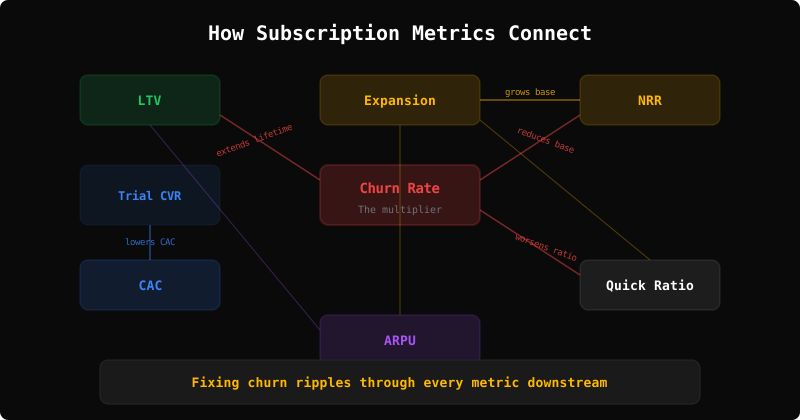
CAC feeds into LTV:CAC and Payback Period. If CAC goes up, both worsen — unless LTV rises too.
Churn Rate feeds into LTV, NRR, and Quick Ratio. A 1-point reduction in monthly churn ripples through every downstream metric. It extends lifetime (LTV up), improves the denominator of your Quick Ratio, and directly boosts NRR.
ARPU feeds into LTV and Payback Period. Higher ARPU means faster payback and higher lifetime value — even if churn stays the same.
Expansion Revenue feeds into NRR, Quick Ratio, and ARPU. More expansion revenue improves NRR (existing base grows), improves Quick Ratio numerator, and pulls ARPU up over time.
Trial Conversion feeds into CAC. A higher trial conversion rate means more subscribers per dollar of marketing spend, which effectively lowers CAC.
This is why I keep saying: most subscription businesses don't have a traffic problem. They have a monetization problem. Fixing churn, improving ARPU, or building expansion paths compounds across the entire system. Adding more traffic only affects one input.
The Metrics Dashboard That Actually Works
Instead of tracking 30 metrics in a sprawling dashboard, here's the dashboard I recommend:
Weekly Check (5 minutes)
| Metric | What You're Looking For |
|---|---|
| MRR | Trending up? By how much? |
| Net new MRR | Positive and growing? |
| Churned MRR this week | Any spikes? Any patterns? |
Monthly Review (30 minutes)
| Metric | What You're Looking For |
|---|---|
| Monthly churn rate (customer + revenue) | Trending down? |
| NRR | Above 100%? Improving? |
| Trial conversion rate | Stable or improving? |
| ARPU | Flat, up, or down? |
| Quick Ratio | Above 2.0? |
Quarterly Deep Dive (2 hours)
| Metric | What You're Looking For |
|---|---|
| LTV by segment | Which customers are most valuable? |
| CAC by channel | Which acquisition channels produce the best LTV:CAC? |
| CAC payback period | Under 12 months? |
| Expansion Revenue % | Growing? What's driving it? |
| Churn by cohort | Are newer cohorts retaining better? |
The weekly check tells you if something broke. The monthly review tells you if you're moving in the right direction. The quarterly deep dive tells you where the biggest opportunities are.
Common Mistakes I See With Subscription Metrics
Mistake 1: Tracking Vanity Metrics
Cumulative signups, page views, social followers, "total registered users" — these are vanity metrics. They go up and to the right because they're cumulative. They don't tell you if the business is healthy.
The subscription metrics that matter are rates and ratios. Churn rate, not "cumulative signups." Trial conversion rate, not "total trials started." LTV:CAC, not "lifetime gross revenue."
Mistake 2: Blending Everything Together
Your blended churn rate hides the fact that enterprise customers churn at 1% and SMB customers churn at 7%. Your blended CAC hides that organic costs $50 and paid costs $600. Your blended ARPU hides that annual subscribers are worth 3x monthly ones.
Segment every metric by plan, channel, cohort, and customer type. The segments tell the story. The blend tells you nothing actionable.
Mistake 3: Ignoring How Metrics Change Over Time
A snapshot of your metrics is useful. The trend is 10x more useful. Churn at 4% isn't inherently good or bad — but churn moving from 3% to 4% over three months is a clear signal. ARPU of $45 is just a number. ARPU declining from $52 to $45 over a year means your pricing or customer mix is degrading.
Always look at the trend line, not just the current value.
Mistake 4: Optimizing One Metric in Isolation
I've seen businesses slash churn by making it nearly impossible to cancel — and destroy their brand reputation in the process. I've seen others cut CAC by eliminating paid channels entirely — and watch growth stall. I've seen price increases that raised ARPU while quietly increasing churn.
Metrics are a system. When you pull one lever, watch what happens to the others.
Mistake 5: Acting on Noisy Data
One large customer cancelling can swing your monthly churn rate dramatically. A single enterprise deal closing can make a month's MRR look incredible. A promotion can distort trial conversion for a quarter.
Use trailing averages (3-month or 12-month) for decision-making. Single-month data points are for awareness. Trends are for action.
FAQ
What are the most important metrics for a subscription business?
The three metrics I'd prioritize are churn rate (how fast you're losing subscribers), NRR (whether your existing base is growing or shrinking), and LTV:CAC ratio (whether your growth economics are sustainable). These three, together, tell you if the business is healthy. Everything else is a deeper diagnostic that helps you understand why.
How many metrics should I track?
Track 10. Act on 2-3 at any given time. The 10 metrics in this guide cover the full picture of a subscription business. But trying to improve all 10 simultaneously is a recipe for spreading too thin. Pick the 2-3 that are most off-target for your stage and focus there until they improve.
What's the difference between customer churn and revenue churn?
Customer churn counts the number of subscribers who leave. Revenue churn measures the dollar value of what you lost. They can tell very different stories. Losing 100 subscribers at $10/month (customer churn: high) is a very different problem than losing 10 subscribers at $1,000/month (customer churn: low, revenue impact: high). Always make decisions based on revenue churn.
What's a good LTV:CAC ratio?
The standard benchmark is 3:1 — for every dollar spent acquiring a customer, you earn three dollars over their lifetime. Below 3:1, you're spending too much relative to what customers are worth. Above 5:1, you're likely underinvesting in growth. But always check the absolute numbers and payback period alongside the ratio.
How do I calculate these metrics if I'm just starting out?
Start with what you have. If you're pre-revenue, focus on trial conversion rate and first-month churn — those tell you if the product delivers value. Once you have 3-6 months of data, calculate MRR, churn rate, and ARPU. After 6-12 months, you'll have enough history for LTV, NRR, and cohort analysis. Don't wait for perfect data to start tracking. Imperfect data you act on beats perfect data you don't have.
What's the Quick Ratio and why does it matter?
Quick Ratio = (New MRR + Expansion MRR) / (Churned MRR + Contraction MRR). It measures growth efficiency — how much revenue you're adding for every dollar you lose. A Quick Ratio of 4.0+ means you're adding $4 for every $1 lost. Below 1.0 means you're shrinking. It's useful because it combines acquisition and retention into a single number, making it easy to spot whether growth is healthy or just covering up churn.
How often should I review my metrics?
Weekly for MRR and churn (5-minute check for anomalies). Monthly for the full dashboard — churn, NRR, trial conversion, ARPU, Quick Ratio. Quarterly for deep dives — LTV by segment, CAC by channel, expansion revenue trends, cohort analysis. The cadence matters more than the exact metrics. Consistency reveals trends; sporadic checking misses them.
What are the key subscription business metrics?
The key subscription business metrics fall into four layers: scoreboard metrics (MRR/ARR, NRR), lever metrics (churn rate, LTV, expansion revenue, ARPU), input metrics (CAC, CAC payback, trial conversion rate), and the verdict metric (Quick Ratio). The specific metrics that matter most depend on your stage — early-stage businesses should focus on trial conversion and first-month churn, growth-stage on LTV:CAC and churn rate, and at scale on NRR, Quick Ratio, and expansion revenue percentage.
My MRR is growing but churn is also increasing. What should I do?
This is the most dangerous pattern in subscription businesses. Growing MRR can mask rising churn because new subscriber revenue temporarily offsets the losses. But churn compounds. Today's rising churn becomes tomorrow's flattening MRR and next quarter's decline. Fix churn now, while you have the growth to absorb the investment. Start with involuntary churn fixes (highest ROI) and add a cancellation flow with pause options.
What to Do Next
If you've read this far, you probably have a clearer sense of which metrics deserve your attention — and which ones have been either ignored or misunderstood.
Here's my recommendation:
- Pick your stage from the hierarchy above and identify the 2-3 metrics that matter most right now.
- Decompose your MRR. Break it into new, expansion, contraction, churned, and reactivation. The components tell you where the problems live.
- Segment everything. Your blended numbers are hiding the signal. Break metrics down by plan, channel, and cohort.
- Fix the biggest leak first. Not the most interesting metric. The one that's costing you the most revenue.
If you want a structured way to find where your biggest revenue opportunities are hiding — across pricing, packaging, conversion, retention, and expansion — I built a free self-assessment that covers all eight revenue leak categories.
Take the Subscription Revenue Leak Audit -->
52 checklist items. 10 minutes. Shows you exactly where you're leaving money on the table.

Dan Layfield
Dan ran growth at Codecademy, scaling ARR from $10M to $55M before the company was acquired for $525M. He now advises subscription businesses on pricing, retention, and revenue optimization.
Work with Dan →Related Guides
The Subscription Model Guide: From Setup to Monetization
Go beyond "pick a pricing model." This guide covers what actually matters: making your subscription business profitable through pricing, packaging, and retention.
23 min readSubscription Onboarding: How to Drive Activation in the First 7 Days
Most subscription onboarding is theater. The metric that moves LTV is time to first value — how Superhuman, Headspace, and Notion get users to their "aha moment" fast.
15 min readUpselling in Subscription Businesses: The Revenue You're Leaving on the Table
The best subscription businesses pull 30-40% of new ARR from existing customers. Learn the triggers, timing, and tactics that actually convert.
Get the playbook every Thursday
Weekly strategies for subscription businesses. Real companies, real numbers, tactics you can steal. From the operator who grew Codecademy from $10M to $50M ARR.