Usage-Based Pricing: The Model That's Changing Subscriptions
61% of SaaS companies now use usage-based pricing. Learn how to implement it, what metric to charge on, and when to go hybrid.

Dan Layfield
Growth at Codecademy, $10M → $50M ARR
In This Guide
- Pricing Models at a Glance
- What Is Usage-Based Pricing?
- Why Usage-Based Pricing Works
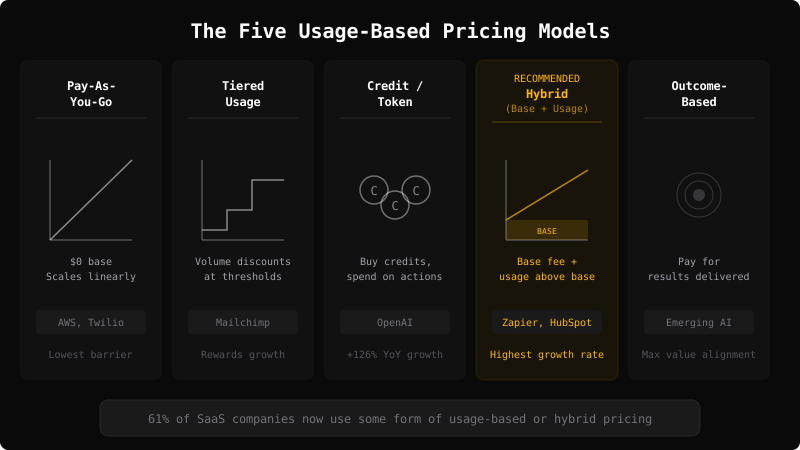
- The Five Usage-Based Pricing Models
- Choosing Your Usage Metric
- When to Use Usage-Based Pricing (And When Not To)
- Implementing Usage-Based Pricing: The Practical Guide
- Usage-Based Pricing and Your Key Metrics
- The Mistakes to Avoid
- FAQ
- What to Do Next
Per-seat pricing isn't the default anymore. It's the legacy.
Per OpenView's State of Usage-Based Pricing, 2nd Edition, 61% of the general SaaS index was projected to have adopted some form of usage-based pricing by the end of 2023, up from 49% the prior year. The credit-based model — where customers buy a pool of credits and spend them on actions — has grown 126% year-over-year: per Kyle Poyar's 2025 State of SaaS Pricing, 79 of the 500 companies in the PricingSaaS Index now offer credit models, up from 35 at end of 2024. This isn't a trend. It's a structural change in how subscription businesses charge, driven by a single failure mode in per-seat pricing.
The failure mode: a 5-person team and a 50-person team can use your product identically — but one pays 10x more. That works until the 50-person team realizes they're overpaying and churns to a usage-based competitor. The customers who care about cost-per-value notice the misalignment first, and they leave first.
Usage-based pricing fixes this by tying revenue to value. As the customer uses more, they pay more. As their business grows, your revenue grows with it. This is why companies like Snowflake (158% NRR at FY2023 peak) and Twilio (~155% NRR historically) post net revenue retention numbers that flat-rate subscription businesses can only dream about.
When I advise subscription businesses on monetization — after running growth at Codecademy from $10M to $50M ARR (2017-2021) — usage-based pricing comes up constantly, especially from companies adding AI features where the underlying compute costs are variable and per-seat doesn't make sense. The question is rarely "should we think about this?" It's "how do we implement it without breaking what works?"
This guide covers that.
Pricing Models at a Glance
| Flat-Rate | Per-Seat | Hybrid (Base + Usage) | Pure Usage | |
|---|---|---|---|---|
| **Best for** | Single-user consumer products | Team collaboration tools | Most B2B SaaS | Infrastructure, APIs, AI inference |
| **Revenue predictability** | Highest | High | Medium-high | Lowest |
| **Expansion mechanism** | Annual upgrade | Add seats | Usage above base + seats + tiers | Customer growth = revenue growth |
| **Typical NRR ceiling** | 100-110% | 105-120% | 110-130% | 130-160% |
| **Billing complexity** | Lowest | Low | Medium | Highest |
| **Customer sensitivity** | "Is it worth the flat fee?" | "How many seats do I need?" | "How much will I actually use?" | "Will I get bill shock?" |
The short answer: Usage-based pricing charges customers in proportion to consumption (API calls, tokens, storage, transactions) instead of a fixed seat or flat fee. There are five model variants — pay-as-you-go, tiered usage, credit/token-based, hybrid (base + usage), and outcome-based — and the right answer for most subscription businesses entering this model is hybrid: keep a base subscription fee for predictability and a revenue floor, then add a usage component for the dimension that scales with customer value. The metric you charge on matters more than the model: it must scale with value, be easy to understand, and be measurable and auditable. Companies that get this right (Snowflake-class) post NRR above 130% because expansion happens automatically; companies that get the metric wrong (charging on what's easy to measure rather than what customers value) trigger bill shock and churn.
What Is Usage-Based Pricing?
Usage-based pricing charges customers based on how much they consume — API calls, storage, transactions, messages, compute hours, tokens, or any other measurable unit of usage.
Instead of "pay $49/month for everything," it's "pay for what you use."
Pure usage-based: No base fee. You only pay when you use the product. AWS and Twilio are the classic examples — $0 if you don't use it, scaling linearly (or with volume tiers) as usage increases.
Hybrid (usage + subscription): A base subscription fee that provides access and a set amount of usage, plus a variable component that scales with consumption beyond the base. This is where the industry is heading — 61% of companies now use some form of hybrid model, and companies using hybrid report the highest median growth rates (21%), outperforming both pure subscription and pure usage models.
Credit/token-based: Customers purchase a pool of credits upfront, then spend them on actions. Each action consumes a specific number of credits. This is increasingly popular for AI products — OpenAI, Anthropic, and most AI SaaS companies use some version of credits or tokens. Credit-based models grew 126% year-over-year, from 35 to 79 companies in one major pricing index.
Why Usage-Based Pricing Works
Revenue Scales With Customer Success
This is the fundamental advantage. In a flat-rate subscription, a customer who gets 10x the value pays the same as one who barely uses the product. Usage-based pricing fixes this — as the customer succeeds, they use more, and revenue grows automatically.
This alignment creates a compounding effect. You're incentivized to make your product stickier and more valuable, because increased usage directly increases revenue. The customer is incentivized to use the product deeply, because they only pay for what they actually use.
Built-In Expansion Revenue
Usage-based pricing is the reason some companies post NRR above 150%. Expansion happens automatically as customers grow — no upsell calls, no upgrade prompts, no sales team nudging people to the next tier. The customer's business grows, their usage grows, and revenue follows.
Compare this to flat-rate or per-seat models where expansion requires an explicit action — upgrading a plan, adding seats, buying add-ons. Each of those is a friction point. Usage-based pricing removes them. More on expansion revenue →
Lower Barrier to Entry
Usage-based pricing lets customers start small and scale up. A startup paying $5/month in API calls is a customer you'd never have acquired at a $99/month minimum. But as that startup grows, they might become a $10,000/month customer.
Snowflake's growth story is exactly this. Companies start with small workloads, prove value, then expand massively — without any contract renegotiation. The pricing model does the selling.
Better Unit Economics Visibility
When you charge per unit of usage, you know exactly what each unit costs you to deliver and what each unit earns. This clarity makes gross margin analysis straightforward and helps you spot customers who are unprofitable at scale.
The Five Usage-Based Pricing Models
Model 1: Pay-As-You-Go
How it works: Customer pays for exactly what they use. No minimums, no commitments. Bill at the end of each period based on actual consumption.
Examples: AWS (compute hours), Twilio (messages sent), Stripe (transactions processed)
Best for: Infrastructure products, APIs, developer tools — products where usage varies dramatically between customers and the cost to deliver scales linearly with usage.
Strength: Lowest barrier to entry. Zero risk for the customer to try.
Weakness: Revenue is completely unpredictable. A slow month for your customers is a slow month for you. No base revenue to count on.
Model 2: Tiered Usage
How it works: Usage is grouped into tiers with different per-unit prices. Higher tiers get lower unit costs. "First 1,000 API calls at $0.01, next 10,000 at $0.008, above 10,000 at $0.005."
Examples: Many API-based products, cloud storage providers, email platforms (Mailchimp charges per contacts tier)
Best for: Products where you want to incentivize high usage while maintaining margin on smaller accounts.
Strength: Volume discounts encourage growth. Customers feel rewarded for increasing usage.
Weakness: Customers can get confused about which tier they're in. Billing complexity increases.
Model 3: Credit/Token-Based
How it works: Customers buy credits upfront (or subscribe to a monthly credit allocation). Each action consumes credits. Different actions can consume different amounts.
The insider subscription playbook
One tactic that moves the needle — every Thursday
Real companies, real numbers, strategies you can steal. From the operator who grew Codecademy from $10M to $50M ARR.
Examples: OpenAI (tokens), most AI products, Shutterstock (downloads), some analytics platforms
Best for: Products with multiple types of actions at different cost levels. Especially popular for AI products where different models or operations have different compute costs.
Strength: Abstracts away complex unit costs behind a simple currency. Customers understand "I have 1,000 credits" better than "I have 4.2 million tokens at variable rates."
Weakness: Credits can feel like casino chips — a layer of abstraction that makes it harder to evaluate cost. If credit pricing doesn't map to perceived value, customers feel cheated.
Model 4: Hybrid (Base + Usage)
How it works: A flat monthly subscription fee provides a base level of access and included usage. Usage above the included amount is charged incrementally.
Examples: Zapier (plan includes X tasks, pay per additional task), HubSpot (platform fee + contacts), most modern SaaS with usage components
Best for: Most subscription businesses. Provides revenue predictability (base fee) with expansion upside (usage component). This is the model the industry is converging on.
Strength: Best of both worlds. Customers get cost predictability. You get a revenue floor plus organic expansion. Companies using hybrid report the highest growth rates.
Weakness: More complex to communicate on a pricing page. Requires clear explanation of what's included vs. what's incremental.
Model 5: Outcome-Based
How it works: Customer pays based on the results delivered, not the usage consumed. "Pay per qualified lead generated," "pay per support ticket resolved," "pay per successful transaction."
Examples: Emerging in AI — some AI sales tools charge per meeting booked, some AI support tools charge per ticket resolved
Best for: Products where you can clearly measure and attribute outcomes. The ultimate value alignment — customer literally pays for results.
Strength: Maximum value alignment. Customer never questions whether they're getting ROI because they only pay when they get it.
Weakness: Extremely hard to implement. Outcome attribution is messy. Who gets credit when a lead converts — the AI, the salesperson, or the content? Most "outcome-based" pricing is still aspirational.
Choosing Your Usage Metric
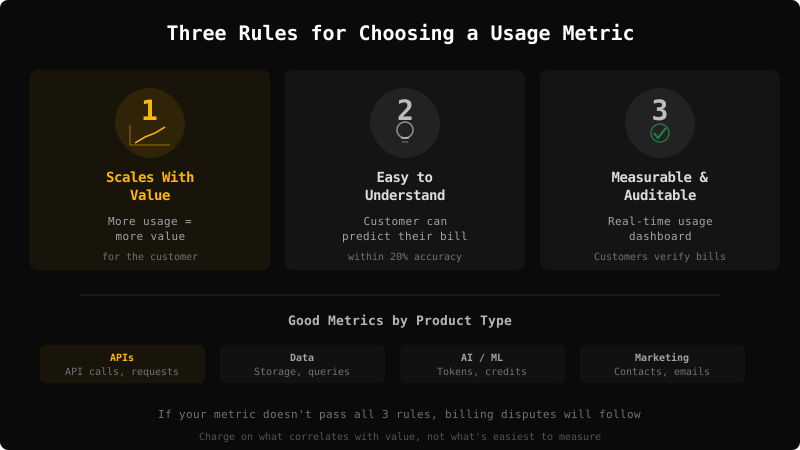
The metric you charge on is the most important decision in usage-based pricing. Get it wrong and the entire model feels misaligned.
The Three Rules for a Good Usage Metric
1. It scales with value. As the customer gets more value, the metric goes up. API calls work for a communications platform because more calls = more customer communication = more value. Storage works for a data platform because more storage = more data = more value.
2. The customer can understand and predict it. If a customer can't estimate their monthly bill within 20%, the metric is too opaque. "Messages sent" is predictable. "Compute units" is not — unless your customers are engineers. If you're selling to non-technical buyers, abstract the metric into something intuitive or use credits.
3. It's measurable and auditable. The customer should be able to see their usage in real time and verify it matches their bill. Usage dashboards aren't optional — they're required infrastructure.
Common Metrics by Product Type
| Product Type | Common Metrics | Why It Works |
|---|---|---|
| APIs / Developer tools | API calls, requests, events | Direct measure of integration usage |
| Data / Analytics | Queries, rows scanned, storage | Scales with data volume |
| Communication | Messages, minutes, contacts | Scales with audience size |
| AI / ML | Tokens, credits, model calls | Maps to compute cost and output volume |
| Infrastructure | Compute hours, bandwidth, storage | Scales with workload |
| Marketing / CRM | Contacts, emails sent, active users | Scales with business growth |
| Payments | Transactions, GMV | Scales with business volume |
The Value Metric vs. Usage Metric Trap
Here's where companies get this wrong: they charge on what's easy to measure (the usage metric) instead of what the customer values (the value metric).
Example: An AI customer support tool. The usage metric might be "messages processed." But the customer doesn't care about messages — they care about tickets resolved. Charging per message penalizes complex issues that require more back-and-forth. Charging per resolved ticket aligns with what the customer actually values.
Map your value metric first (what does the customer actually care about?), then find a usage metric that correlates with it. The closer the two align, the healthier the pricing model.
When to Use Usage-Based Pricing (And When Not To)
Strong Signals for Usage-Based
Usage varies 10x+ between customers. If your smallest customer uses 100 units and your largest uses 100,000, a single flat price doesn't work. You're either overcharging the small customer or massively undercharging the large one.
Your costs scale with usage. If every API call, every compute cycle, every transaction costs you money, tying revenue to usage protects your margins. This is especially relevant for AI products where inference costs are real and variable.
Customer success equals more usage. If successful customers naturally use your product more over time, usage-based pricing turns customer success into revenue growth automatically.
You're adding AI features with variable costs. AI compute costs are unpredictable. A per-seat price that includes unlimited AI usage can destroy your margins when a power user sends 10,000 queries. Usage-based pricing for AI components protects you.
Signals to Stay With Flat-Rate or Per-Seat
Usage is roughly uniform across customers. If everyone uses the product about the same amount, usage-based pricing adds billing complexity without capturing meaningful revenue differences.
Your customers hate bill unpredictability. Some markets — especially SMB and consumer — strongly prefer knowing exactly what they'll pay. A project management tool for freelancers probably shouldn't charge per task created.
You can't meter usage cleanly. If you can't reliably measure and display usage in real time, don't charge for it. Billing disputes kill trust faster than almost anything else.
Your product's value is access, not volume. A news subscription, a community membership, an all-you-can-eat content library — the value is having access, not consuming units. Usage-based doesn't fit.
The Hybrid Default
For most subscription businesses exploring usage-based pricing for the first time, hybrid is the right starting point. Keep a base subscription fee for predictability and a revenue floor, then add a usage component for the dimension that scales with value.
This lets you test usage-based pricing on one axis without overhauling your entire pricing model. If it works, you can shift more of the price into usage over time.
Implementing Usage-Based Pricing: The Practical Guide
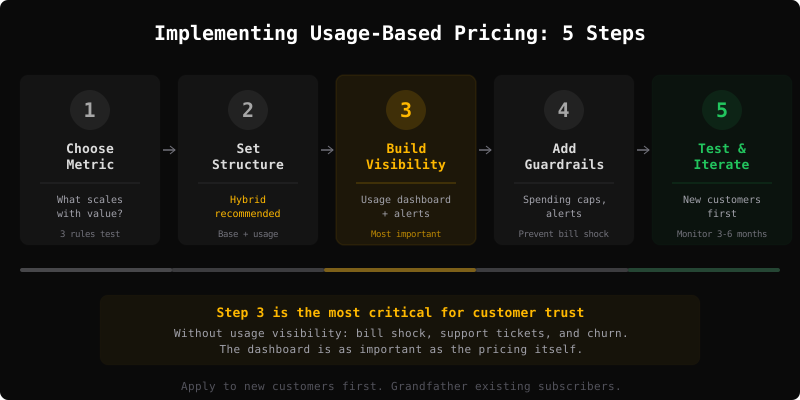
Step 1: Choose Your Metric (See Above)
Identify the metric that scales with value, is understandable to customers, and is technically measurable.
Step 2: Set the Pricing Structure
For hybrid (recommended starting point):
Monthly fee = Base platform fee + (Usage above included amount × Per-unit rate)

Example:
$99/month base (includes 10,000 API calls)
+ $0.005 per additional API call
For tiered usage:
Tier 1: 0-1,000 units    → $X/unit
Tier 2: 1,001-10,000     → $Y/unit (lower per-unit)
Tier 3: 10,001+          → $Z/unit (lowest per-unit)
For credits:
Monthly plan includes X credits
Additional credits available in packs
Each action consumes N credits (varies by action type)
Step 3: Build Usage Visibility
This is non-negotiable. Customers need:
- Real-time usage dashboard — How much have I used this billing cycle?
- Spend tracking — What's my estimated bill right now?
- Usage alerts — Notify me at 50%, 80%, 100% of my included usage
- Historical trends — How does this month compare to previous months?
Without usage visibility, you'll get bill shock complaints, support tickets, and churn. The dashboard is as important as the pricing itself.
Step 4: Set Guardrails Against Bill Shock
Bill shock — when customers receive an unexpectedly high bill — is the #1 killer of usage-based pricing models. Prevent it:
- Spending caps. Let customers set a maximum monthly spend. When they hit it, either throttle usage or pause billing (their choice).
- Usage alerts. Automated emails at 50%, 80%, and 100% of typical usage. "You're on track to spend 40% more than last month."
- Overage review periods. Before billing overages, send a summary email and give 48 hours to review before the charge processes.
- Volume discount tiers. As usage increases, per-unit cost decreases. This softens the impact of high-usage months.
Step 5: Grandfather and Test
Same principle as any pricing change: apply usage-based pricing to new customers first. Existing customers stay on their current model.
Monitor for 3-6 months:
- Is average revenue per customer higher or lower?
- Is conversion from free/trial different?
- How does churn compare to the flat-rate cohort?
- Are customers hitting bill shock? (Support tickets about pricing are the signal.)
- Is NRR improving? (The key metric for usage-based models.)
If the data is positive, begin migrating existing customers — with generous notice and clear communication about what's changing and why.
Usage-Based Pricing and Your Key Metrics
NRR Gets Supercharged
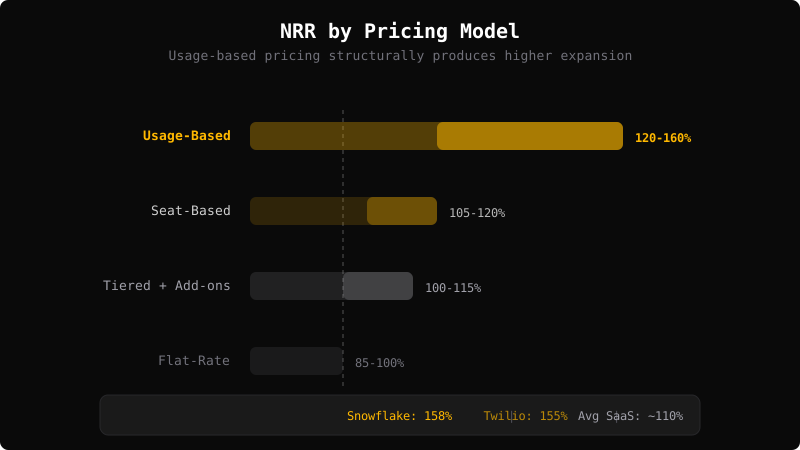
Usage-based pricing's biggest impact is on net revenue retention. When revenue expands automatically with usage growth, NRR climbs without any sales effort. This is why:
- Companies with usage-based components average NRR of 120%+
- Pure usage-based leaders hit 140-160% NRR (Snowflake: 158%, Twilio: 155%)
- Pure subscription models typically range from 100-115% NRR
The difference is structural. In a per-seat model, expansion requires someone to consciously add seats. In usage-based, expansion happens every time the customer does their job.
LTV Changes Shape
Customer lifetime value in usage-based models isn't a fixed number — it grows over time as the customer's usage increases. The LTV curve is upward-sloping, not flat. This means early months underrepresent the customer's eventual value, which has implications for acquisition spending.
If your typical customer's monthly spend doubles between month 1 and month 12, your LTV:CAC calculation should account for this ramp, not just the starting ARPU.
Churn Gets Nuanced
Churn in usage-based models is more complex than binary "stayed or left." A customer who reduces usage by 50% but doesn't cancel hasn't churned — but you've lost half the revenue. This is why revenue churn (not logo churn) is the metric that matters for usage-based businesses.
Track contraction separately: customers who remain active but spend less. High contraction is a warning sign even if nobody's cancelling.
The Mistakes to Avoid
Choosing the Wrong Metric
If your usage metric doesn't correlate with customer value, everything breaks. Customers feel overcharged when usage is high but value is moderate. Or they pay nothing despite getting enormous value. Test the correlation before committing.
Making Bills Unpredictable
If customers can't estimate their bill within 20%, you have a predictability problem. Fix it with dashboards, alerts, and spending caps — or simplify the metric.
Ignoring the Pricing Page
Usage-based pricing is harder to communicate than "$49/month." Your pricing page needs to clearly explain: what the metric is, what's included in the base, what the per-unit cost is above the base, and what a typical customer pays. Include a cost estimator or calculator if possible.
Going Pure Usage When Hybrid Works Better
Pure usage-based pricing has zero revenue floor. If customers reduce usage — seasonality, economic downturn, internal changes — your revenue drops immediately. Hybrid gives you a base to rely on.
Underinvesting in Billing Infrastructure
Usage-based pricing requires real-time metering, usage tracking, and flexible billing. If your billing system can't handle this, you'll have billing errors, support escalations, and trust issues. Invest in the infrastructure or use a billing platform (Stripe Billing, Metronome, Orb, Lago, Togai) that handles usage metering natively.
FAQ
What is usage-based pricing?
Usage-based pricing charges customers based on how much they consume — API calls, storage, transactions, messages, tokens, or any other measurable unit. Instead of a fixed monthly fee regardless of usage, the customer pays in proportion to how much value they extract. It's the dominant pricing trend in SaaS right now, with 61% of companies using some form of usage-based or hybrid model.
What's the difference between usage-based and subscription pricing?
Subscription pricing charges a fixed recurring fee for access. Usage-based pricing charges based on consumption. In practice, most companies are converging on hybrid models that combine both: a base subscription fee for access and predictability, plus a usage component that scales with consumption. The hybrid approach captures the best of each — predictable revenue floor plus organic expansion.
Is usage-based pricing better than per-seat?
It depends on your product. If value scales with the number of users (collaboration tools, team communication), per-seat makes sense. If value scales with how much the product is used rather than how many people use it, usage-based is better aligned. The test: does adding another seat genuinely deliver proportionally more value? If not, per-seat may be costing you customers.
How do I prevent bill shock with usage-based pricing?
Four tactics: spending caps that let customers set a maximum monthly charge, automated usage alerts at 50%, 80%, and 100% thresholds, real-time usage dashboards so customers always know where they stand, and volume discount tiers that reduce per-unit cost as usage increases. The goal is zero surprises on the invoice.
What's the best usage metric to charge on?
The best metric scales with value (more usage = more value for the customer), is easy to understand and predict, and is technically measurable and auditable. Common choices: API calls for developer tools, contacts or messages for communication/marketing platforms, storage or queries for data products, and tokens or credits for AI products. Avoid metrics that are easy to measure but don't correlate with what the customer actually values.
Should I switch my entire pricing to usage-based?
Probably not all at once. Start with a hybrid model — keep your base subscription fee and add a usage component for the dimension that scales most naturally. Apply to new customers only, monitor for 3-6 months, and iterate. This lets you test the model without disrupting existing revenue. If the data shows higher NRR and better customer fit, shift more of the price into usage over time.
What to Do Next
If your product's value scales with usage but your pricing is flat-rate or per-seat, you're leaving expansion revenue on the table. Usage-based pricing — especially the hybrid approach — aligns your recurring revenue with your customers' success.
But pricing is one piece of a larger monetization puzzle. To see the full picture of where your subscription business might be leaking revenue — across pricing, packaging, conversion, checkout, retention, and expansion — I built a free diagnostic.
Take the Subscription Revenue Leak Audit →
52 checklist items across 8 revenue leak categories. Takes 10 minutes. Pricing is Leak #1 — and for many businesses, shifting to a usage-based or hybrid model is the single highest-impact change they can make.

Dan Layfield
Dan ran growth at Codecademy, scaling ARR from $10M to $55M before the company was acquired for $525M. He now advises subscription businesses on pricing, retention, and revenue optimization.
Work with Dan →Related Guides
Value-Based Pricing for Subscription Businesses: A Practitioner's Guide
Most subscription businesses set pricing once and forget it. Learn how to price based on what customers actually value — with frameworks and steps to do it right.
24 min readSubscription Win-Back: How to Reactivate Lapsed Subscribers
Most subscription businesses ignore win-back. Lapsed subscribers cost 5-7x less to reactivate than acquiring net-new — and Recurly says 1 in 4 new subs are returns.
18 min readAnnual Churn Rate: Formula, Benchmarks, and How to Calculate It
If you multiply monthly churn by 12 you overstate annual churn by ~50%. Here's the right formula, real-company benchmarks, and the conversion math operators get wrong.
Get the playbook every Thursday
Weekly strategies for subscription businesses. Real companies, real numbers, tactics you can steal. From the operator who grew Codecademy from $10M to $50M ARR.