Subscription Win-Back: How to Reactivate Lapsed Subscribers
Most subscription businesses ignore win-back. Lapsed subscribers cost 5-7x less to reactivate than acquiring net-new — and Recurly says 1 in 4 new subs are returns.

Dan Layfield
Growth at Codecademy, $10M → $50M ARR
In This Guide
- Win-Back vs New Acquisition at a Glance
- What Is a Win-Back Campaign?
- When to Send Win-Back Emails (Timing Matters More Than Offer)
- Win-Back Email Sequences: 3-Touch, 5-Touch, 7-Touch
- What Offer Works for Win-Back (And What Doesn't)
- Win-Back Reactivation Rate Benchmarks
- Real Save-Flow Examples (and Why They're Not Win-Back)
- Win-Back vs Cancellation Flow vs Dunning: How They Fit Together
- How to Segment Your Lapsed Subscribers
- When NOT to Run Win-Back Campaigns
- FAQ
- What to Do Next
Most subscription businesses spend 60% of their marketing budget acquiring net-new customers and 0% reactivating churned ones. That's backwards.
Your churned subscriber list is the most qualified audience you have access to. They've shown intent, used the product, and given you their payment details. Ignoring them is leaving the easiest growth on the table — and the data backs that up. According to Recurly's 2026 State of Subscriptions report, former subscribers now drive nearly 1 in 4 new sign-ups across the 2,200 merchants and 76 million subscribers they analyzed. Reactivation isn't a hedge against churn — it's a primary acquisition channel.
I worked through this exact lever at Codecademy during the run from $10M to $50M in ARR, and I've audited a dozen subscription businesses since. The pattern is consistent: either no win-back at all, or one "we miss you" email sent two weeks after cancellation with a generic 30% off and never followed up. Both leave money on the table. The fix isn't a bigger discount — it's the right offer at the right cadence, segmented by why the subscriber left.
This guide covers the timing framework, three sequence options (3-touch, 5-touch, 7-touch), what offer matches each cancel reason, what reactivation rates to expect, and when not to run win-back at all.
Win-Back vs New Acquisition at a Glance
| New Acquisition | Win-Back | |
|---|---|---|
| **CAC** | $40-$400+ depending on channel | 5-7x cheaper per recovered subscriber ([Invesp](https://www.invespcro.com/blog/customer-acquisition-retention/)) |
| **Intent signal** | Inferred from clicks, ads, content | Proven — they already paid you once |
| **Data available** | Cold / partial (email + maybe firmographics) | Full payment history, usage, exit-survey reason, plan tier |
| **Conversion rate** | 2-5% landing-page conversion typical | 5-15% reactivation typical; 14.7% for optimized 4-email sequences ([Klaviyo 2025 benchmark](https://community.klaviyo.com/marketing-30/winback-flow-benchmarks-5148)) |
| **Time to revenue** | Weeks to months (trial → paid → ramp) | Immediate — one-click resubscribe |
| **Brand risk** | Neutral | Low if cadence is respectful; high if you spam ex-subscribers daily |
The short answer: Win-back is the cheapest acquisition channel in your subscription business and most operators ignore it. A 4-email sequence at days 7, 30, 60, and 90 — segmented by cancel reason and with the offer matched to the reason — reactivates 10-15% of lapsed subscribers at roughly one-fifth the CAC of cold acquisition. Recurly's 2026 data shows 1 in 4 net-new subscriptions now come from returning customers. The biggest mistake is sending one generic "we miss you" email with a blanket discount and calling it done. The second biggest is running win-back for a few weeks then abandoning it. Win-back is an always-on system, not a campaign.
What Is a Win-Back Campaign?
A few terms to get straight before the rest of the playbook makes sense — these are the building blocks for the sequences and segments below.
Win-back campaign: A sequence of emails (or SMS, push, paid retargeting) sent to a subscriber after their subscription has ended, with the goal of getting them to resubscribe. Distinct from dunning, which targets involuntary churn during the grace period before cancellation.
Reactivation: A lapsed subscriber returning as a paying customer. The headline metric for any win-back program. Calculated as (churned subscribers who resubscribe / total churned subscribers targeted) × 100 (Optimove).
Re-engagement: A softer cousin of win-back — pinging active-but-disengaged users (haven't logged in for 30 days, haven't opened the app, streak broken) before they actually cancel. Duolingo's "your owl is sad" push notifications are re-engagement. A "come back for 50% off" email three months after cancellation is win-back.
Lapsed subscriber: Anyone who was a paying subscriber and is no longer one. Includes both voluntary churn (clicked cancel) and involuntary churn (payment failed past the dunning window). Most win-back programs ignore involuntary lapsers, which is a mistake — they convert at higher rates because they didn't choose to leave.
Dormant user: Free or trial users who stopped engaging without ever paying. Out of scope for win-back proper, but the same sequence architecture works on them.
When to Send Win-Back Emails (Timing Matters More Than Offer)
The single biggest mistake in win-back is wrong timing. Send too early and you look desperate; send too late and the brand has gone cold. Most consumer subscription businesses converge on the same framework: 7 / 30 / 90 days.
Here's why each touch lands where it does, and what it accomplishes.
Day 7: The "Did You Mean To Do That?" Touch
The Day 7 email catches users who cancelled by accident, got distracted mid-trial, or had a one-time billing dispute. No discount, no pressure — just a clean confirmation and an easy resubscribe link.
This touch matters because some "cancellations" aren't really cancellations. They're moments of friction. The subscriber meant to update their card and clicked the wrong button. They cancelled to test if you'd send a save offer (they're now waiting for it). Their company card got recycled and they didn't realize the auto-renewal turned off.
At Day 7, your data is still warm — they remember what your product does, they know their login, their data is intact. A simple "click here to resume right where you left off" reactivates the easiest 2-4% of all cancellations.
Day 30: The "Here's What You're Missing" Touch
By Day 30, the easy reactivations are gone. The remaining lapsed subscribers chose to leave and have spent a month not using your product. The question shifts from "did you mean to?" to "have you actually been getting along without us?"
This is the touch where you remind them what they had. Specific data beats generic copy: their progress (Codecademy showed courses completed), their saved content (Spotify shows playlists they made), their habit streak (Duolingo shows the streak they broke), their cost savings (Mint showed total saved while using the product).
If you're going to offer a discount in your win-back program, Day 30 is when most operators do it. A modest, time-limited offer — 25-50% off the first month back, expiring in 7 days — gives the subscriber a concrete reason to act now rather than later.
Day 60-90: The "Last Call / What Changed" Touch
By Day 60-90, the lapsed subscriber has fully moved on. They've either solved the problem elsewhere or decided they didn't really need a solution. To win them back at this point, you need a reason — something must have changed since they left.
Effective Day 90 touches:
- A new feature they specifically asked about. If they cited "missing feature X" on the exit survey and you've shipped it, this is a high-converting trigger.
- A new content release. "Three new courses since you left" works for content-heavy products.
- A price drop or new plan tier. "We launched a lighter $5/mo plan based on feedback from members like you" gives former subscribers a face-saving way back in.
- A genuine personal note (B2B and high-ARPU only — see the 5-touch sequence below).
If none of those apply, send a clean "your data will be deleted in 30 days — reactivate to keep everything" message. That's an honest last-chance trigger, not a contrived one.
After Day 90: Stop, Then Reset
After three touches with no response, stop. Continuing to email at Day 120, 150, 180 doesn't recover meaningful additional revenue and it tanks your deliverability. Recurly's data suggests stopping after 3-4 contact attempts to preserve sender reputation.
Quarantine non-responders for 6-12 months, then either drop them entirely or re-enter them into a fresh win-back sequence triggered by a real product event (major feature launch, pricing change, content drop). A 6-month-cold subscriber being told "we miss you" again is just noise. A 6-month-cold subscriber being told "the thing you asked for is finally here" is a genuine signal.
Win-Back Email Sequences: 3-Touch, 5-Touch, 7-Touch
There is no single "right" win-back sequence — the right one depends on your ARPU, your audience size, and how much segmentation infrastructure you have. Below are three sequences that all work, in order of complexity.
The 3-Touch Sequence (Start Here)
Best for: Businesses under 10,000 subscribers, single product, limited segmentation.
| Day | Subject Line | Offer |
|---|---|---|
| **Day 7** | "Did you mean to cancel?" | None — just a clean resubscribe link |
| **Day 30** | "Here's what's been happening at [Product]" | 30% off first month back, 7-day expiry |
| **Day 90** | "Your account closes in 30 days" | Reactivation + "keep your data" framing |
This is the minimum viable win-back program. Three emails, no segmentation, runs as a single Klaviyo / Customer.io / Iterable flow. You can ship it in an afternoon. Expect 6-10% reactivation if your subject lines are competent and your offer is real.
The 5-Touch Sequence (Once You Have Exit Survey Data)
Best for: Businesses with a cancellation flow capturing exit-survey reasons, 10K-100K lapsed subscribers, and the ability to send different content per segment.
| Day | Subject Line | Offer (Reason-Specific) |
|---|---|---|
| **Day 3** | "Quick fix for [their stated reason]" | None — content addressing their exit reason |
| **Day 14** | "Did we get it right?" | Direct ask: "What would bring you back?" — open-text reply |
| **Day 30** | "[Specific change since you left]" | Product update tied to their stated reason |
| **Day 60** | "An honest offer" | 50% off 2 months, time-limited, only sent to "too expensive" segment |
| **Day 90** | "Your data, before it's gone" | Last-call + reactivation link |
The 5-touch sequence beats the 3-touch primarily because it routes by exit reason. A subscriber who left because of price gets a different sequence than one who left because of a missing feature. The "too expensive" segment is the only one that gets a discount — discounts for everyone train your subscriber base to game the system and cap your ARPU on return.
Expect 10-15% reactivation with this sequence if your exit-survey data is good. If you don't have exit-survey data yet, start by building the cancellation flow — it's the prerequisite.
The 7-Touch Sequence (B2B and High-ARPU Only)
Best for: B2B SaaS, B2C subscriptions over $40/month, businesses with a sales-assist motion or CSMs.
| Day | Touch | Channel | Sent By |
|---|---|---|---|
| **Day 1** | "Cancellation confirmed — your data is safe" | Automated | |
| **Day 7** | "Quick question about your cancellation" | Looks-personal from a real human | |
| **Day 14** | "Have 15 minutes? I'd like to understand what we missed" | Account manager or founder | |
| **Day 30** | "[Feature you mentioned] just shipped" | Product-led, tied to exit reason | |
| **Day 60** | "Quick LinkedIn / phone check-in" | LinkedIn DM or phone | Human |
| **Day 90** | "An offer that won't repeat" | Custom — discount, contract flexibility, or a feature gate lift | |
| **Day 180** | "We rebuilt [thing] — worth another look?" | Major product update tied to original objection |
High-ARPU win-back works differently because the per-recovery economics support human time. Spending 30 minutes of a founder's day to recover a $5,000/year customer pays back instantly. Spending 30 seconds of a marketer's time to recover a $99/year customer barely breaks even.
The insider subscription playbook
One tactic that moves the needle — every Thursday
Real companies, real numbers, strategies you can steal. From the operator who grew Codecademy from $10M to $50M ARR.
The 7-touch sequence is heavier and slower, but expect 15-25% reactivation in B2B contexts — substantially higher because the buying motion involves multiple stakeholders and longer evaluation cycles. A six-month gap before reactivation is normal in B2B.
What Offer Works for Win-Back (And What Doesn't)
The conventional answer is "offer a discount." The contrarian answer — and the right one for most subscription businesses — is the offer should match why they left. Same principle as the cancellation flow save offer: a 50% discount does nothing for someone who cancelled because they were too busy to use the product.
The Offer Matrix
| Why They Left | Best Win-Back Offer | Why It Works |
|---|---|---|
| **Too expensive** | Time-limited discount (30-50% off 1-2 months) OR a steeper [annual plan discount](/guides/annual-vs-monthly-pricing) | Addresses the actual objection — price |
| **Not using it enough** | Reminder of what they're missing + a 30-day no-discount resubscribe | A discount doesn't fix usage. A nudge + frictionless return does. |
| **Missing a feature** | Notification when feature ships — *only* if it actually shipped | Genuine product update is the highest-converting trigger |
| **Switching to competitor** | A comparison-flavored email + content showing differentiation | Low save rate, but data is gold for product roadmap |
| **Temporary break / life change** | Soft "we're here when you're ready" + easy resume | Patience converts. Pressure burns the relationship. |
| **Achieved my goal** | Referral incentive + alumni-tier offering (if applicable) | Don't push reactivation — turn them into referral sources |
| **No stated reason** | Default 3-touch sequence with a Day 30 modest discount | Best-guess baseline when you don't have segment data |
The discount-only approach reactivates maybe 5-8% of lapsed subscribers. The reason-matched approach reactivates 10-15% — and the resubscribed users return at full price for everything after the first month back, because the discount was tied to a reason, not a gimme.
Beyond Discounts: Four Underused Levers
1. New feature or content release. A "we just launched X" email to a Day-30+ lapsed subscriber outperforms any discount. Best execution: tie the feature to the exit-survey reason. If they said "missing a feature for [thing]" and you've shipped that feature, the email writes itself.
2. Personal note from a human. "Hey, I noticed you cancelled — anything I can do?" from a founder or CSM. Doesn't scale below ~$30 ARPU, but at higher tiers it's the single highest-converting touch.
3. Plan downgrade. If your product has multiple tiers and they cancelled the premium plan, offer the lighter plan at a discount instead of pushing them back to premium. Captures some revenue, keeps the relationship.
4. Pause-to-reactivate. If they cancelled but never used pause, offer pause as a "soft restart" instead of full reactivation. Lower friction than committing again, and Recurly's data shows 75% of paused subscribers eventually return.
Win-Back Reactivation Rate Benchmarks
Reactivation rates vary dramatically by industry, ARPU, and how aggressive your churn definition is. Here's what to expect across categories. (Treat as ranges, not point estimates — these come from blended benchmarks across different platforms.)
| Industry / Segment | Typical Reactivation Rate | Best-in-Class | Source / Context |
|---|---|---|---|
| **Optimized 4-email e-commerce sequence (all verticals)** | 10-15% | 14-18% with segmentation + escalation | [Klaviyo 2025 benchmark](https://community.klaviyo.com/marketing-30/winback-flow-benchmarks-5148) |
| **Single-email win-back (any industry)** | 5-8% | ~6.2% median | [Klaviyo](https://community.klaviyo.com/marketing-30/winback-flow-benchmarks-5148) |
| **B2C streaming / media** | 8-12% | 15%+ with content-trigger | Industry blended |
| **B2C apps (dating, fitness, learning)** | 5-10% | 12-15% if reason-matched | Industry blended |
| **B2B SaaS (mid-market)** | 12-20% | 25%+ with human touch | Industry blended |
| **Subscription box / consumables** | 8-15% | 18-22% with timed product drop | Industry blended |
| **Day 1 after cancellation (iGaming bench)** | 27% reactivate | n/a | [Optimove](https://www.optimove.com/resources/blog/igaming-descending-recovery-curve) |
| **Day 90 after cancellation (iGaming bench)** | 2% reactivate | n/a | [Optimove](https://www.optimove.com/resources/blog/igaming-descending-recovery-curve) |
Two things worth pulling out of that table:
The single-email vs sequence delta is brutal. A one-shot "we miss you" reactivates 5-8%. A 4-email reason-segmented sequence reactivates 10-15%. The marginal email costs you nothing — you've already done the data work. Most subscription businesses still send one email.
Time decay is steep. Optimove's iGaming data shows a Day 1 reactivation rate of 27% collapsing to 2% by Day 90, with predicted future value of returning subscribers dropping 87% over the same window. The Day 7 touch isn't optional — it's where most of the recoverable value lives.
Reactivation Cost vs Acquisition Cost
The other side of the benchmark conversation is cost. The classic figure — repeated across Invesp, HBR, and most CRM vendors — is that acquiring a new customer costs 5-7x more than retaining or reactivating an existing one. Recurly's own copy puts it as "5 to 25 times more" depending on industry.
For a back-of-envelope sanity check: if cold paid-acquisition CAC is $120 and your win-back program costs $5,000/month in marketing automation tooling + design time, you only need to reactivate ~42 subscribers/month to be cheaper than the cold channel. Most subscription businesses with 5,000+ historical subscribers will clear that bar in week one of running the program.
Real Save-Flow Examples (and Why They're Not Win-Back)
Before the examples: a distinction most subscription operators miss. The screenshots below are save flows — what happens at the moment a subscriber clicks "Cancel." True win-back is the email that fires after they leave. Most consumer subscription businesses have invested heavily in save flows because they're a measurable in-product surface owned by product and growth teams. Almost none of them have invested equivalently in post-churn win-back, which is the email sequence we covered in the timing section above.
The gap matters. A great save flow recovers 15-25% of cancel intents in-flow. A great win-back program then recovers another 10-15% of the subscribers the save flow didn't save. Most businesses run the first system and skip the second — leaving roughly a third of recoverable churn on the table.
With that framing, here's what best-in-class save flows actually look like — these are the upstream cousin of the win-back sequence, and the pattern language transfers directly.
Spotify
Spotify's save flow appears at the moment a Premium subscriber clicks "Cancel." Instead of a one-screen cancel button, the flow walks the user through what they'll lose (downloads, ad-free listening, on-demand playback) and offers a stepped path: keep Premium, switch to a cheaper Duo or Family plan, or proceed to cancel.
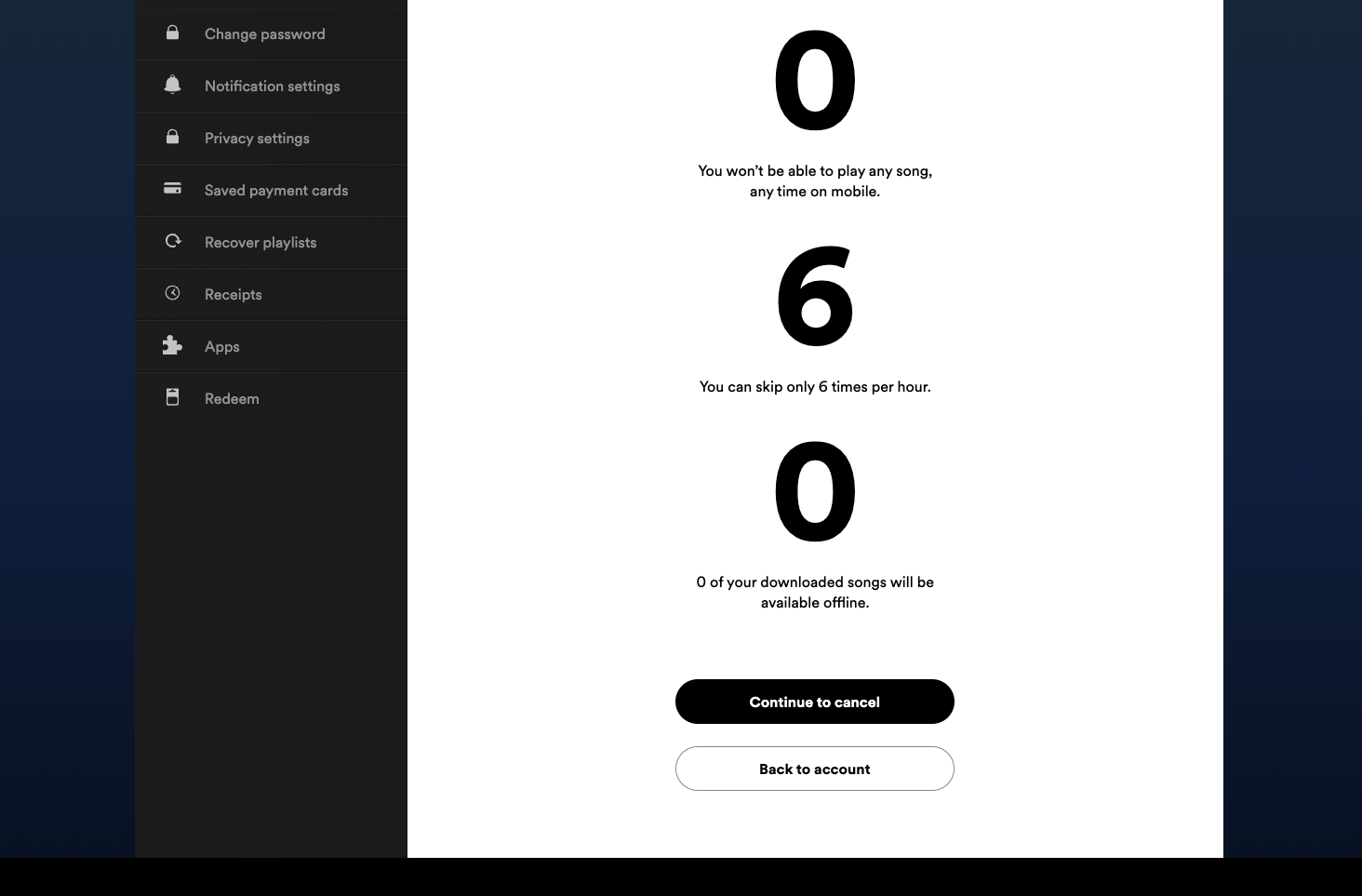
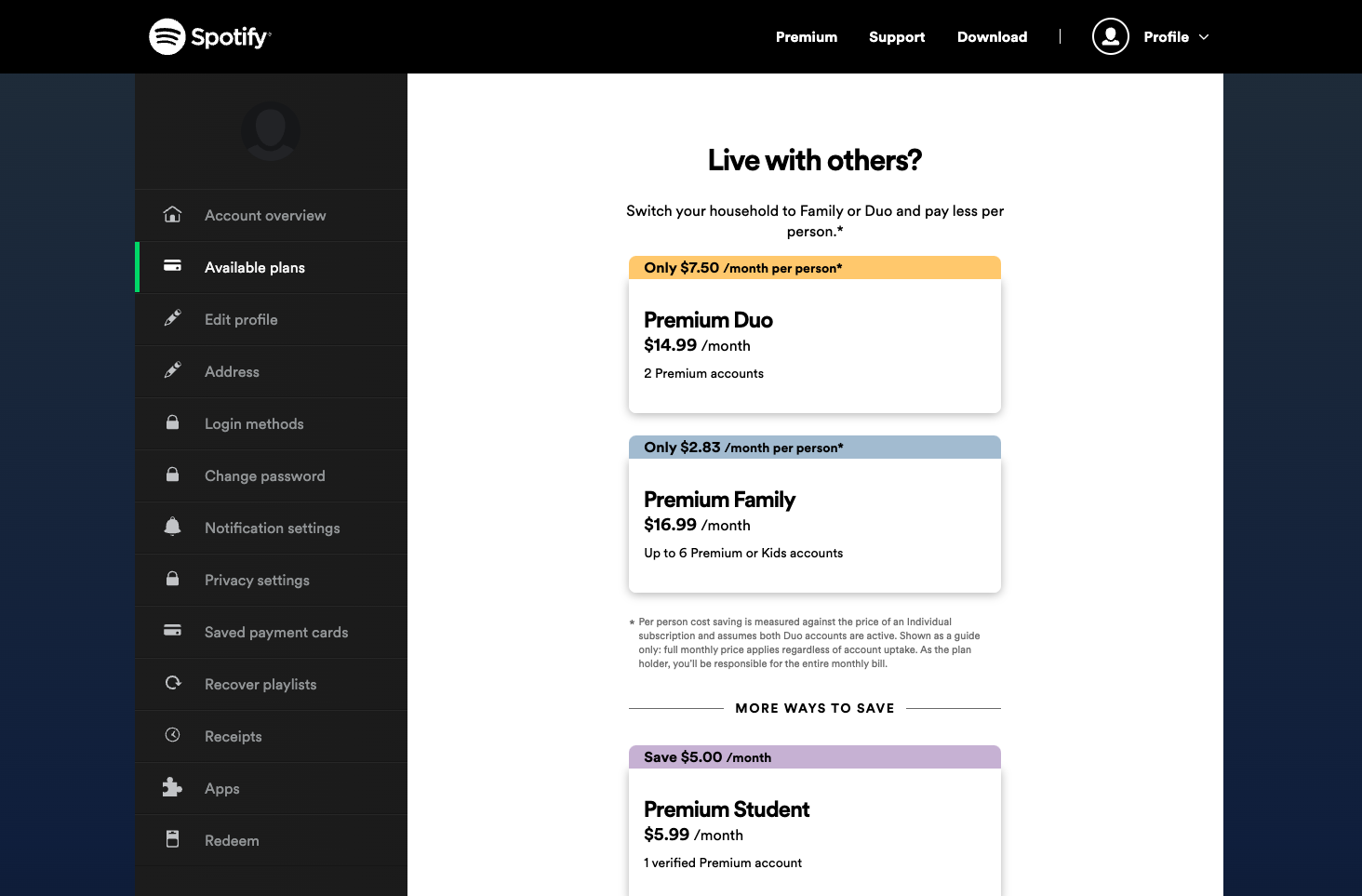
What works: the loss framing (specific features, not generic "are you sure?") plus the plan-switch lifeline. A subscriber on Premium Individual who's tightened their budget may stay if Duo or Family is shown as an option — Spotify keeps the subscriber and the relationship, just at a different ARPU. The pattern that transfers to win-back: lead with what they'd be losing in concrete, personalized terms.
YouTube TV
YouTube TV's flow goes further than Spotify's by capturing structured exit-reason data and then routing to different offers based on the answer. A "too expensive" answer drives one screen; "missing channels" drives another.
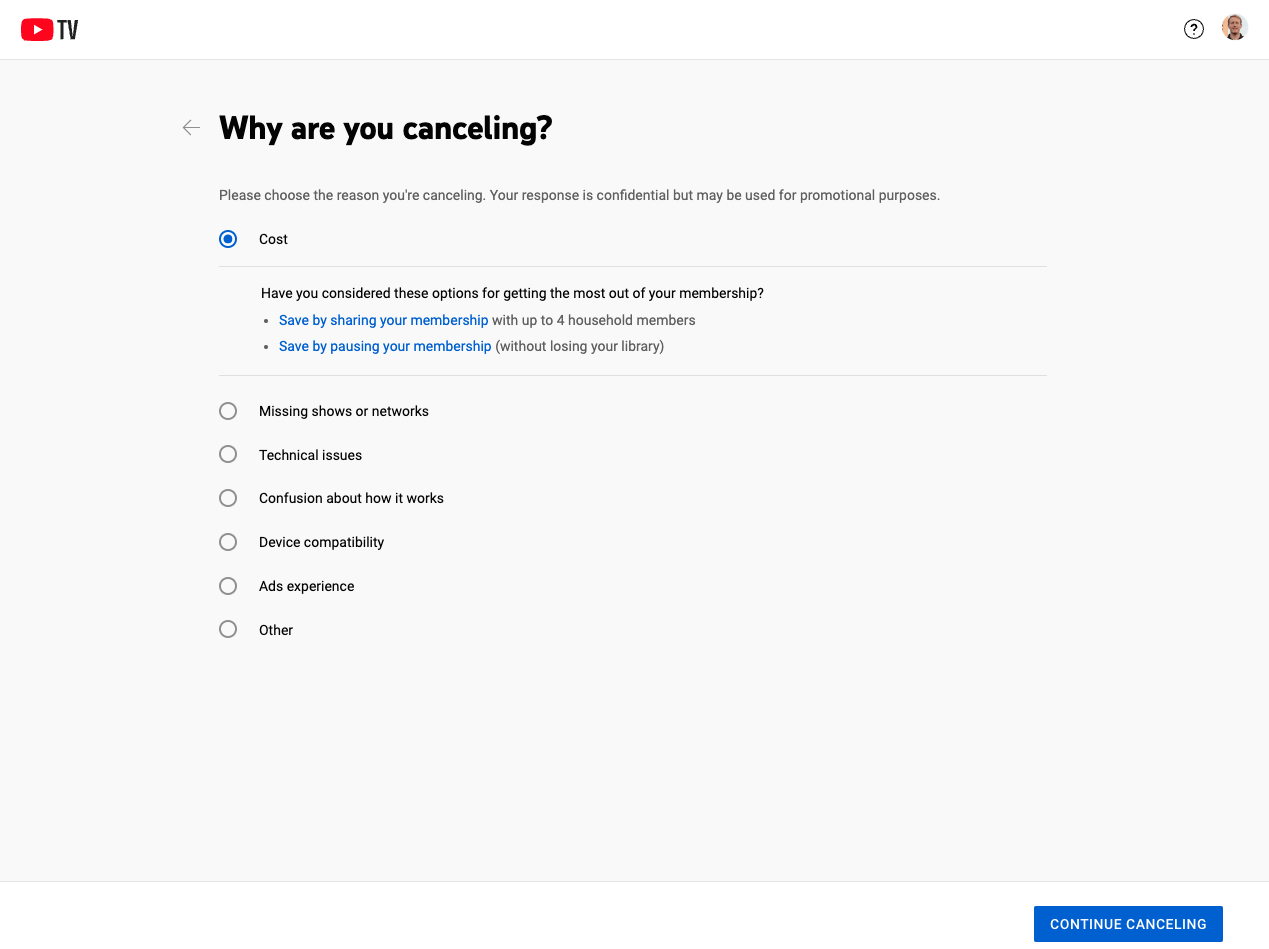
The flow then offers a pause-instead-of-cancel option calibrated to the cited reason. This is the structured exit-survey data we discussed in the segmentation section — except YouTube TV uses it in real-time inside the save flow, not just downstream for win-back.
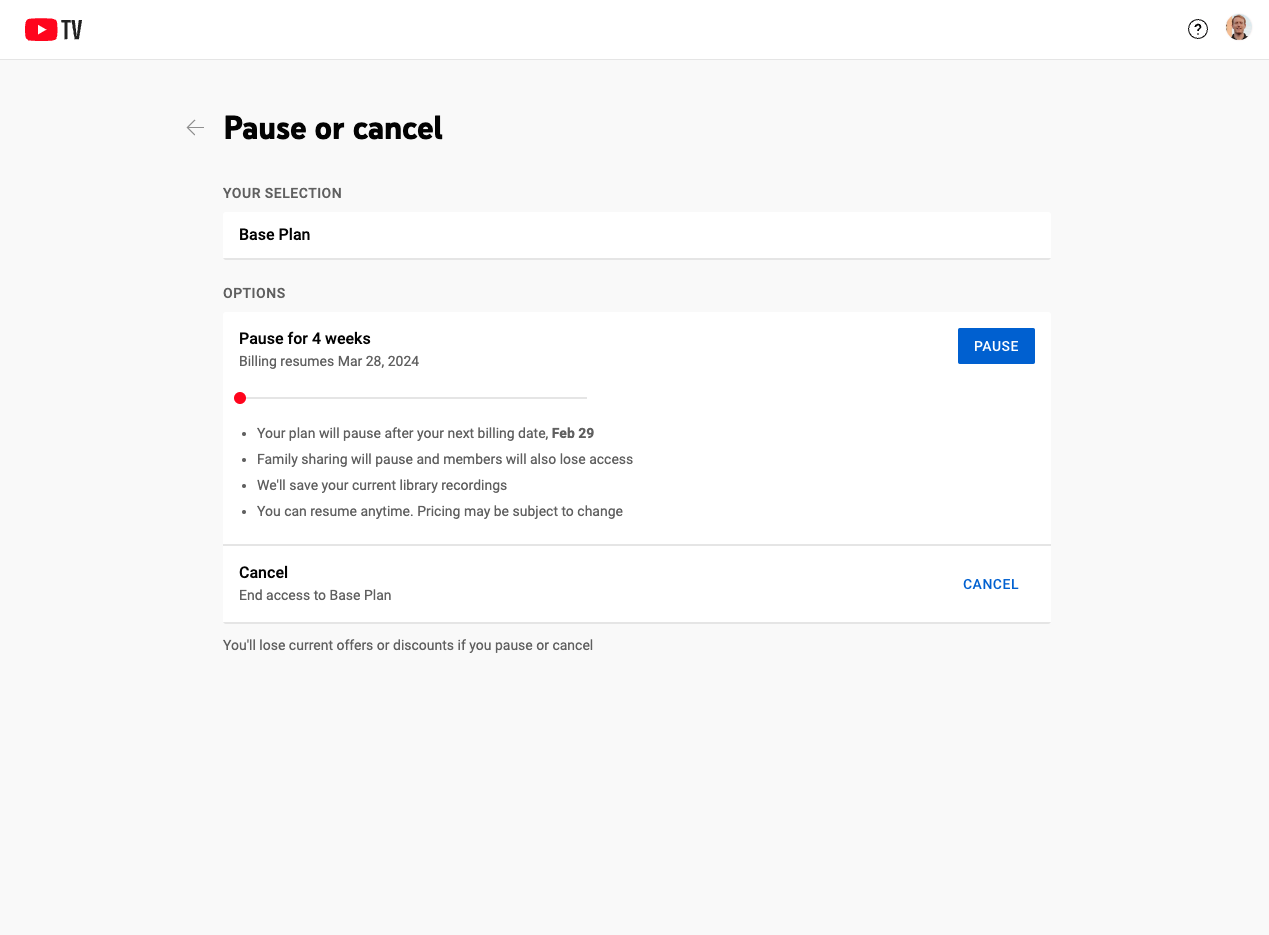
What works: the pause lever. Recurly's data shows ~75% of paused subscribers eventually return — substantially higher than the reactivation rate for fully-churned subscribers. If your product doesn't offer pause as a save lever today, that's the single highest-ROI addition.
Paramount+
Paramount+ runs the deepest discount most consumer streaming services will offer in a save flow: 99 cents for the next month. The framing is time-limited and reason-agnostic — the offer fires regardless of the user's stated reason for cancelling.
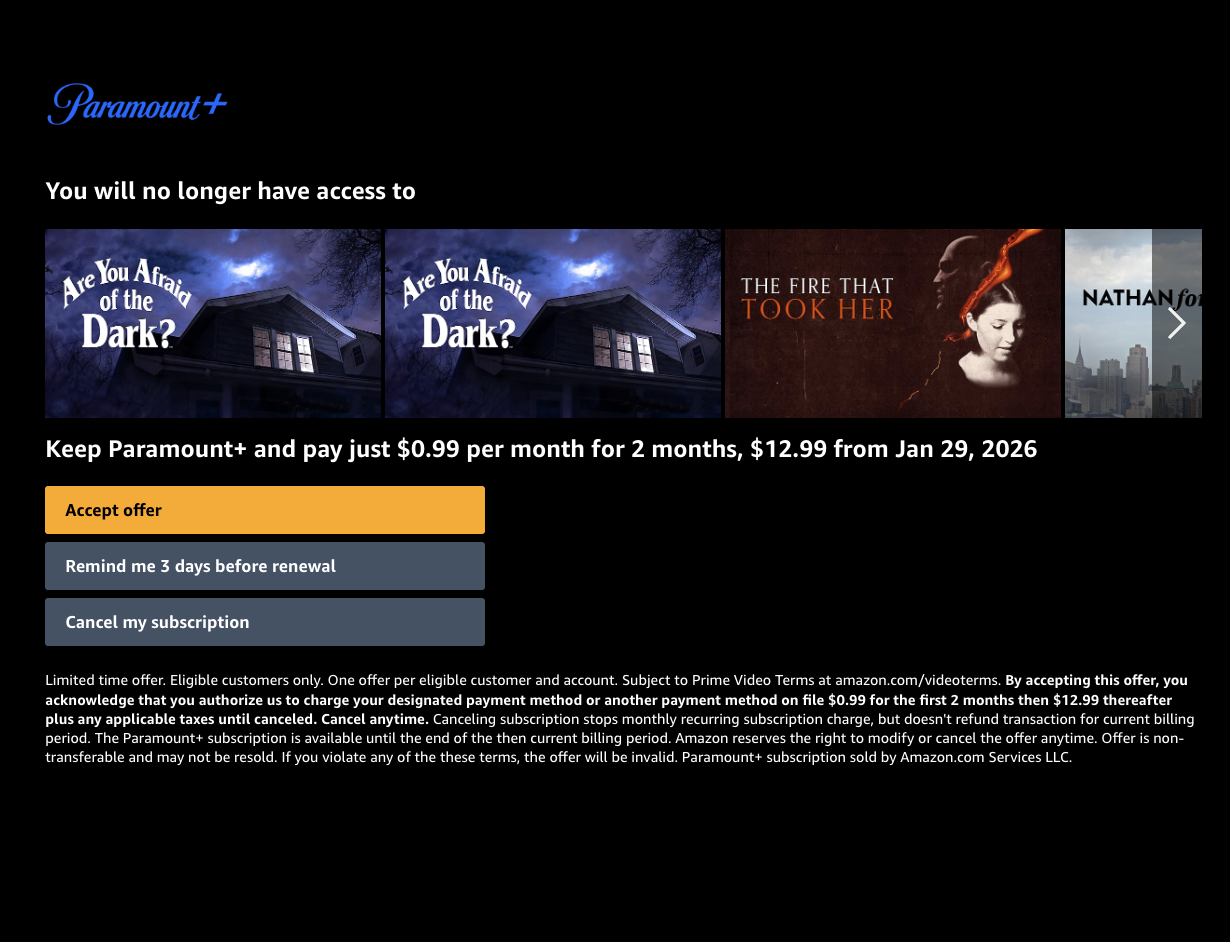
What works: aggressive enough to capture price-sensitive cancellers and short enough that retention math works out. The risk is what we covered in the win-back offer matrix: a non-segmented blanket discount trains subscribers to game cancellation. Paramount+ accepts this trade because their content slate produces enough genuine value that even discount-conditioned subscribers eventually convert back to full price.
The generic 50% off antipattern
Most subscription save flows default to "50% off your next month" with no segmentation. It's the path of least resistance — set it once in the billing system and walk away. And it consistently underperforms reason-matched offers.
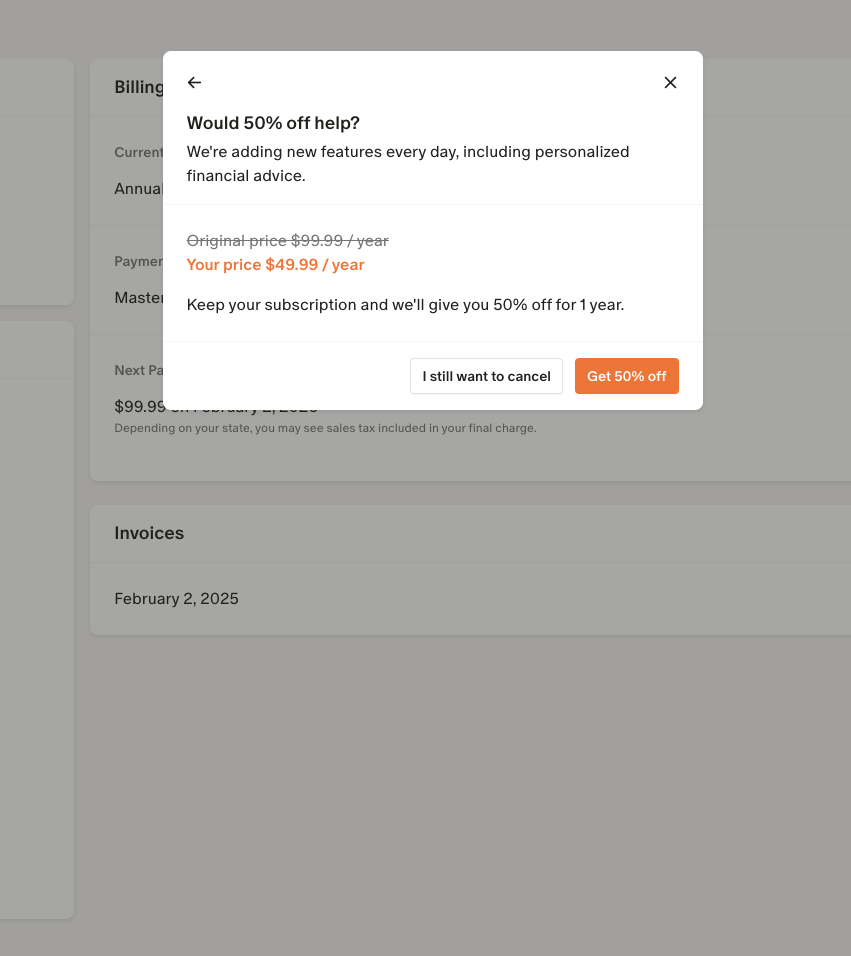
What doesn't work: the offer is the same for every cancel reason. Someone leaving because they don't use the product enough doesn't need a discount — they need a reason to come back. Someone leaving because they finished the content needs different content, not cheaper content. A blanket discount converts the easiest 5-8% of cancel intents and trains the next year of subscribers to expect it. The reason-matched version (the offer matrix above) converts 2-3x more without permanently depressing ARPU.
Where save flows end and win-back begins
The pattern across all four examples: specific personalization beats generic urgency, content/data triggers outperform discount-only triggers, and the offer should match the cancel reason. Those principles apply equally to save flows (in-product, at cancel-click) and to win-back (post-churn, over email).
The hand-off matters more than either system in isolation. A subscriber who exits a save flow without being saved is the first email in your win-back sequence — and the reason they cancelled (captured in the save flow) is the segmentation key for which sequence they enter. Save flows and win-back are two halves of the same retention system, and most businesses have built only the first half.
Win-Back vs Cancellation Flow vs Dunning: How They Fit Together
These three systems get conflated constantly, but they target different moments in the subscriber lifecycle and require different tactics. Get the three of them running together and you've covered every meaningful subscriber-loss event.
| System | When It Fires | Goal | Typical Save Rate |
|---|---|---|---|
| **[Cancellation flow](/guides/cancellation-flow)** | Subscriber clicks "Cancel" — before cancellation is processed | Save the cancel intent before it completes | 15-25% of cancel intents |
| **[Dunning emails](/guides/dunning-emails)** | Payment fails — during the grace period before involuntary cancellation | Recover the payment, prevent involuntary churn | 70-85% of failed payments |
| **Win-back** | Subscription has ended — voluntary or involuntary | Reactivate the lapsed subscriber as a returning customer | 10-15% of lapsed subscribers |
The three are sequential, not redundant. Cancellation flow catches users at the moment of intent. Dunning catches users whose payment broke. Win-back catches everyone the first two missed.
The most common mistake: building one of the three and treating it as a substitute for the others. A great cancellation flow doesn't reduce the need for win-back — it just changes the pool of lapsed subscribers (people who left despite a save offer are harder to reactivate). A great dunning system doesn't reduce the need for cancellation flow — they target different churn types.
If you have to build them in order: dunning first (highest ROI per hour of engineering, often shipped in a day), then cancellation flow (1-2 sprints), then win-back (a marketing automation flow, can be live in a week). The compounding effect of all three is what separates retention-mature subscription businesses from the long tail.
How to Segment Your Lapsed Subscribers
The 3-touch sequence works without segmentation. The 5-touch and 7-touch sequences only work with segmentation — sending everyone the same offer wastes most of the lift.
Three segmentation dimensions matter, in this order:
1. Recency (How Long Ago They Lapsed)
The single most important segmentation axis. Optimove's data shows the recoverable value of a lapsed subscriber drops 87% between Day 1 and Day 90. Treat the recently-lapsed differently from the long-cold.
- 0-7 days: "Did you mean to do that?" — no offer, no pressure
- 8-30 days: Reminder + modest offer (if exit reason supports one)
- 31-90 days: Reason-specific re-pitch + clear time-limited offer
- 91-365 days: Quarterly product-triggered emails only
- 365+ days: Drop or reset on next major product event
2. Original Plan / ARPU
A $5/mo subscriber and a $500/mo subscriber should not get the same sequence. ARPU determines how much human time the recovery economics support.
- Under $20/mo ARPU: Pure automated email/SMS, no human touch
- $20-$100/mo ARPU: Automated sequence + LinkedIn touch from a real human on Day 30
- $100+/mo ARPU: Personal outreach from CSM or founder is the primary mechanic; email is the backup
3. Reason for Leaving
The output of your cancellation flow exit survey. The whole point of capturing the cancel reason is to use it downstream — and win-back is the highest-leverage downstream use.
- Price-sensitive: Discount offer, time-bound
- Usage-driven (didn't use it enough): Re-engagement content, no discount
- Feature gap: Wait until you've shipped the feature, then trigger
- Competitor switch: Differentiation content + occasional check-in
- Achieved goal: Referral track, not reactivation track
- Life change: Soft "we're here when you're ready" cadence
A simple way to think about it: recency tells you the cadence, ARPU tells you the channel, and reason tells you the offer. Get the segmentation right and the same emails reactivate 2-3x more subscribers than a blast.
When NOT to Run Win-Back Campaigns
Win-back is high-ROI for most subscription businesses, but not all. Skip or defer if any of these are true:
You have fewer than ~500 lapsed subscribers. At low scale, the time to build, test, and operate a segmented win-back sequence outweighs the recovered revenue. Send a single Day-14 "we miss you" from your founder's personal email instead — it'll outperform a sophisticated automation built for 50 lapsed subscribers, and it'll teach you what objections look like.
Your subscribers are mostly App Store / Play Store billed and you don't have their email. Apple and Google don't share subscriber email by default. If you don't have a direct email relationship with your lapsed subscribers, you can't run win-back. Build the email collection mechanism first (in-app prompt, account creation flow, magic-link login) — then revisit win-back when you have an addressable audience.
Your churn reason is "achieved my goal" for the majority of cancellations. Some products serve a real endpoint — exam prep, weight loss, debt payoff. If most of your lapsed subscribers churned because they succeeded, win-back is the wrong system. Build a referral program for graduated users instead — they're your best evangelists, not your reactivation pool.
Your product changed materially and the lapsed subscribers wouldn't recognize it. If you pivoted between when they cancelled and now, a "come back to [Product]" email is misleading — they're not coming back to what they left. Either send a "we rebuilt it" reintroduction (essentially a re-acquisition email, not a win-back) or skip the cohort entirely.
Your sender reputation can't take the hit. Win-back targets disengaged users — by definition, the lowest-engagement cohort in your file. If you're already fighting Gmail / Outlook deliverability issues, sending an aggressive win-back sequence to a stale list will make it worse. Warm the program slowly, segment hard, and watch your bounce/complaint rates as you go.
FAQ
What is a win-back email?
A win-back email is a message sent to a former subscriber to convince them to reactivate. The most effective win-back emails are part of a multi-touch sequence (typically 3-5 emails over 90 days), segmented by why the subscriber originally cancelled, and tied to a specific offer or product update. According to Klaviyo's 2025 benchmark, a single-email win-back reactivates around 6% of lapsed subscribers, while a 4-email sequence reactivates 14-18%.
When should I send a win-back email?
The standard cadence is Day 7, Day 30, and Day 90 after cancellation, with optional additional touches at Day 14 and Day 60 for higher-ARPU subscriptions. Day 7 catches accidental cancellations; Day 30 is when most operators deploy a discount; Day 90 is the last-call before quarantine. Beyond Day 90, stop — Recurly's data suggests continuing past 3-4 touches damages deliverability without meaningfully improving recovery.
What's a good reactivation rate?
10-15% reactivation is a solid benchmark for a well-built automated sequence in most B2C subscription categories (Klaviyo). B2B SaaS with human-assist sequences can hit 15-25%. Single-email programs typically land at 5-8%. If you're seeing under 5%, your timing is probably wrong or your offer isn't reason-matched.
Should every win-back email include a discount?
No. Generic discounts are the most common win-back mistake — they reactivate price-sensitive subscribers at a permanently reduced ARPU and train your subscriber base to game the system. Offer discounts only to the "too expensive" segment (from exit-survey data), and only on the Day 30-60 touch. For other segments, lead with product updates, new content, or a personal note — those convert better and preserve full-price ARPU on return.
How much cheaper is reactivating vs acquiring?
Industry benchmarks put reactivation at 5-7x cheaper per recovered subscriber than new acquisition (Invesp); Recurly puts it as "5 to 25 times" depending on industry and price point. The reason is structural: a lapsed subscriber has zero ad cost (you already have their email), zero onboarding cost (they know the product), and a much shorter consideration window (one click vs weeks of evaluation).
How is win-back different from dunning and cancellation flow?
Dunning targets failed payments before the subscription is cancelled — the goal is to recover the payment in the grace period. Cancellation flow targets the moment a subscriber clicks "Cancel" — the goal is to save the intent before it completes. Win-back targets subscribers whose subscription has already ended — the goal is to bring them back as returning customers. The three are sequential, not substitutes: a mature subscription business runs all three.
Do win-back campaigns hurt sender reputation?
They can, if you do it wrong. Win-back lists are by definition low-engagement, which means higher bounce and lower open rates than your active subscriber base. The fix is segmentation: only send to lapsed subscribers who engaged with email in the 90 days before they cancelled, quarantine non-responders after 3 touches, and monitor deliverability metrics weekly. Done well, win-back actually improves your overall sender reputation by removing dead weight from your active list.
What to Do Next
If you don't have a win-back program today, here's the build order:
Verify you can email lapsed subscribers. Confirm your billing platform exports cancelled-subscriber email addresses to your ESP. If you're on App Store / Play Store with no email collection mechanism, fix that first — there's no win-back without an addressable audience.
Ship the 3-touch sequence in one afternoon. Day 7, Day 30, Day 90. Same email for everyone. No segmentation. This is the minimum viable program and it'll outperform whatever you're doing today (which is probably nothing).
Layer in exit-survey segmentation once your cancellation flow is live. The 5-touch sequence reactivates 50-100% more subscribers than the 3-touch precisely because the offer matches the reason.
Measure reactivation rate, not open rate. Open rate is vanity. Reactivation rate at 30 / 60 / 90 days is the only metric that pays the bills. Track it monthly and kill the touches that underperform.
Build the human-touch layer if your ARPU supports it. Above $50/mo ARPU, add a Day-14 personal email from a real human (founder, CSM, account manager). The recovery economics support the time at higher tiers.
Win-back is one of seven places subscription businesses leak revenue. The Revenue Leak Audit covers all of them — pricing, packaging, conversion, churn, expansion, dunning, and reactivation — and shows you exactly where your business is leaving money on the table.
Take the Subscription Revenue Leak Audit →
52 checklist items across 7 revenue leak categories. Takes 10 minutes. Reactivation is one of the leaks most operators discover they've never measured.

Dan Layfield
Dan ran growth at Codecademy, scaling ARR from $10M to $55M before the company was acquired for $525M. He now advises subscription businesses on pricing, retention, and revenue optimization.
Work with Dan →Related Guides
Annual Churn Rate: Formula, Benchmarks, and How to Calculate It
If you multiply monthly churn by 12 you overstate annual churn by ~50%. Here's the right formula, real-company benchmarks, and the conversion math operators get wrong.
20 min readAnnual vs Monthly Pricing: How to Set Your Annual Subscription Discount
Most annual subscription pricing is set backwards. Here's how to price annual plans using retention data, with real ratios from Noom, Tinder, and Headspace.
26 min readARR (Annual Recurring Revenue): The Number That Defines Your Subscription Business
ARR is the metric investors, operators, and acquirers care about most. Learn how to calculate it correctly, avoid common mistakes, and grow it.
Get the playbook every Thursday
Weekly strategies for subscription businesses. Real companies, real numbers, tactics you can steal. From the operator who grew Codecademy from $10M to $50M ARR.