Annual vs Monthly Pricing: How to Set Your Annual Subscription Discount
Most annual subscription pricing is set backwards. Here's how to price annual plans using retention data, with real ratios from Noom, Tinder, and Headspace.

Dan Layfield
Growth at Codecademy, $10M → $50M ARR
In This Guide
- Annual vs Monthly Pricing at a Glance
- What is an annual subscription?
- What Does "Billed Annually" Mean?
- Monthly vs Annual Plans: What's the Real Difference?
- Why Annual Plans Exist (And Why Some Companies Skip Them)
- How much should an annual subscription cost?
- The Pricing Ratio Formula
- Real Company Pricing Ratios (And What They Reveal)
- 7 Business Benefits of Annual Plans
- When NOT to Offer an Annual Plan
- How to Test Annual Pricing
- Annual vs Monthly Plan Pricing Presentation Best Practices
- FAQ
- What to Do Next
Most subscription businesses set their annual discount the same way: they look at what competitors charge, pick something around 15-20% off, and call it a day.
That's backwards. Your annual plan discount shouldn't be based on what Spotify or Netflix charges. It should be based on your own retention data — specifically, how long your average monthly subscriber sticks around before churning. Understanding your customer retention strategies is the starting point.
I figured this out at Codecademy while growing the business from $10M to $50M in annual recurring revenue. We tested a pricing approach that was counterintuitive at the time but turned out to be one of the most effective revenue levers we ever pulled. It shifted a material number of users to long-term plans, increased customer lifetime value, and dropped churn.
This guide covers the exact formula, why it works, how to reverse-engineer your competitors' retention from their pricing pages, and how to present annual vs monthly options to maximize conversion.
Annual vs Monthly Pricing at a Glance
| Monthly Pricing | Annual Pricing | |
|---|---|---|
| **Commitment** | Low — cancel anytime | High — 12-month lock-in |
| **Cash flow** | Collected in installments | Collected upfront |
| **Churn risk** | Higher — 12 decision points per year | Lower — 1 decision point per year |
| **Best for** | Acquisition, low-barrier entry | Retention, maximizing LTV |
| **Typical discount** | None (base price) | 15-50% off monthly equivalent |
| **Renewal rate** | Lower (monthly re-evaluation) | Higher (habit formation + sunk cost) |
The short answer: Most subscription businesses should offer both. Monthly plans are your acquisition engine — they reduce the barrier to sign up. Annual plans are your retention engine — they lock in revenue and increase lifetime value. The key question is how to set the annual discount, which this guide covers in detail below.
What is an annual subscription?
An annual subscription is a recurring purchase billed once per year instead of monthly. You pay 12 months upfront, usually at a 15-20% discount off the monthly price — though as you'll see below, that number is wrong for most products.
Annual plans do three things at once: lock in revenue, reduce churn, and signal buyer confidence. Companies that get the pricing right see 25-50% higher customer lifetime value than monthly-only competitors. Companies that anchor to a generic "15% off" leave most of that on the table.
What Does "Billed Annually" Mean?
Before diving into strategy, let's clarify the terms — these are some of the most commonly searched questions about subscription billing.
Billed annually means you pay once per year for 12 months of access, usually at a discounted rate compared to paying month-to-month. For example, if a service costs $15/month, the annual plan might be $120/year (equivalent to $10/month) — saving you $60 compared to paying monthly for 12 months.
"Per month, billed annually" is how most pricing pages display the annual option. When you see "$10/month, billed annually," it means you're paying $120 upfront as a single charge, not $10 each month. The monthly figure is just the math to make comparison easier.
Annual subscription simply refers to any plan with a 12-month billing cycle. It's the same as a yearly subscription or yearly plan.
The tradeoff is straightforward: annual billing costs less per month but requires a larger upfront commitment. Monthly billing costs more per month but lets you cancel anytime without losing money on unused months.
Monthly vs Annual Plans: What's the Real Difference?
The difference between monthly and annual subscription plans goes beyond pricing. Each option signals something different to your customers and impacts your subscription metrics differently.
Monthly plans offer flexibility and lower commitment. They're easier to sell but produce higher churn rate — users can leave any month. Monthly plans are your acquisition engine.
Annual plans lock in revenue and dramatically reduce churn. An annual subscriber is 3-5x more likely to renew than a monthly subscriber who's been paying for 12 months — see how the compounding math works in our annual churn rate guide. Annual plans are your retention engine.
The question isn't which one to offer — it's how to set the discount that makes annual plans attractive without giving away too much margin.
Why Annual Plans Exist (And Why Some Companies Skip Them)
Annual plans exist for one reason: some products serve a permanent need where customers stay for years, and locking in a year of revenue upfront aligns with that reality. Netflix, Spotify, and Zoom all fit this profile.
Companies skip annual plans when their product serves a short-lifecycle need (3-5 months) — most customers won't stay long enough to justify the annual commitment, so offering one would lose money on the majority. Noom and Tinder Plus famously avoid traditional annual plans for exactly this reason.
Not every subscription business should offer an annual plan. Understanding why requires a simple framework: how long does your customer naturally need your product?
Some products solve problems that last forever. You'll always need your cellphone. You'll always want entertainment. You'll always need a place to live. Products serving these permanent needs — Netflix, Spotify, Verizon, Google Fiber, AWS — rarely offer meaningful annual discounts. Why would they? Their users stick around for years without a price incentive.
There are a limited number of behaviors that humans will do basically forever: needing a house, transportation, the ability to communicate with others, entertainment. Products serving these needs have a natural retention advantage.
Then there are products with a natural endpoint. Learn-to-code platforms (users either succeed or give up). Weight loss apps (users hit their goal or quit). Exam prep (the exam date passes). Dating apps (users find a partner — hopefully). These are short-lifecycle products, and they have a structural retention problem: users leave when they've gotten what they came for.
If your product has a natural endpoint — if users tend to churn within 3-6 months because they've achieved their goal or given up — annual plans become one of your most powerful monetization tools. They let you capture more lifetime value from users who'd otherwise leave before the 12-month mark.
If your users naturally stay for 12+ months, an annual discount just gives away margin for free. You're discounting something people were already going to pay full price for.
How much should an annual subscription cost?
The right annual subscription price depends on three things: how long your average customer stays, your monthly price, and your churn risk profile. A 15-20% discount off monthly billing is the industry default — and it's wrong for most products.
As a rough benchmark:
- Short-lifecycle B2C (dating, fitness, learning): 2.5x to 4x monthly → effective 67-79% discount on annual run-rate
- Long-lifecycle B2C (streaming, productivity): 8x to 11x monthly → effective 8-33% discount
- B2B SaaS: 10x to 12x monthly → effective 0-17% discount
The math: multiply your monthly price by your typical customer lifespan in months, then discount from there. If a customer stays 4 months at $20/mo, your annual price ceiling is $80 — not $200 with a 17% discount. The full formula and worked examples are in the next section.
The Pricing Ratio Formula
Here's the core insight, and it's surprisingly simple:
Price your annual plan to be slightly more than your average monthly subscriber's total LTV.
If your average monthly subscriber sticks around for 4 months before churning, price your annual plan at 5 months' worth of your monthly price.
Why? Because that monthly subscriber was going to pay you for 4 months and leave. By offering an annual plan priced at 5 months' cost, you're giving them a significant discount (they pay for 5 months instead of 12) while increasing the total revenue you collect from that user by 25%.
The formula:
Annual Price = Monthly Price x (Average Monthly Retention in Months + 1 to 2)
If your monthly price is $20 and users stay an average of 4 months:
- Current monthly LTV: $20 x 4 = $80
- Annual plan at 5 months: $20 x 5 = $100/year
- Annual plan at 6 months: $20 x 6 = $120/year
- LTV increase: 25-50% — for users who would have churned anyway
That's a 25-50% boost in lifetime value, which is a huge win for not a lot of effort.
What the Ratio Tells You
The ratio between a company's annual and monthly price is a hidden metric. It reveals how long the company thinks its average monthly user retains.
Pricing Ratio = Annual Price / Monthly Price
A low ratio (3-5x) means the company expects short retention — users stay 3-5 months on monthly plans. A high ratio (8-10x) means longer retention. And no annual plan at all? That usually means the company's users stick around well past 12 months.
The insider subscription playbook
One tactic that moves the needle — every Thursday
Real companies, real numbers, strategies you can steal. From the operator who grew Codecademy from $10M to $50M ARR.
I shared this framework on LinkedIn and it struck a nerve — 2,700+ reactions from subscription operators who recognized the pattern in their own businesses.
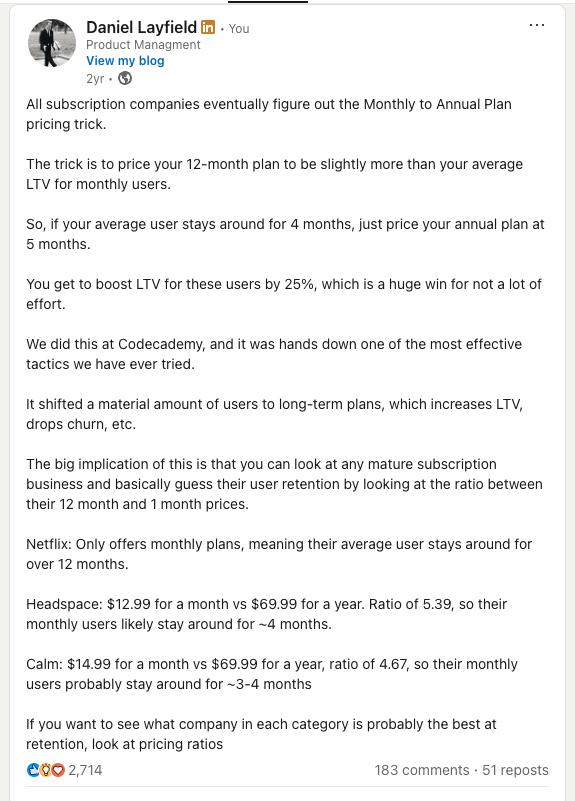
Want to run this formula on your own numbers? Try the Annual Discount Calculator → — plug in your monthly price and retention data to find your optimal annual plan price in seconds.
Real Company Pricing Ratios (And What They Reveal)
Let's look at actual companies and reverse-engineer their retention from pricing:
Short-Lifecycle Products
| Company | Monthly | Annual | Ratio | Implied Retention |
|---|---|---|---|---|
| Noom (weight loss) | $70/mo | $209/yr | 2.99x | ~2-3 months |
| Tinder Plus (dating) | $7.99/mo | $32.04/yr | 4.01x | ~3 months |
| DataCamp (learning) | $39/mo | $149.04/yr | 3.82x | ~3 months |
| Headspace (meditation) | $12.99/mo | $69.99/yr | 5.39x | ~4 months |
| Calm (meditation) | $14.99/mo | $69.99/yr | 4.67x | ~3-4 months |
Notice the pattern. These are all products where the user has a natural endpoint: lose the weight, find the partner, learn the skill, build the habit. Retention tops out at 3-5 months for most monthly subscribers, and the annual pricing reflects exactly that.
Noom's ratio of 2.99x is telling. At $70/month, they know users who don't see results will churn fast — within 2-3 months. So they price the annual plan at barely 3 months' cost. Users get a massive deal compared to monthly, and Noom collects roughly one extra month of revenue per user who switches. At scale, that's transformative.
Here's what this looks like in practice. Headspace's pricing page pre-selects the annual plan, tags it "Best value," and breaks down the per-month cost ($5.83 vs $12.99). Textbook execution:
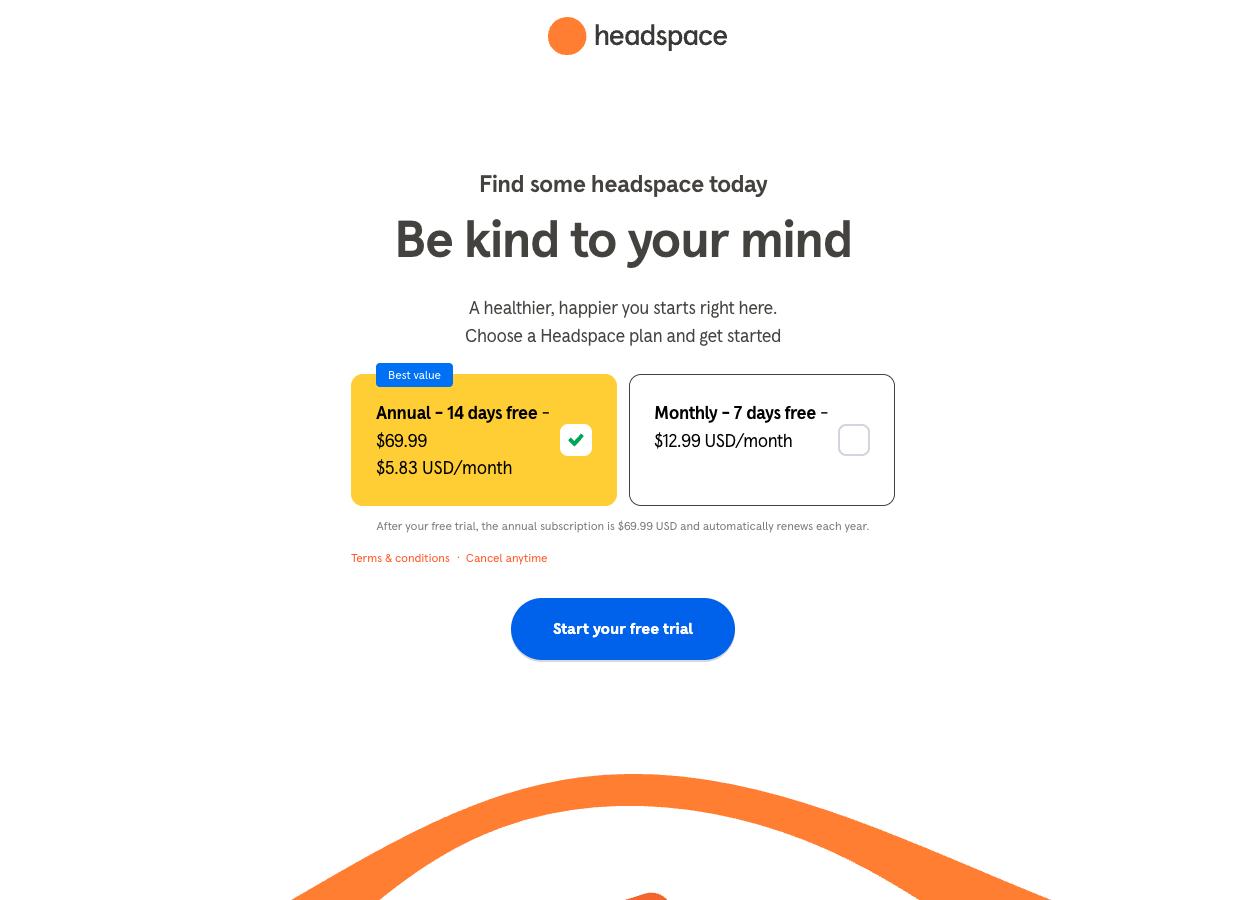
The $69.99 annual price divided by the $12.99 monthly price gives a ratio of 5.39x — telling us Headspace estimates their average monthly user retains for about 4 months. The annual plan captures roughly one extra month of value per user.
DataCamp takes a similar approach. Their pricing page defaults to the annual toggle ("Save $255 with Yearly") and shows the monthly-equivalent price prominently:
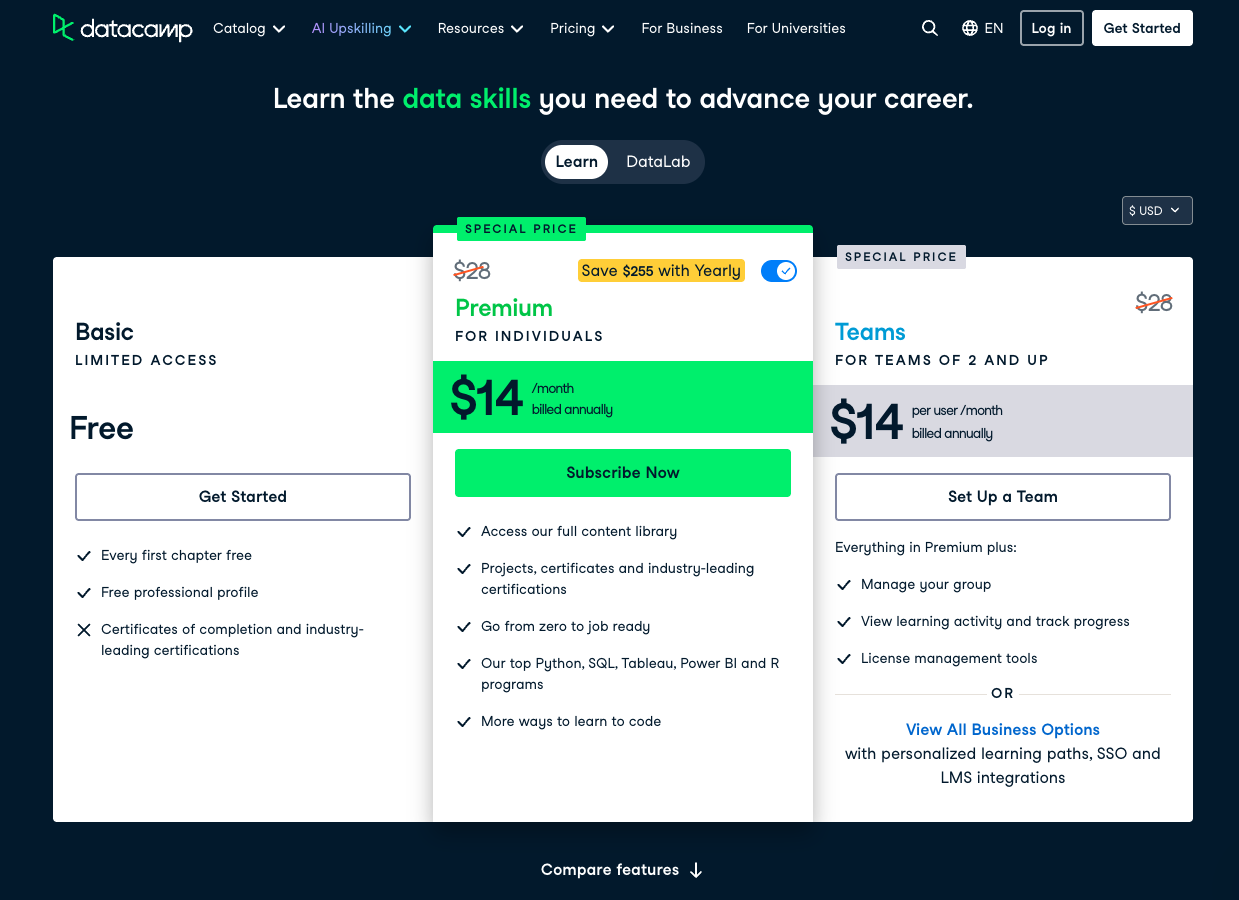
DataCamp's current ratio of 6x ($168/year vs $28/month) is actually more generous than the 3.82x ratio they used to offer — suggesting they've learned that users retain shorter than expected and adjusted their annual discount to be more aggressive. As a learn-to-code platform (similar to Codecademy), their users have a natural endpoint: either they learn the skill and move on, or they lose motivation. The steeper discount captures more lifetime value from users who would otherwise churn at month 3-4.
Streaming and Entertainment
| Company | Monthly | Annual | Ratio | What This Tells You |
|---|---|---|---|---|
| Netflix | $15.49/mo | No annual plan | — | Users stay 12+ months |
| Hulu | $17.99/mo | ~$15.12/mo annual | ~10.1x | ~8-9 months, 16% discount |
| Paramount Plus | $12.99/mo | ~$10.91/mo annual | ~10.1x | Similar to Hulu, 16% discount |
| HBO Max | $15.99/mo | ~$12.79/mo annual | ~9.6x | Slightly lower retention, 20% discount |
Netflix doesn't offer an annual plan because their content library keeps users subscribed indefinitely. They don't need to lock users in — the product does that on its own. When you see a streaming service without an annual plan, it's a signal of confidence in retention.
HBO's slightly larger 20% discount (versus Hulu's 16%) likely reflects the episodic nature of their content — users subscribe for a specific show, watch it, and may cancel until the next season. The bigger discount is an attempt to bridge those gaps.
Headspace: A Case Study in Learning
Headspace's pricing has evolved over the years, and the changes are instructive:
- 2014: $12.95/month, $7.95/month billed annually — ratio of 0.62 (annual per-month / monthly price)
- 2023: $12.99/month, $7.99/month billed annually — ratio down to 0.47
The annual discount got steeper over time. This suggests Headspace learned that meditation habit formation is harder than expected — users don't stick with daily meditation as long as hoped. Unable to significantly change actual retention, they adjusted the annual price downward to capture more value from shorter-lifecycle users.
7 Business Benefits of Annual Plans
When priced correctly, annual plans do much more than just extend revenue per user. Here's what happened at Codecademy when we implemented this approach:
1. Raises [LTV](/guides/customer-lifetime-value) Proportionally
The most direct benefit. If a monthly subscriber pays you for 4 months and an annual subscriber pays you for 5 months' equivalent — that's a 25% LTV increase, multiplied by every subscriber who switches to annual.
2. Collects Cash Upfront
Annual subscribers pay in full at the start. That cash flow advantage is significant — you can reinvest in growth immediately rather than waiting for 12 monthly installments. For early-stage businesses, this can be the difference between funding growth organically and needing to raise capital.
3. Enables Higher Acquisition Spend
When LTV goes up, your CAC ceiling goes up too. If you maintain a 3:1 LTV:CAC ratio and your average LTV jumps 25%, you can spend 25% more to acquire each subscriber. That opens up acquisition channels that were previously unprofitable — paid search, partnerships, content sponsorships.
4. Reduces Churn Percentages
Annual subscribers are locked in for 12 months. They don't appear in monthly churn calculations. Converting even 20-30% of your subscriber base to annual plans can dramatically improve your headline churn number, which matters for investor conversations, benchmarking, and team morale.
More importantly, annual subscribers have higher renewal rates than you'd expect. Users who commit to a year develop stronger habits around the product. At Codecademy, our year-two renewal rates for annual subscribers were meaningfully higher than what we'd have predicted from monthly churn data alone.
5. Increases User Commitment and Engagement
There's a psychological dimension. When someone pays for a full year, they're more committed to getting value from the product. They log in more. They complete more courses. They explore more features. This creates a virtuous cycle: higher engagement leads to more perceived value, which leads to higher renewal rates.
6. Grows [MRR](/guides/recurring-revenue) Steadily
Each annual subscriber contributes 1/12th of their payment to MRR every month. This creates a stable, predictable revenue base that smooths out the natural lumpiness of monthly subscriptions.
7. Reduces Payment Processing Complexity
One payment per year versus twelve. Fewer transactions means fewer failed payments, fewer dunning emails, fewer involuntary churn events. If involuntary churn accounts for 20-40% of total churn, reducing payment frequency is a structural fix.
When NOT to Offer an Annual Plan
Annual plans aren't always the right move. Skip them (or deprioritize them) if:
Your users already retain for 12+ months. If your average monthly subscriber stays 14 months, an annual discount just erodes margin. Netflix figured this out. You should too. Check your retention data before building annual plans — if your retention curve flattens well past the 12-month mark, your money is better spent on upselling and expansion revenue.
You don't have retention data yet. The pricing formula requires knowing your average monthly retention. If you launched three months ago, you don't know this yet. Run on monthly billing until you have 6-12 months of cohort data, then introduce annual plans based on what the data shows.
Your product changes rapidly. If you're pivoting features or pricing frequently, locking users into annual plans creates expectations you might not meet. Monthly billing gives you more flexibility during periods of rapid iteration.
Your ARPU is very low. If your monthly price is $3-5, the annual discount math doesn't move the needle much. A 25% LTV increase on a $4/month user is an extra $4 per year. The engineering and product effort to build, test, and manage annual billing might not be worth it at that price point.
How to Test Annual Pricing
Getting the annual price right matters. Too high and nobody converts. Too low and you're giving away margin. Here's how to test it.
Start With Your Retention Data
Pull your cohort retention curves. You need to know: what percentage of monthly subscribers are still active at month 3, 6, 9, and 12?
The month where your retention curve flattens is your average monthly LTV ceiling. If 50% of users are gone by month 4, your average retention is somewhere around 4 months.
Set Your Initial Price
Use the formula: Monthly Price x (Average Retention + 1 to 2 months).
If you're unsure, start with +1 month. You can always increase the annual price later (reducing the discount), but cutting the price after launch feels like a concession.
A/B Test the Discount Level
Run a simple test with 2-3 annual price points:
- Variant A: Monthly x (Retention + 1) — aggressive discount
- Variant B: Monthly x (Retention + 2) — moderate discount
- Variant C: Monthly x (Retention + 3) — conservative discount
Measure two things: annual plan conversion rate and total revenue per subscriber (including both monthly and annual revenue across the cohort). A higher discount converts more users but generates less per annual subscriber — you need to find the sweet spot where total revenue is maximized.
Watch the Right Timeframe
Before you start, check whether your traffic is high enough to detect a meaningful difference. Use the MDE calculator to see the smallest pricing effect your test can reliably measure — running underpowered tests wastes time and produces misleading results.
Don't evaluate your A/B test after one week. You need at least 2-3 months of data to see how annual conversion affects overall subscriber economics. Early results will overweight conversion rate and underweight the LTV impact. When you do read the results, run them through the statistical significance calculator to confirm the lift isn't random noise before you ship.
What to Measure
| Metric | Why It Matters |
|---|---|
| Annual plan take rate | What percentage of new subscribers choose annual |
| Revenue per subscriber (blended) | Total revenue across monthly + annual, per subscriber |
| Annual renewal rate | Do annual subscribers renew at year end? |
| Engagement by plan type | Are annual subscribers more or less engaged? |
| CAC payback period | Does faster cash collection change your growth math? |
Annual vs Monthly Plan Pricing Presentation Best Practices
How you display the options matters as much as the price itself. The queries driving traffic to this topic include "annual vs monthly plan pricing presentation best practices" — so let's cover exactly that.
Default to Annual
Most high-performing pricing pages default the toggle to annual billing. This uses the default effect — users are more likely to stick with whatever's pre-selected. If your annual plan is the better deal (it should be), make it the default.
Show the Savings Clearly
Don't make users do math. Show the monthly-equivalent price for annual billing, and display the savings explicitly:
- "$10/month billed annually" with a crossed-out "$15/month" — clear price comparison
- "Save 33%" or "2 months free" — whichever framing resonates more with your audience
"2 months free" tends to outperform percentage discounts for consumer products because it's more concrete. "$X saved per year" works better for B2B where buyers justify budget line items.
Use Visual Hierarchy
Make the annual plan visually prominent:
- Larger card or highlighted border
- "Most Popular" or "Best Value" badge
- Slightly different background color or elevation
The monthly plan should still be clearly available — hiding it erodes trust — but the annual plan should be the obvious recommended choice.
Don't Offer Too Many Options
A common mistake: offering monthly, quarterly, semi-annual, and annual plans. Too many choices cause decision paralysis. Stick to two options — monthly and annual. If you must add a third, make it a distinct tier (different features), not just a different billing period.
Address the Commitment Concern
Some users hesitate on annual because they worry about being locked in. Address this directly:
- "Try risk-free — cancel anytime in the first 30 days for a full refund"
- "Not sure yet? Start monthly and upgrade to annual anytime"
The refund guarantee removes the psychological barrier without meaningfully increasing actual refund rates. Most users who commit to annual billing don't request refunds.
FAQ
What's a standard annual plan discount?
The most common discount across all industries is about 16-17% (effectively 2 months free on a 12-month plan). But "standard" is the wrong question. The right discount depends on your retention data. A product with 3-month average retention should discount much more aggressively than one with 8-month retention. Use the formula — Monthly Price x (Average Retention + 1-2 months) — rather than copying what competitors do.
Should I offer monthly billing at all?
Yes. Monthly billing reduces the barrier to sign up. Not everyone is ready to commit to a year of your product sight unseen. Monthly plans let users try before they commit, and you can always offer an annual upgrade after they've experienced enough value. Removing monthly billing entirely will cost you signups.
How do I convert monthly subscribers to annual?
The best time to offer an annual upgrade is when the user has just experienced a value milestone — completed their first project, hit a usage threshold, or reached a streak. Send a targeted email or in-app prompt with the annual savings calculated based on what they've already paid. "You've paid $X over the last 3 months. Switch to annual and save $Y this year." Specific numbers convert better than generic pitches.
What annual plan renewal rates should I expect?
Annual renewal rates typically range from 60-80% for consumer subscriptions and 80-95% for B2B SaaS. The key insight: annual renewal rates are usually higher than what monthly retention would predict. Users who commit to a year develop stronger product habits, which drives better retention at renewal time. This is the compounding benefit of annual plans that most operators undercount.
What is annual pricing?
Annual pricing is a subscription billing option where customers pay once per year instead of monthly. The annual price is typically offered at a discount to the equivalent monthly rate — most commonly 15-20% off, though the optimal discount depends on your retention data. Annual pricing benefits businesses through reduced churn, improved cash flow, and higher customer lifetime value.
Should I offer a quarterly plan?
Usually no. Quarterly plans split the difference in a way that satisfies neither goal: they don't provide the commitment and cash flow benefits of annual, and they don't offer the low-friction entry of monthly. The rare exception is very high-ARPU products where the annual price tag causes sticker shock — a quarterly option can serve as a stepping stone. But for most businesses, monthly and annual is the right combination.
How much should I discount annual vs monthly pricing?
This depends entirely on your user retention. If your average monthly user stays 4 months, pricing annual at 5 months' cost gives you roughly a 58% discount off the monthly rate — but that's the right discount because those users were never going to pay for 12 months anyway. If your average monthly user stays 9 months, a 17% discount (10 months' cost) makes more sense. The discount should be driven by your data, not by convention.
Will an annual plan lower my total subscription cost?
Usually yes — most annual plans save 15-25% versus paying monthly for 12 months. To check: multiply the monthly price by 12 and compare to the annual price. If the gap is less than 15%, the discount isn't compelling enough to justify the commitment. If the gap is over 30%, the company is likely flagging that average customers don't stay 12 months — which is useful information about retention.
What to Do Next
If you're running a subscription business and haven't optimized your annual pricing, here's the playbook:
Pull your retention data. What's your average monthly subscriber retention? If you don't know, that's step zero — you need at least 6 months of cohort data before setting annual prices intelligently.
Calculate your annual price. Monthly Price x (Average Retention + 1-2 months). Start with +1 if you're unsure.
Default your pricing page to annual. Show savings clearly. Make it the obvious recommended choice.
A/B test the discount level. Don't guess — test 2-3 price points and measure total revenue per subscriber over 2-3 months.
Upgrade existing monthly subscribers. After 2-3 months of successful monthly billing, offer the annual switch with a personalized savings calculation.
Annual pricing isn't a one-time decision. Revisit it every 6-12 months as your retention data evolves. As your product improves and retention increases, you can gradually increase the annual price (reducing the discount) — capturing more value from a base that now sticks around longer.
If you want to see how annual pricing fits into your broader monetization strategy — alongside churn reduction, value-based pricing, and net revenue retention — I built a free self-assessment that covers all of it.
Take the Subscription Revenue Leak Audit →
52 checklist items across 8 revenue leak categories. Takes 10 minutes. Shows you exactly where you're leaving money on the table.

Dan Layfield
Dan ran growth at Codecademy, scaling ARR from $10M to $55M before the company was acquired for $525M. He now advises subscription businesses on pricing, retention, and revenue optimization.
Work with Dan →Related Guides
ARR (Annual Recurring Revenue): The Number That Defines Your Subscription Business
ARR is the metric investors, operators, and acquirers care about most. Learn how to calculate it correctly, avoid common mistakes, and grow it.
20 min readSubscription Cancellation Flow: Save 15-25% of Subscribers (With Examples)
Design a subscription cancellation flow that saves 15-25% of subscribers who try to leave. Includes real examples, exit survey templates, and save offer strategies.
22 min readChurn Rate: What It Really Costs You (And How to Fix It)
Your churn rate is costing you more than you think. Learn the formulas, benchmarks, and specific fixes that actually recover lost revenue.
Get the playbook every Thursday
Weekly strategies for subscription businesses. Real companies, real numbers, tactics you can steal. From the operator who grew Codecademy from $10M to $50M ARR.