Most subscription businesses set their free trial length the same way they set their annual discount.
They look at what competitors charge, pick something around 14 days, and stop there.
That's a mistake. Your trial length shouldn't be based on what HubSpot or Asana offers.
It should be based on a single question: what does your trial prove to the user, and how long does it take to prove it? Most trials fail because they don't deliver a value moment inside the trial window.
The user signs up, gets a "Welcome!" email, opens the product twice, never hits the moment that would make them pay, and the trial expires. That's not a conversion problem. That's a time-to-value problem dressed up as a trial-length problem.
I saw this at Codecademy while we grew from $10M to $55M in ARR.
We tested trial structures (with and without credit card, different lengths, reverse trials with a freemium fallback) and the lesson was the same every time: the variant that worked was the one where the trial window matched the time it took a typical user to complete a real lesson, build a habit, and feel like a programmer.
When the window matched the value moment, conversion jumped.
When it didn't, it didn't matter how slick the onboarding emails were.
It walks through the Superhuman / Notion reverse trial playbook and the Headspace / Calm contrast in consumer trial design, plus sourced conversion benchmarks by industry and what to do when a trial isn't the right tool at all.
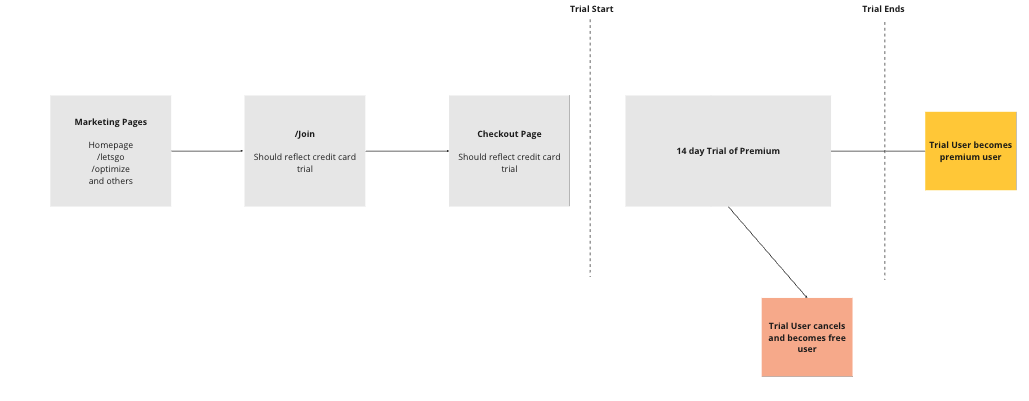
Free Trial Strategy at a Glance
| Free Trial | Freemium | Reverse Trial | No Trial | |
|---|---|---|---|---|
| User commitment | Medium — sign up, sometimes enter card | Low — sign up only | Medium — sign up to get full access | High — pay upfront |
| Typical conversion rate | 8–25% no card / 30–60% card required | 2–5% free-to-paid | 10–40% lift over freemium baseline | N/A — direct sales |
| Best for | Single-player products with a clear value moment in 7–30 days | Multi-player or network-effect products | Products where the "wow" is in the paid features but the base utility is real | High-touch B2B, enterprise, infrequent-use products |
| Main downside | Hard deadline can rush the user past the value moment | Most free users never upgrade — long-term cost on infra | More complex to build and explain | Slower acquisition, higher CAC |
| Real example | Calendly — 14-day Teams trial, auto-downgrade to Free | Notion Free tier | Superhuman, Linear, Canva Pro | Enterprise plans across most SaaS |
What is a free trial?
The terms are worth getting right.
Free trial. A time-limited window (typically 7, 14, or 30 days) where a prospect gets full or near-full access to a paid product.
Calendly's 14-day Teams trial is a textbook example: full access for two weeks, then auto-downgrade to the Free tier (Calendly Pricing FAQ, May 2026).
Freemium. A permanent free tier with intentionally limited capability: usage caps, fewer integrations, and no advanced features. There's no clock. Notion's Free plan ($0, unlimited individual use, 5MB upload cap, 7-day version history) is the canonical example (Notion Pricing, May 2026).
Reverse trial. A hybrid. New users get full access to paid features for a fixed period (often 7, 14, or 30 days).
Elena Verna (formerly Dropbox, Miro, Surveymonkey) has publicly attributed 10-40% conversion lifts to the model over pure freemium baselines.
Time-limited trial. Synonym for the standard free trial above.
It's defined by the clock, not by usage.
Usage-limited trial. Defined by consumption instead of time.
Opt-in trial. Trial requires no credit card.
Opt-out trial. Trial requires a credit card up front.
How long should a free trial be?
This is the question every team asks and almost every team gets wrong.
The default answer is "14 days, because everyone does 14 days." That's not a strategy. That's mimicry.
The real answer comes from a formula:
Trial Length = Time-to-Value × Safety Factor
Where:
- Time-to-Value (TTV) = the median number of days from signup to the moment a user completes the action that proves the product is worth paying for.
- Safety Factor = 1.5 to 2.0, to absorb user variation, weekend gaps, and life getting in the way.
If your TTV is 4 days (a project management tool where a user has to set up a workspace, invite a teammate, and complete a first task), your trial should be 6-8 days, not 14.
If your TTV is 12 days (a financial planning app where the user has to link accounts, wait for transactions to import, and complete one budgeting cycle), your trial should be 18-24 days, not 14.
The two failure modes:
- Trial too short. User signs up, gets distracted, comes back on day 10, opens the product once, trial expires on day 14. They never hit the value moment. Conversion is bad and you blame the audience.
- Trial too long. User signs up, plays around for two days, forgets about it. The trial expires 28 days later, by which point they've replaced you with something else or forgotten why they signed up.
The right length is the shortest window that gets a median user past the value moment with one weekend of buffer.
For most B2B software with active onboarding, that's 7-14 days.
For consumer products with infrequent use, it's 14-30. For complex B2B (CRM, accounting), it's 21-30.
Don't pick the length first. Pick the value moment first.
Then measure how long it takes a typical user to get there. Then set the trial.
Free trial vs freemium: which converts better?
The honest answer is "they convert different users, so the comparison is somewhat misleading." But the numbers are still worth knowing.
| Model | Typical conversion rate | Source |
|---|---|---|
| Freemium (free-to-paid) | 2–5% organic; up to 5.1% with role-based feature gating | ProfitWell 2026 SaaS Monetization Index, via Paddle |
| Free trial, opt-in (no card) | 8–25% trial-to-paid; median ~15% | OpenView Product-Led Growth Benchmarks |
| Free trial, opt-out (card required) | 30–60% trial-to-paid; median ~48% | First Page Sage / Softletter studies, cited via Userpilot |
| Reverse trial | 10–40% lift over freemium baseline | Elena Verna, ex-Dropbox/Miro VP Growth |
A few things to read into those numbers:
Freemium has a lower top-line conversion rate, but a much higher absolute reach. A product with 100,000 freemium users and a 3% conversion rate (3,000 paid users) beats a product with 10,000 trial users at 20% conversion (2,000 paid users).
Freemium has higher LTV per converted user. ProfitWell's 36-month cohort analysis shows freemium products demonstrate roughly 2x higher customer lifetime value than trial products.
Freemium has lower CAC. ProfitWell's 2026 data shows freemium companies have roughly 50% lower customer acquisition cost than trial-only competitors, because free users do marketing for you (sharing docs, inviting teammates, embedding the product in workflows).
Trials work better at higher ACVs. ProfitWell's 2025 SaaS Metrics Report notes products with ACVs above $50/month achieve 40-60% higher conversion through trials vs freemium. Below $50/month, freemium tends to win.
The decision tree:
- High ACV, single decision-maker, clear value moment in <30 days → Free trial (probably opt-out if you have brand trust)
- Low ACV, network or collaboration effect, multi-stakeholder → Freemium
- You have both a paid-feature value moment and a real free use case → Reverse trial (the rest of this guide explains why)
Should you require a credit card for the free trial?
This is the single most-debated decision in trial design, and the data on it is unusually consistent.
| Trial type | Conversion rate range | Trade-off |
|---|---|---|
| No card required (opt-in) | 8–25% trial-to-paid, median ~15% | Higher signup volume, lower conversion, smaller paid base of more-committed users |
| Card required (opt-out) | 30–60% trial-to-paid, median ~48% | Lower signup volume, higher conversion, larger paid base — but with a chunk who forgot to cancel and will churn at month 2–3 |
The insider subscription playbook
Get new guides and teardowns by email
Real companies, real numbers, strategies you can steal. From the operator who grew Codecademy from $10M to $55M ARR.
The 4-5x conversion gap is real, and it's driven by two effects:
- Selection. Users who hand over a card are more committed. They're already mentally prepared to pay. The trial is a try-before-confirm, not a try-before-decide.
- Friction asymmetry. Cancelling requires action. Continuing requires nothing. Default bias does the rest.
The honest version of the math: a lot of card-required conversions are not "saves." They're forgotten cancellations. This is why the headline conversion rate looks great, while the day-90 retained rate on opt-out trials is usually 10-20 percentage points worse than the equivalent number on opt-in trials.
When card-required wins:
- Established brand the user already knows
- Higher price point ($20+/month) where the user is making a deliberate decision
- B2B contexts where expensing a card is routine
When no-card-required wins:
- New brand without trust
- Consumer products where "I'll think about it" is a real concern
- Products optimizing for top-of-funnel data (every signup is a marketing signal even if they don't pay)
My take from running this at Codecademy: if you require a card, you must invest in trial-end communication, clear "your trial ends in 3 days, here's what you'll be charged" emails, an easy cancel path, and a no-questions-asked refund policy for the first billing cycle.
Reverse trials: the Superhuman / Linear / Notion playbook
The reverse trial is the most interesting trial pattern of the last five years, and most teams still aren't aware it's a distinct category.
The pattern: A new user signs up and immediately gets full access to paid features, the same as a free trial.
After 7, 14, or 30 days, instead of losing access entirely, the user drops to a freemium tier with reduced capabilities. They keep using the product. When their needs grow, they upgrade back to paid.
Why it works:
- The trial gives the user the paid experience: they've seen the wow, and they know what they're losing.
- The freemium fallback removes the cliff: they don't abandon the product the way they would after a hard expiry.
- The product keeps marketing itself: every time the user hits a feature that's now locked, it's a soft upgrade prompt that didn't cost an email.
The pattern was articulated by Wes Bush in Product-Led Growth.
How three companies do it
Notion. New users land in a Free tier with full personal capability but real limits at the collaboration layer (5MB file uploads, 10 external guests, 7-day version history).
The Free tier is genuinely useful (many individuals never upgrade) but teams hit the collaboration walls fast and convert (Notion Pricing, May 2026).

Linear. Doesn't run a traditional 14-day trial. Instead, the Free plan is the reverse trial: a full feature set capped at 250 issues and 2 teams.
A solo developer or 2-person team can run on Free indefinitely.
The moment a real product team adopts Linear, they blow through the issue cap within a month or two and convert to Basic ($10/user/mo) or Business ($16/user/mo) (Linear Pricing, May 2026).
Superhuman. It offers a trial period that includes the full Starter experience and 1-on-1 onboarding.
Length varies by signup channel: 14 days from direct signup, up to 30 days from partner referrals.
Pricing starts at $30/month or $300/year for Starter (Superhuman Pricing, May 2026).
The comparison is instructive because their high ACV ($30+/month) makes opt-out economics work.
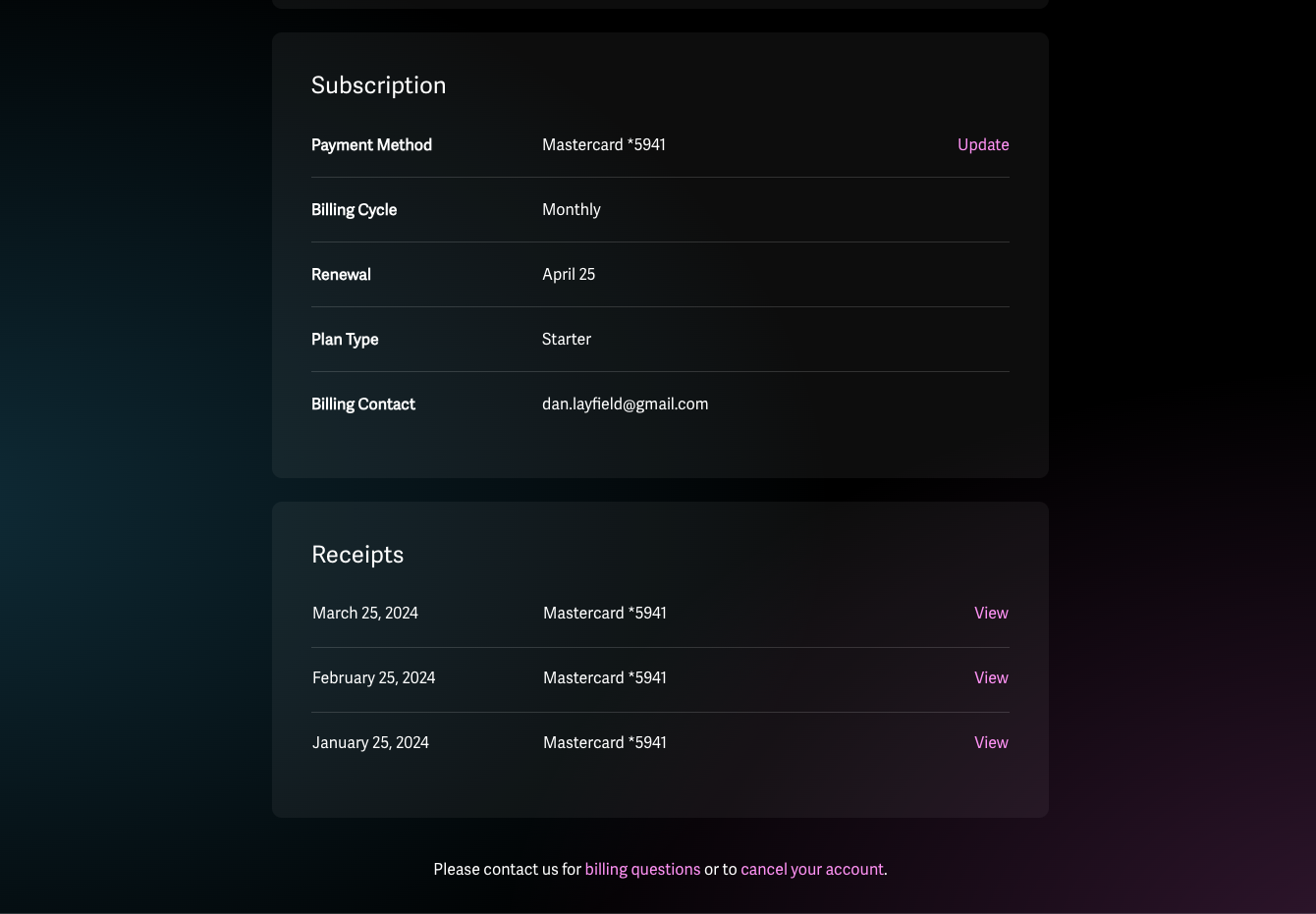
The takeaway across the three is simple.
Consumer contrast: Headspace vs Calm trial design
Same category (meditation), same price band (~$70/year), nearly identical product premise. The trial strategies are meaningfully different. Putting them side by side shows how much of "trial design" is actually pricing-page design.
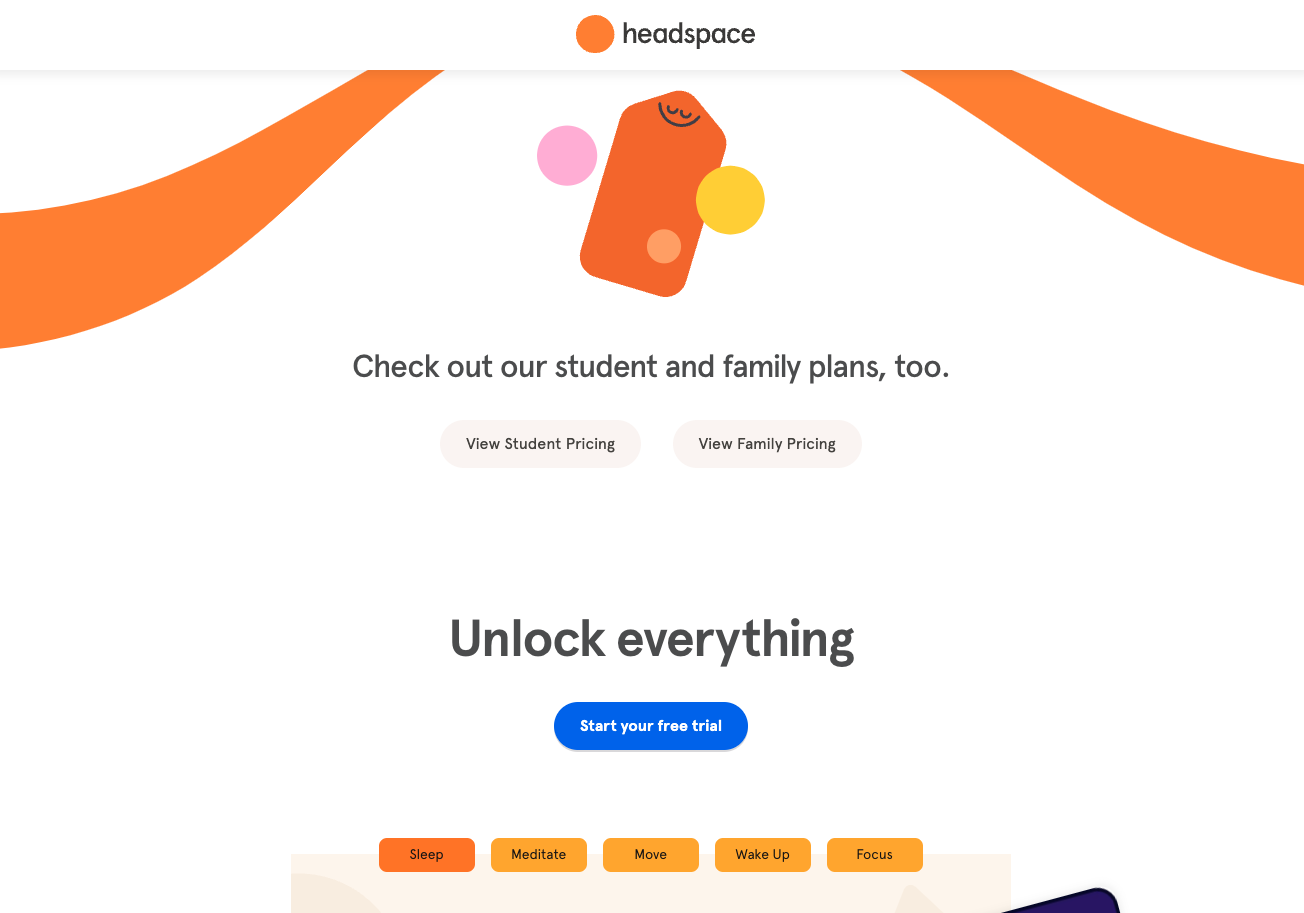
Headspace funnels every new user toward a 7-day free trial of the annual plan.
The pricing page pre-selects annual, frames the monthly equivalent ("$5.83/month"), and the trial ask captures a credit card up-front, classic opt-out economics.
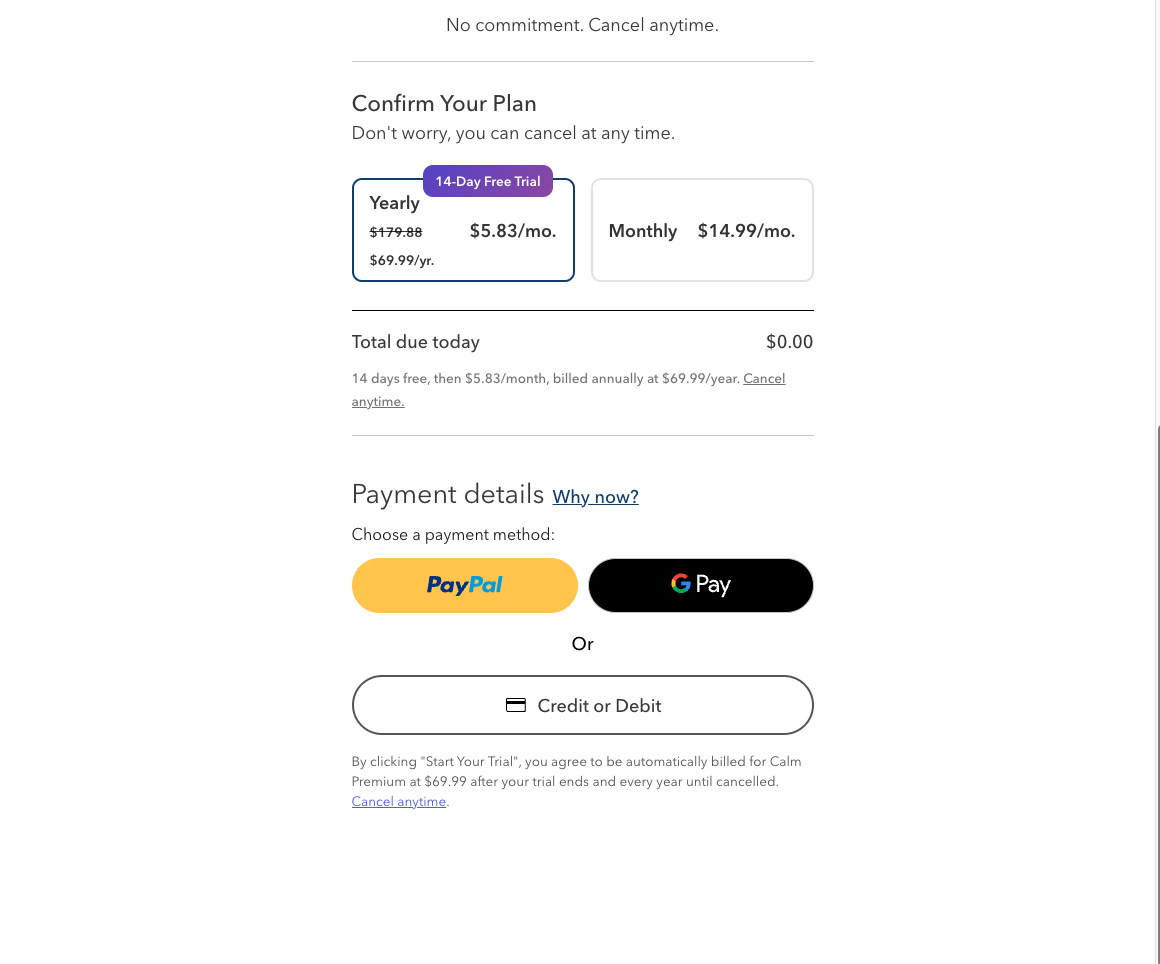
Calm sells almost the same product at almost the same price, but historically has structured trials differently.
Sometimes the trial was shorter (7 days), sometimes longer (14 days), with more aggressive lifetime-deal pricing at the end-of-trial moment.
The lesson: in commoditized consumer categories, trial design is product strategy. The pricing page IS the funnel.
Free trial conversion rate benchmarks
There is no single "right" trial conversion number.
It depends on industry, model, and what counts as a conversion. Here are the most-cited benchmarks, sourced.
| Segment | Conversion rate | Source |
|---|---|---|
| Consumer subscription (avg) | 5–10% trial-to-paid (opt-in), 15–30% (opt-out) | Userpilot benchmark roundup, May 2026 |
| B2B SaaS (avg) | 15–25% opt-in, 40–60% opt-out | OpenView Product-Led Growth Benchmarks |
| B2B SaaS, opt-in median | ~14.7% | OpenView 2025 PLG Benchmarks, cited via ADV.me 2026 report |
| B2B SaaS, opt-out median | ~48.8% | First Page Sage study cited via Userpilot |
| Freemium, organic | 2–5% free-to-paid | ProfitWell 2026 SaaS Monetization Index |
| Freemium with role-based gating | Up to 5.1% | ProfitWell 2026 SaaS Monetization Index |
| Reverse trial | 10–40% lift vs freemium baseline | Elena Verna analysis |
| Top quartile (any model) | 25%+ trial-to-paid | ADV.me / OpenView synthesis |
How to read these: Use them as goalposts, not as targets.
If your opt-in trial is converting at 8%, you're below the OpenView median (14.7%). There's clear opportunity. If you're at 22%, you're top quartile and the next move is to test opt-out, not to squeeze 1-2% more out of opt-in.
One important caveat: trial conversion is gameable. Look at conversion in the context of retained revenue at day 90, not standalone.
A 40% trial-to-paid with 50% month-2 churn is worse than a 20% trial-to-paid with 90% month-2 retention.
How to design a trial that converts
After auditing dozens of trial flows, and running the Codecademy trial through more variants than I can count, here are the seven principles that consistently change the number.
1. Set length by time-to-value, not by convention
The length rule is covered above. The single most common trial-design mistake is "14 days because everyone does 14." If your TTV is 5 days, your trial should be 7-10.
If your TTV is 20 days, your trial should be 30. Pick the length last, not first.
2. Engineer a guaranteed value moment in the first session
Don't make the user discover the value on their own.
Onboarding should drag them to the moment that proves the product works. Notion does this with templates. Linear does it with a sample issue and a guided keyboard tour.
Superhuman famously runs a 30-minute 1-on-1 onboarding call as part of trial.
Yes, it's expensive, and yes, it's why their conversion rate is high enough to justify it.
If your trial user closes the tab on day 1 without hitting the value moment, the rest of the trial is wasted.
3. Use the trial timer as a feature, not a threat
Show the days remaining. Frame it as "you have 9 days left to set up your workspace" rather than "your trial expires in 9 days." The first is helpful. The second is a countdown to loss.
Send trial-status emails at specific milestones (day 1, day 3, halfway, 2 days remaining, 1 day remaining).
4. Match the trial scope to the buyer
If you sell to teams, your trial should include team features (inviting collaborators, shared workspaces).
If you sell to individuals, don't force team setup.
5. Don't gate the wow moment behind the paywall
The most expensive trial design mistake: putting the feature that would convert the user behind a "paid only" wall during the trial itself.
The exception: usage-based pricing. If your paid feature is "unlimited X" and the trial gives them 100 of X, that's legitimate. But never block a core capability.
6. Make trial-end communication unmissable and humane
Three emails minimum: trial-ending-in-7-days, trial-ending-in-2-days, trial-ended. Each one should have:
- A clear statement of what changes when the trial ends
- A one-click upgrade path
- A one-click cancel/downgrade path
- A real number: what they used during the trial, what they'd lose, and what it'd cost to keep
The unhumane version: surprise charges, hidden cancel buttons, "you'll be billed automatically" buried in the footer.
These create short-term revenue and long-term FTC exposure.
The FTC has pursued companies aggressively for exactly this pattern.
7. Instrument trial activation, not just trial conversion
The metric that predicts trial conversion is activation rate (% of trial users who complete the core value action), not signup-to-paid.
If activation is 30% and paid conversion is 15%, half your activated users convert.
That's healthy, and the lever is more activation.
If activation is 80% and conversion is 15%, your product is doing its job but your trial-end flow is leaking. The lever is the upgrade prompt.
You can't optimize what you can't separate.
Trial paywall and end-of-trial flows
What happens between "trial ending tomorrow" and "user pays / doesn't pay" matters more than most teams realize.
The paywall design and the upgrade flow are where 5-15% of conversion happens.
What works at end-of-trial:
- Show the user their own usage. "You created 14 projects, sent 87 messages, and shared 6 docs with your team during your trial." Personalized usage is the single most persuasive paywall ingredient.
- Pre-fill the recommended plan. Don't make the user choose between five tiers. Use their trial behavior to recommend the right plan and let them adjust.
- Offer annual at the moment of upgrade. This is the best moment to push annual billing. The user is making a paid decision anyway. Adding the annual vs monthly comparison at upgrade adds incremental annual revenue with minimal friction.
- Reverse-trial fallback (if applicable). If you have a free tier, route declined upgrades there instead of locking them out. They might convert later.
- One-time discount for the on-the-fence user. A small discount (20-30% off the first month or first year) works for the segment that's price-sensitive but interested. Tie it to a deadline ("upgrade in the next 24 hours"). Don't use it as the default. Only for users who clicked decline and saw an exit-intent prompt.
What doesn't work:
- Aggressive paywalls during the trial itself. Showing "upgrade to get this" prompts every other action during the trial poisons the experience and trains users to ignore the eventual real ask.
- Forced credit card capture mid-trial. If you didn't capture the card at signup, asking for it on day 12 with three days left is the worst of both worlds: opt-out friction without the opt-out conversion lift.
- Generic "your trial has ended" emails. No usage data, no personalized recommendation, no clear next step. These are the dunning emails of the trial world. They perform 5-10x worse than instrumented ones.
For the post-decline experience, treat the user the same way you'd treat someone going through a well-designed cancellation flow: one targeted save offer, easy exit, no dark patterns. They might come back.
When NOT to offer a free trial
Trials aren't free for you to offer. They consume infrastructure, support time, engineering attention, and onboarding bandwidth. Skip the trial if:
Your product is high-touch B2B with a long evaluation cycle. If buying your product requires security review, procurement, and 4+ stakeholders, a self-serve trial doesn't fit the buying motion.
A free trial in this context creates noise, not signal.
Your value is back-loaded past the trial window. Some products genuinely take 60+ days to demonstrate value (financial planning, long-term coaching, multi-quarter SEO tools).
Trying to compress that into a 14-day trial sets the user up to underestimate the product and not pay.
Your customer is paying for outcomes, not features. If you sell guaranteed results (a service guarantee, a performance bond), a trial doesn't fit.
Your unit economics can't support free users. If your COGS per active user is meaningful (heavy compute, expensive integrations, human support), 1,000 trial users who don't convert can be more expensive than 100 paid users you onboarded directly.
Run the math before opening a trial spigot.
You haven't found product-market fit yet. A trial amplifies whatever's true about your product. Fix the product, then build the trial.
FAQ
How long should a free trial be?
Long enough for a typical user to hit your product's value moment, plus 50-100% buffer. For most B2B SaaS, that lands at 7-14 days. For consumer products with infrequent use, 14-30 days. For complex enterprise tools, 21-30 days. The mistake is picking the length based on what competitors do — pick it based on your own time-to-value data.
Should I require a credit card for the free trial?
It depends on brand trust and ACV. Requiring a card raises conversion 4-5x (from ~15% to ~48% median, per OpenView and First Page Sage data) but a meaningful chunk of that lift is forgotten cancellations that churn at month 2-3. If you have brand trust and ACV above $20/month, opt-out usually wins net. If you're a newer brand or selling to consumers, opt-in produces a smaller but stickier paid base.
What's a good free trial conversion rate?
The OpenView median for B2B SaaS opt-in trials is 14.7%. Top quartile is 25%+. Opt-out trials median around 48%. Freemium converts 2-5% organically. Use these as goalposts — if you're below the median, there's clear opportunity in trial design; if you're top quartile, look at retained-revenue-at-day-90 rather than chasing more headline conversion.
Free trial vs freemium — which is better?
Different jobs. Trials work at higher ACVs ($50+/mo) and for products with clear value moments inside 30 days. Freemium works at lower ACVs and for products with network effects, multi-stakeholder buying, or long evaluation cycles. ProfitWell data shows trials convert more on a per-user basis but freemium has 50% lower CAC and 2x higher LTV over 36 months. Most mature subscription businesses run hybrid models — see the reverse trial section above.
What is a reverse trial?
A trial that gives the user full paid access for a fixed period, then drops to a permanent freemium tier instead of cutting off access. The user has experienced the paid version, so they know what they're losing — but they keep using the product on the free tier, which keeps marketing the upgrade. Wes Bush coined the term in Product-Led Growth; Superhuman, Notion, Linear, and Canva are the most visible examples. Elena Verna reports 10-40% conversion lift over pure freemium baselines.
How do I know when a user has hit the value moment in their trial?
Pick the one action that correlates most with paid conversion in your data. For Slack it's "2,000 messages sent in a workspace." For Dropbox it's "1 file in 1 folder on 1 device." For project management tools it's usually "first task completed by a second user." Once you've defined the value moment, instrument it — every trial dashboard should show "trial users who hit the value moment" as the leading indicator, not "trial signups."
Should I extend trials for users who didn't activate?
Selectively yes. If a user signed up but never logged in, sending a "we'll extend your trial 7 days if you finish setup" email recovers 5-10% of lost trial users at low cost. If a user activated but didn't convert, extending the trial usually doesn't help — they evaluated and chose not to pay, and another week won't change that. Use extensions to recover non-activation, not to delay non-conversion.
What to Do Next
If you're running a subscription business and your trial isn't working as well as it should, here's the playbook:
Define your value moment. What's the one action that, when a user completes it during the trial, predicts they'll convert? If you don't know, that's step zero. Pull your data and find the correlation.
Measure your time-to-value. How many days does it take a median trial user to hit that action? That number, times 1.5-2x, is your right trial length.
Audit your trial against the 7 principles above. Score yourself honestly. Most trials score 3/7 or 4/7. Each principle you fix is worth 1-3 percentage points of conversion.
Test opt-in vs opt-out (if you haven't recently). This is the single biggest lever in trial design. If you've never run the test, do it. Read it at day 90, not day 30. The headline number is misleading.
Consider whether you should be running a reverse trial instead. If your product has both a real free use case and a strong paid feature set, the reverse trial pattern is almost always worth a serious look.
If you want to see how trial design fits into your broader monetization strategy, start with the data you already have.
Put it next to annual vs monthly pricing, cancellation flow design, subscription onboarding, and customer lifetime value optimization.