Most subscription onboarding is theater. Teams spend weeks on tours, tooltips, and checklists, then wonder why activation didn't move.
The metric that drives lifetime value is whether the user hits value in the first session.
At Codecademy, while I was growing the business from $10M to $55M ARR (2017–2021), onboarding moved LTV more than pricing did.
Users who hit their "aha moment" in the first session stayed much longer. The price didn't change. Their lifetime did.
You want the shortest path from signup to real value.
Below: time to value, the aha moment, the email sequence, the in-product flow, and examples from Superhuman, Headspace, and Notion. To price an activation lift, run the LTV calculator before and after.
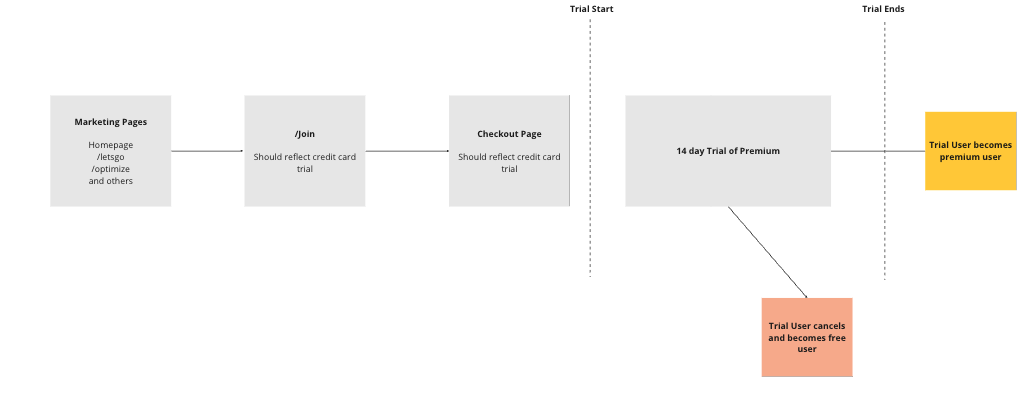
Subscription Onboarding at a Glance
| Onboarding Done Wrong | Onboarding Done Right | |
|---|---|---|
| Focus | UI tours, tooltips, checklists | Time to first value (TTV) |
| Primary metric | Tour completion rate | Activation rate (users hitting the aha moment) |
| Time horizon | First 14–30 days, drip-style | First session, first 7 days |
| LTV impact | Marginal — saves a few percent on early drop-off | Compounding — every activated cohort retains for months longer |
| Common tool | Pendo / Appcues product tour | Empty-state design, sample data, "do the thing" first-run |
| What users feel | "Why is this app talking at me? Let me skip." | "Oh. I get it. This is useful." |
What is subscription onboarding?
Subscription onboarding is everything between signup and the moment a user becomes a habitual, paying customer. That includes email, in-product flows, and any human touch that gets them to value.
Five terms get used interchangeably, and they shouldn't. Teams that name them move activation. Teams that ship tours and call the result onboarding don't.
Onboarding. The whole flow: signup, setup, first session, and the first 7–30 days where a habit forms. It's a window, not a screen.
Activation. The event that says a user reached the product's core value. Slack: 2,000 messages in a workspace. Dropbox: one file in a folder on one device. Facebook in 2008: 7 friends in 10 days. (Mode, Richard Price)
Time to value (TTV). Time from signup to activation. Consumer apps: minutes (Duolingo's first lesson runs before signup). Prosumer: days (Notion's first useful page). B2B SaaS: weeks (a connected integration, a populated dashboard).
Aha moment. What the user feels when activation happens. They understand the promise. Activation is the metric. Aha is the feeling.
Activation rate. The percentage of new signups who reach the activation event inside a set window. Userpilot's 2025 benchmark across SaaS and AI tools puts the median at 37%, sales-led at 41.6% and product-led at 34.6%. (Userpilot)
If you don't have a named activation event, you don't have onboarding. You have a sequence of screens. The rest of this guide is about fixing that.
The "aha moment" and time to value (TTV)
The aha moment turns "improve the experience" into a target: get more users to event X inside Y days. Every email, tour, and empty state then has one test. Does it shorten TTV, or lengthen it?
1. It's an event, not a feeling. "Users feel delighted" is unmeasurable. "Users sent their first message," "users uploaded their first file," and "users completed their first lesson" are events you can query and test against retention.
2. It's discovered, not designed. You don't pick the aha moment in a meeting. Compare retained users with churned users. The behavior that tracks with retention is the aha moment.
3. It governs retention more than features do. A user who hits aha in session one will tolerate a worse UI, fewer features, and a higher price. The product didn't change. Their relationship to it did.
A beautiful tour for a user who hasn't reached aha is wasted. A clunky first session that ends in aha is a win. Optimize for the event, not the experience around it.
How to find your aha moment
This is the method behind the examples people cite. The pattern is the same. The products aren't.
Slack: 2,000 messages
Stewart Butterfield's team split teams that stuck with Slack from teams that left. The cleanest signal: a team that had exchanged 2,000 messages had "really tried" Slack. After 2,000 messages, 93% of those customers were still using Slack. That number fell out of the data. (First Round Review)
Facebook: 7 friends in 10 days
Chamath Palihapitiya's growth team compared engaged and unengaged users. Users who reached 7 friends in their first 10 days kept a flat retention curve. Users who didn't, churned. The growth org reorganized around that metric. Chamath said they "talked about nothing else." (Startup Archive, Mode)
Dropbox: 1 file in a Dropbox folder on 1 device
Dropbox's promise ("your files anywhere") is real only after you put a file into the system. The activation event was one file in a Dropbox folder on one device. Some versions of the story say two devices. The metric they ran was the upload. Onboarding was rebuilt to push that upload within minutes. (Richard Price / growth hacking leading indicators, Intercom)
The five-step method
Apply this to your own product:
The aha-moment method
- Define a retention cohort: users still active and paying at day 30 (or 60, or 90 — pick what matters).
- Pull the 5–10 most-fired product events from each user's first session and first 7 days.
- For each event, compute the lift: P(retained | event fired) ÷ P(retained | event didn't fire).
- Rank events by lift. The top 1–3 events with high lift and high addressability (you can plausibly get more users to do them) are your aha candidates.
- Threshold the event. Did 1 message correlate with retention, or 10, or 100? Bucket users and find the inflection point.
The output is one sentence: "Users who do [event] at least [N] times within [window] retain at [rate] versus [rate] for users who don't." That sentence is the onboarding strategy. Without it, you're guessing.
Onboarding email sequences that work
In-product onboarding handles users who came back. Email handles users who didn't. Both should push the same activation event.
Welcome emails average around 51% open rates per Klaviyo's 2026 benchmark report (SaaS-specific welcome emails commonly hit 50–70%). They convert at roughly 0.94% versus 0.10% for standard marketing emails, a 9.4x improvement. Sent instantly, they convert at around 4.01%. (Mailmend) Timing matters more than copy.
A day-0 to day-7 framework that works:
Day 0 — Sent within 60 seconds of signup
- Goal: Get the user back into the product to perform the aha event.
- Subject line: Specific and verb-led. "Send your first message in Slack" beats "Welcome to Slack!"
- Body: One sentence on why they signed up, one CTA, one link. No team intros. No feature list. No tour video.
- CTA destination: Deep-link directly into the first step of the activation flow, not the dashboard.
Day 1 — 24 hours after signup, only if user didn't activate
- Goal: Address the most common day-1 blocker (usually "I didn't know what to do first" or "I forgot why I signed up").
- Subject line: Frame the next concrete step they're missing. "Your workspace is empty: add your first project in 2 minutes."
- Body: Acknowledge the gap, show one screenshot of the next step, deep-link. Optionally offer a 1-click template / sample data.
Day 3 — Educational nudge, segmented by what they did and didn't do
- Goal: Push activated users toward the next milestone (retention event); push unactivated users back to the aha event with a different angle.
- Subject line: For unactivated users, lead with a use case ("How [persona] uses [product] to [outcome] in 5 minutes"). For activated users, the next habit-building step.
- Body: Short case study or 1-minute demo. Avoid feature dumps.
The insider subscription playbook
Get new guides and teardowns by email
Real companies, real numbers, strategies you can steal. From the operator who grew Codecademy from $10M to $55M ARR.
Day 7 — Decision point
- Goal: Convert paid trial holdouts, re-engage dormant signups one final time before they're written off.
- Subject line: Concrete and slightly time-bound, not desperate. "Your trial ends Friday: here's what you've done so far."
- Body: Personalized usage summary (events fired, value delivered), one CTA. For unactivated users, last call with a stripped-down "just do this one thing" path.
Two rules that matter more than the structure:
- Branch on behavior, not time. Day 3 to an activated user is a different email than day 3 to a dormant user. If your tool only supports time-based drips, fix the tool first.
- Always deep-link, never dump them at the dashboard. Every email should land the user one click away from doing the next thing.
In-product onboarding: tours, checklists, empty states
Most teams misallocate effort here. "Let's add a tour" usually reduces activation in measured tests. Userpilot's data shows reducing onboarding steps by 30% can lift activation by up to 50%. (Userpilot) Less is usually the move.
What works
Empty states that pre-load a path. Notion's "Let's create your first page," a big + button, and a few templates skip the blank page. New users pick from three options built around their goal, not an infinite menu. An empty state should answer one question: what should the user do right now?
First-run experience that lets users do the real thing immediately. Duolingo has users finish a real translation exercise before signup. The product proves value before it asks for commitment. In subscription onboarding, that order is the highest-payoff pattern I know.
Sample data, sample projects, templates. Three sample projects on a dashboard beat a tutorial about how to create one. Linear, Notion, and Airtable ship sample workspaces. Power users can turn them off. Everyone else gets a shorter TTV.
Progressive disclosure tied to action. Show the next feature when the user finishes the current step. Checklists work when each box is an activation step the user can do in <2 minutes. A static list of 12 items fails.
What doesn't work
Tooltip-on-load product tours. Users skip them. The 3% who finish aren't representative. They're the users who'd activate anyway.
"Watch this 2-minute intro video." Bounce trap. Clicking play, watching, and coming back is harder than just doing the thing.
Profile completion meters / gamified setup quests with no value payoff. "Complete your profile to access features" creates resentment. Gamification works when it ladders to use, the way Duolingo streaks tie to lessons. It fails when it gates basic functionality.
Multi-step setup wizards before first use. Every screen between signup and value is a drop-off. Asking 8 personalization questions up front loses more users than the personalization wins back.
For each onboarding screen, ask "if I deleted this, would activation go up or down?" Run it. The answer surprises most teams.
Activation rate benchmarks
Use these to calibrate, not to set your target. Your target comes from your own cohorts. Numbers below are from Userpilot's 2025 activation benchmark report unless noted. (Userpilot 2025, Userpilot 2024)
| Segment | Median activation rate | Notes |
|---|---|---|
| Overall SaaS & AI tools (2025) | 37% | Up from prior years as tooling and personalization improved |
| Product-led companies | 34.6% | Lower self-serve activation than sales-assisted |
| Sales-led companies | 41.6% | Human touch lifts activation by ~7 percentage points |
| AI & Machine Learning | 54.8% | Strong "do the thing" first-run pattern lifts the category |
| CRM | 42.6% | Sales-led tailwind, but setup friction caps it |
| B2B SaaS (general) | 30–40% | Wide variance by ICP and TTV |
| Consumer subscription (estimate) | 20–35% | High signup volume, lower intent per signup |
| FinTech & Insurance | ~5% | Compliance-heavy onboarding crushes activation |
Two cross-cutting findings from the same research that matter more than any single benchmark:
- Reducing onboarding steps by 30% can lift activation by up to 50%. Less is more.
- Personalized onboarding flows lifted activation by an average of 32% across the 150 SaaS products Appcues analyzed. Personalization here means branching on user role / goal, not adding more screens. (Userpilot)
If your activation rate is below the relevant benchmark, the fix is rarely "more onboarding." It's a shorter path to the same event.
Real onboarding flows: 3 examples
These three are worth studying because each gets a user to value before they leave, in a different way.
Superhuman: white-glove handoff to the aha moment
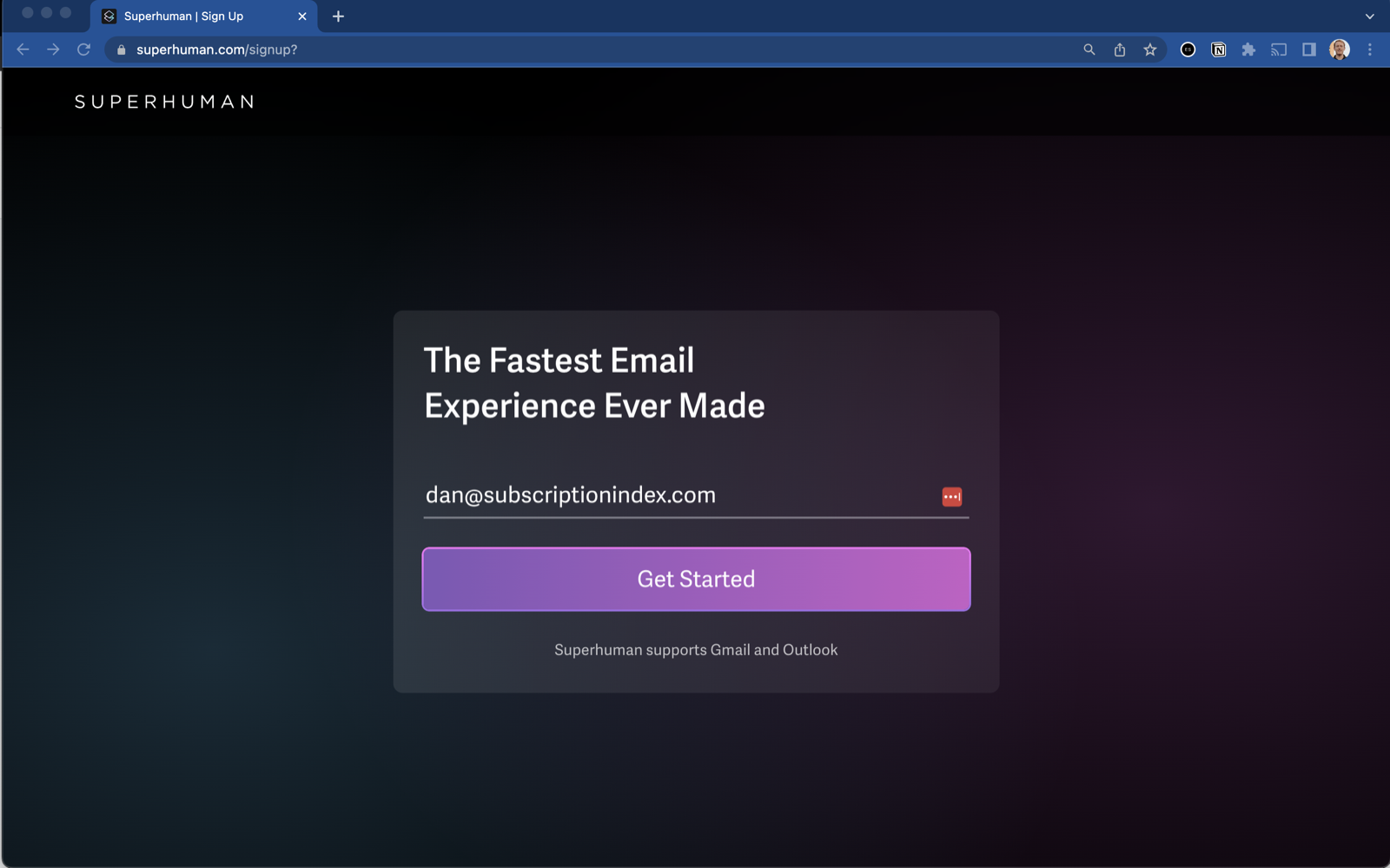
Superhuman runs the most expensive onboarding in consumer SaaS. Their ACV ($30/month) supports it. New users book a 30-minute 1-on-1 call. A teammate sets up the inbox, walks the shortcuts, and lands the user on a faster workflow. The aha event ("inbox zero in under 10 minutes using shortcuts") happens during the call.
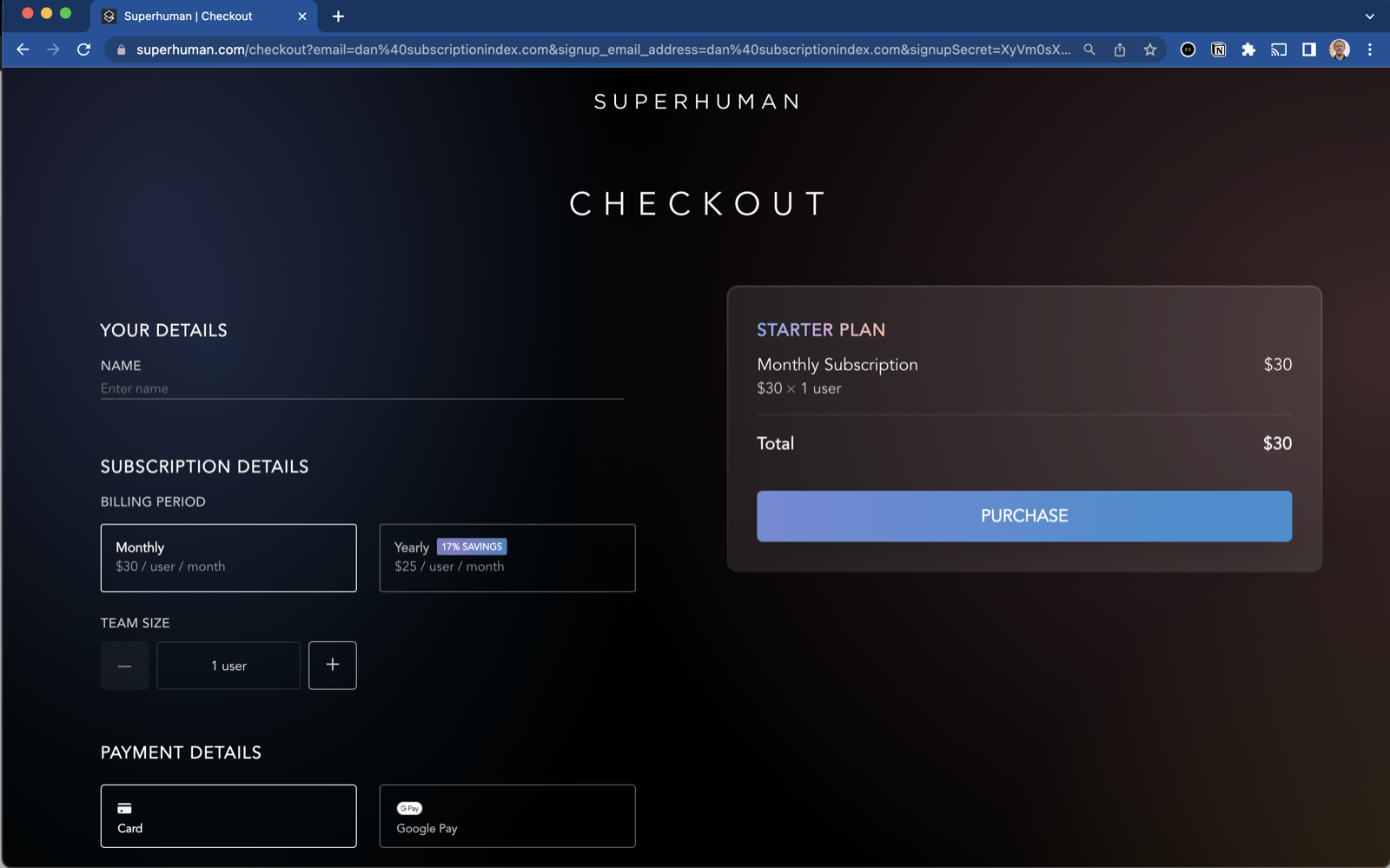
The lesson isn't that everyone should do white-glove onboarding. Superhuman backed out of feature parity to deliver a single moment of value with certainty. If you can't justify that cost, spend what the unit economics support to get the user to aha.
Headspace: one session, one win
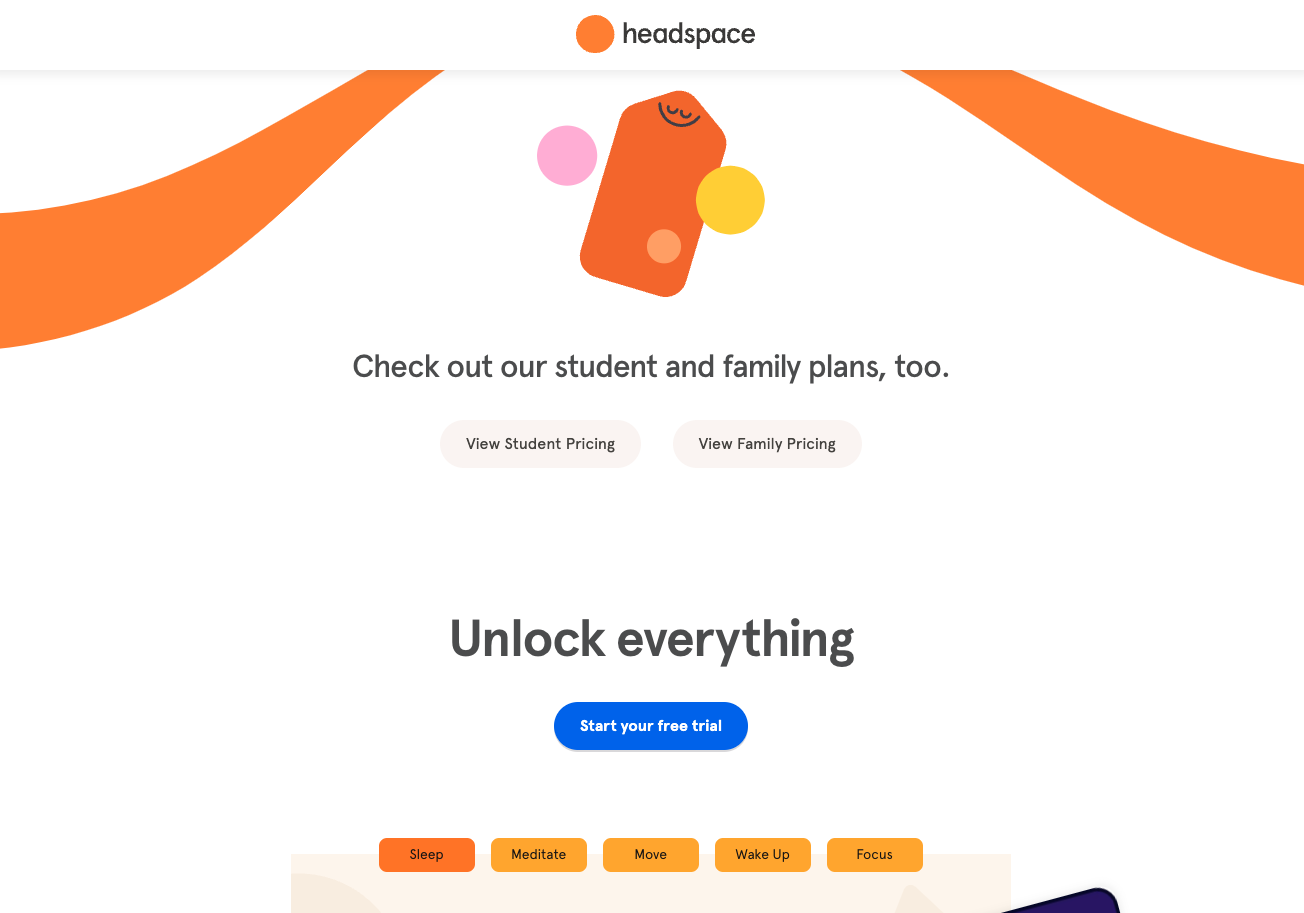
Headspace's aha event is one meditation session, which is also the product. Collect intent, recommend the shortest matching session, and get the user through it. No settings tour, no friend invite, no profile. After the session: streak, a daily reminder, a next session. Headspace converts session-1 into session-2 better than almost anyone in the meditation category. The pricing page (annual pre-selected at $69.99/yr, ~5.39x monthly) is set against that retention. (Annual pricing analysis)
Notion: solve the blank page

Notion's problem is the blank page. They ask 2–3 questions ("personal," "team," "school"), then pre-load templates. The user lands on something that looks like their workspace. Intent capture is under 30 seconds, and it changes the first 5 minutes. (Candu breakdown, Appcues)
Common subscription onboarding mistakes
In the order I see them, and what they cost in LTV:
No defined activation event. "We're working on onboarding" without a named event = no goal. Without a goal, every team disagrees about what success looks like and the changes never compound. Fix: Run the five-step aha method above. Write one sentence. Get the team to agree.
Optimizing tour completion instead of activation. A 60% tour completion rate looks great in your dashboard and means nothing for retention. Fix: Delete the tour for a treatment cohort. If activation doesn't drop, the tour wasn't doing anything. Most don't.
Asking for too much before delivering value. Email verification, phone verification, role picker, team-size picker, integration picker, billing. All before the user has done one valuable thing. Every screen is a leak. Fix: Move every non-essential setup step after the first activation event.
Time-based drips instead of behavior-based. "Day 3 email to everyone" sends the wrong email to half your list. Users who've activated need a different next step than users who've ghosted. Fix: Branch on a single boolean (activated yes/no) before anything else.
Generic welcome emails. "Welcome to [Product]! Here are 7 things you can do." gets a tour-completion-rate-quality outcome (low open, lower click, near-zero activation lift). Fix: Single verb-led subject line, one CTA, deep-link to the activation step.
No measurement loop. Teams ship onboarding changes without instrumenting the activation funnel. Six months later, nobody knows what worked. Fix: Track the activation event from day one. Cohort by signup week. Watch it move (or not) after every change.
Treating onboarding as a project, not a system. Onboarding is the highest-payoff surface in the product. It should have an owner, a quarterly target, and a weekly review cadence. Most companies build it once at launch and then never look at it again. That's a one-time investment in something that compounds.
How to measure onboarding success
You need a metric for where users drop, a metric that proves a change worked, and a metric you can track over time. The numbers below feed customer retention strategies and customer lifetime value.
The activation funnel (diagnostic)
A 5–7 step funnel from signup to activation, as a cohort. Each step shows the % still there and the absolute drop.
Signup                       10,000   (100%)
Email verified                7,800   (78%)
Workspace created             6,200   (62% of verified, 80%)
First action attempted        4,100   (53% of created, 66%)
Activation event fired        2,700   (66% of attempted, 27% overall)
Activated AND day-7 retained  2,100   (78% retention, 21% overall)
The biggest absolute drop is the fix with the most payoff. In the example above, "workspace created → first action attempted" loses 2,100 users, more than any other step. Instrument that step, talk to users, and ship the next test.
Headline metrics (track weekly)
| Metric | Definition | What "good" looks like |
|---|---|---|
| Activation rate (D7) | % of signups who fire the activation event within 7 days | Move toward your industry benchmark, then past it |
| Time to value (median) | Median minutes from signup to activation event | Lower is better; track P50 and P90 |
| Day-1 return rate | % of signups who return within 24 hours | <30% means email + product nudges aren't working |
| D7 / D30 retention by activation status | Retention curves split into activated vs not | Activated cohorts should retain 3–5x better |
| Welcome email metrics | Open, click, downstream activation by email | Open 50–70% for SaaS, instant-send converts 4x |
Long-term metrics (track quarterly)
- Activation rate trend over 12 months. Are you compounding?
- LTV by activation status. The dollar gap between activated and non-activated cohorts. This is the number that justifies onboarding investment to your CEO.
- Cohort retention 90/180/365. Pull these every quarter and watch the curves separate.
Build this dashboard first: activation rate by signup week, split by channel (paid / organic / referral). Channel gaps are usually huge, and almost never measured.
When NOT to invest more in onboarding
Onboarding pays off. It is not always the next investment. Skip it if:
Your activation rate is already above benchmark and retention beyond day 30 is the bigger gap. If you activate 50% of signups and day-90 retention is 15%, the leak is the product or the price.
You haven't shipped product-market fit. Onboarding multiplies PMF. It doesn't create it. If every cohort decays toward zero, find the audience the product actually works for, then onboard them.
Your ARPU is very low and acquisition is the constraint. If LTV is $30 and you're CAC-constrained, a cheaper channel beats another activation project. Onboarding pays back in proportion to LTV.
You're pre-launch or pre-traffic. You can't read activation cohorts without users. Don't design a long onboarding before you have 200+ activations. Ship a short flow, get data, then change it.
In every other case, onboarding is one of the top three things you can work on. With PMF and some scale, it's usually the top thing, and it's under-resourced for the LTV it moves.
FAQ
What's a good activation rate for a subscription business?
The 2025 cross-SaaS median is around 37%, with product-led companies at 34.6% and sales-led at 41.6% per Userpilot's benchmark. (Userpilot) But the benchmark only tells you whether you're in the rough range — your real target should come from your own cohort analysis. If users who fire your activation event retain 4x better than users who don't, every percentage point of activation lift is worth real LTV dollars. Calculate the gap, then set your target.
How long should subscription onboarding take?
For the user, the shortest possible — ideally a single session, minutes not days. Duolingo gets users to value before signup. Slack's aha event (2,000 messages) takes weeks for a team, but the path to it starts within minutes. For your team, onboarding is a permanent system, not a project. Plan to revisit it every quarter as you learn more about your activation event and your churn drivers.
What's the difference between activation and onboarding?
Onboarding is the whole flow — emails, in-product setup, first sessions, the first 30 days. Activation is the specific event inside that flow that signals the user has reached the product's core value. You design onboarding to maximize activation rate. Conflating them is the most common reason teams ship "onboarding improvements" that don't move retention.
Should I use a product tour?
Probably not — at least not as the headline of your onboarding. Tooltip tours have a self-selection problem (the users who complete them would activate anyway), and most measured tests show they don't lift activation. If you must use one, keep it to 2–3 steps, gate it on user action (don't auto-trigger on load), and instrument completion against activation to verify it's actually helping. The bigger lever is shortening the path to the aha event, not narrating it.
How do I find my product's aha moment?
Pull your 30-day retained cohort and your churned cohort. List the 5–10 most-fired product events in each user's first 7 days. For each event, compute the retention lift: P(retained | event fired) ÷ P(retained | event didn't). The event with the highest lift and a plausible path to "get more users to do this" is your aha candidate. Then find the right threshold — is it 1 occurrence, 10, or 100? — by bucketing and looking for the inflection. Write the result as one sentence; that sentence is your onboarding strategy.
Do welcome emails actually matter for activation?
Yes — when they're sent fast and deep-link to the activation step. Welcome emails average ~51% open rates and convert at 9.4x standard marketing emails, jumping to 4.01% when delivered instantly versus delayed. (Mailmend) The two non-negotiables: send within 60 seconds of signup, and deep-link the user one click away from doing the next thing. Generic "welcome to the family!" emails fail; verb-led, single-CTA emails work.
Should I personalize onboarding by user role or goal?
If you can do it with 1–2 questions, yes — Appcues found personalized flows lifted activation by an average of 32% across 150 SaaS products. (Userpilot) Notion's intent picker ("personal / team / school") is a good example: short, drives template selection, materially personalizes the first 5 minutes. If you need 8 questions, you've turned personalization into a setup wizard and you'll lose more users to the friction than you gain from the personalization.
What's the relationship between onboarding and churn?
Activated users churn at a fraction of the rate of non-activated users — typically 3–5x lower at day 30 and beyond. That gap is the dollar value of onboarding. Onboarding is upstream of every other retention lever you'll read about in our customer retention strategies guide. A great cancellation flow and dunning system recover users at the exit; great onboarding prevents them from heading toward the exit in the first place. The math always favors prevention.
What to Do Next
If you haven't named your activation event, do it in this order:
- Define your aha event. Run the five-step method on your retained-vs-churned cohorts. Write one sentence. Get the team to agree on it.
- Instrument the activation funnel. Five to seven steps from signup to the activation event. Cohort by signup week.
- Audit the path. For each step in your current onboarding, ask "if I deleted this, would activation go up or down?" Run the experiments. Most tours, tooltips, and pre-aha setup screens lose.
- Fix the day-0 email. Send within 60 seconds, single verb-led subject, deep-link to the activation step. This is the highest-payoff email in your entire lifecycle.
- Rebuild your empty states. Pre-load templates, sample data, or opinionated defaults. The blank page is where activation goes to die.
- Branch on behavior. Segment your follow-up emails by activation status, not just by day number.
- Make it a system, not a project. Quarterly review, named owner, target tied to a real retention number.
Want the dollar value of an activation lift? Run the LTV calculator. If onboarding is one of several leaks (pricing, packaging, dunning, expansion), the free Revenue Leak Audit covers all seven categories in 10 minutes.
If you're testing onboarding against retention, pair this with the free trial strategy guide and the churn rate guide. Together they are the activation-retention loop behind subscription LTV.
Name your activation event this week. Everything else follows from that sentence.