CAC Payback Period: Formula, Benchmarks and Calculator
How to calculate CAC payback period, consumer and SaaS benchmarks, churn-adjusted payback, app store fees, and a free leadership-view template.

Dan Layfield
Growth at Codecademy, $10M → $55M ARR
CAC payback is the number of months of gross margin it takes to earn back what you spent to acquire a subscriber. It decides how fast you can afford to grow.
LTV:CAC tells you whether a subscriber is eventually worth more than they cost. Payback tells you how long your cash is tied up before that happens. Two businesses with the same LTV:CAC can have completely different growth curves. One recycles acquisition spend inside a quarter. The other is financing a year or more of growth before any of it comes back.
I ran growth at Codecademy from $10M to $55M ARR (2017-2021). In the subscription businesses I work with now, the blended payback number often looks fine while one channel or one plan quietly drags it out. The formula is simple. Knowing when it misleads you is the hard part.
This guide covers the formula (the same one our CAC Payback Calculator uses), what goes into each input, where the simple version misleads subscription businesses, what a "good" payback looks like for consumer and SaaS businesses, what app store fees do to it, how to shorten it, and how to report it to leadership. There's a free leadership-view template at the end.
CAC Payback at a Glance
| Simple CAC payback | Churn-adjusted (cohort) payback | Cash payback | |
|---|---|---|---|
| Question it answers | How many months of gross margin per subscriber to cover CAC? | How long until the cohort covers its CAC, after churn? | When does the cash we collected cover the cash we spent? |
| Formula | CAC ÷ (monthly ARPU × gross margin) | Cumulative gross margin per acquired subscriber ≥ CAC | Cumulative cash collected ≥ acquisition spend |
| Accounts for churn? | No | Yes | Yes, if measured on real cohorts |
| Accounts for annual prepay? | No | Partly | Yes |
| Best for | Quick comparisons, leadership headline | Deciding how much you can spend per channel | Runway and financing decisions |
The short answer: CAC payback period = CAC ÷ (monthly ARPU × gross margin), and the answer is in months. If you spend $120 to acquire a subscriber who pays $15/month at an 80% gross margin, payback is 10 months. It's a cash-timing metric: the shorter it is, the faster acquisition spend comes back and can be reinvested. The simple formula ignores churn, so subscribers who cancel before month 10 never pay back. Read it alongside retention and LTV:CAC, and calculate it by channel and plan, not just blended.
The CAC Payback Formula
CAC Payback (months) = CAC ÷ (Monthly ARPU × Gross Margin %)
This is the formula on the Subscription Index CAC Payback Calculator. If your ARPU is annual, either divide it by 12 first, or calculate CAC ÷ (annual ARPU × gross margin) and multiply the result by 12 to get months.
Worked Example (Hypothetical)
A consumer subscription app:
- CAC: $120 (all acquisition spend in the month ÷ new paying subscribers that month)
- Monthly ARPU: $15
- Gross margin: 80%
CAC Payback = $120 ÷ ($15 × 0.80) = $120 ÷ $12 = 10 months
Each new subscriber generates $12 of gross margin a month, so it takes 10 months to recover the $120. Plug in your own numbers →
What Belongs in CAC
CAC is acquisition spend ÷ new paying subscribers in the same period. The argument is always about what counts as "acquisition spend":
- Paid media only (ad spend). Useful for in-channel optimization, misleading as "the" CAC.
- Blended: all marketing spend ÷ all new subscribers, including organic. Flatters paid channels by mixing in free signups.
- Fully loaded: media plus the salaries, agencies, tools and creative that exist to acquire customers. The honest number for unit economics.
There's no single right answer, but there is a wrong one: comparing a fully loaded payback with a media-only payback and calling it progress. Write your CAC definition in a footnote and keep it consistent. The LTV:CAC guide goes deeper on blended vs paid vs fully loaded.
ARPU vs ARPA
Use ARPU (average revenue per user) when each subscriber is a separate account, which is typical for consumer. Use ARPA (per account) when one account has several users, as with family plans or team plans. Either way, use the ARPU of the cohort you acquired, not the company-wide average. New subscribers often come in on promo pricing or cheaper plans.
Which Gross Margin
Gross margin turns revenue into the cash that actually pays back CAC. A $15 subscription at 80% margin contributes $12 a month toward payback, not $15. Decide whether you're using accounting gross margin or a contribution margin that also deducts variable costs like payment processing fees, app store fees, content royalties and variable support. For app-store-billed consumer subscriptions the platform fee is significant, so leaving it out makes payback look much shorter than it is (worked example below). On Subscription Index we use contribution margin as the standard, and the CAC payback calculator does too.
Worked Example: App Store Fees (Hypothetical)
Same subscriber: $120 CAC, $15 a month. Assume $3 a month of other variable costs (hosting, support, content), which is the 80% margin from the example above. Here's what changes when the $15 is billed through an app store instead of on the web:
| Billed through | Store fee | Monthly contribution | Simple payback |
|---|---|---|---|
| Web (fee already in the $3) | None | $12.00 | 10 months |
| Apple App Store, subscriber's first year | 30% ($4.50) | $7.50 | About 15 months* |
| Apple App Store, after one year of paid service | 15% ($2.25) | $9.75 | n/a |
| Google Play, auto-renewing subscription | 15% ($2.25) | $9.75 | About 12.3 months |
*12 months at $7.50 recovers $90. The remaining $30 takes about 3 more months at $9.75, once Apple's rate drops.
The fee rates come from the platforms. Apple pays developers 70% of the subscription price during a subscriber's first year of paid service and 85% after that, minus applicable taxes. Developers in Apple's Small Business Program get the lower 15% commission from the start. Google Play charges 15% on auto-renewing subscriptions: in the US, UK, EEA, Australia and Japan that's now split as a 10% service fee plus a 5% billing fee. Check the current terms before you model, because both platforms have changed fee structures in the last two years. For simplicity this example ignores sales tax and VAT, which come off the price before the platform's share.
The point: an app-store-heavy subscription can need around 50% longer to pay back than the same subscriber on the web, before churn. If your calculator inputs use web margin for app-store subscribers, your payback is understated.
When the Simple Formula Misleads
The formula assumes every subscriber stays and pays the same amount until CAC is recovered. Real subscription cohorts don't behave that way. Seven things break that assumption. The first matters most for consumer subscriptions, where a large share of each cohort can cancel before acquisition spend comes back.
The insider subscription playbook
One tactic that moves the needle — every Thursday
Real companies, real numbers, strategies you can steal. From the operator who grew Codecademy from $10M to $55M ARR.
1. Churn Before Payback
If subscribers cancel before month 10, they never pay back. Here's the same $120 / $15 / 80% example, but now the cohort loses a fixed share of subscribers every month (hypothetical numbers). Each cell is the cumulative gross margin earned per subscriber you acquired, including the ones who've since left:
Cumulative gross margin after n months = ARPU × gross margin × (1 − (1 − c)ⁿ) ÷ c, where c is monthly churn
| Month | 0% churn | 3% churn | 6% churn | 10% churn |
|---|---|---|---|---|
| 1 | $12 | $12 | $12 | $12 |
| 3 | $36 | $35 | $34 | $33 |
| 6 | $72 | $67 | $62 | $56 |
| 9 | $108 | $96 | $85 | $74 |
| 10 | $120 ✓ | $105 | $92 | $78 |
| 12 | $144 | $122 ✓ | $105 | $86 |
| 15 | $180 | $147 | $121 ✓ | $95 |
| 18 | $216 | $169 | $134 | $102 |
| 24 | $288 | $207 | $155 | $110 |
| 36 | $432 | $266 | $178 | $117 |
| Payback month | 10 | 12 | 15 | Never |
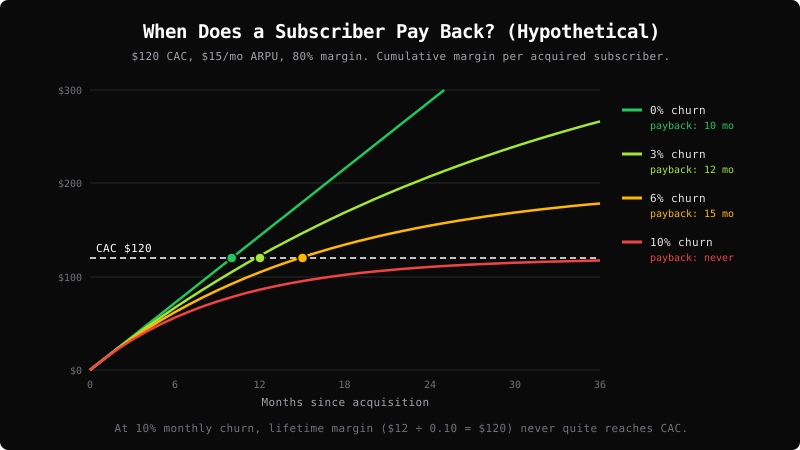
At 10% monthly churn, the average acquired subscriber's lifetime gross margin ($12 ÷ 0.10 = $120) only ever approaches CAC. On a simple payback basis, the channel looks fine. In reality it never earns its money back.
To solve for the payback month directly: n = ln(1 − CAC × c ÷ monthly margin) ÷ ln(1 − c). If CAC × c ÷ monthly margin is 1 or more, payback never happens. The leadership-view template does this per channel. This is the most common way payback misleads consumer subscription businesses. Run the churn-adjusted version on your real cohort retention curves, and see the churn rate calculator to sanity-check your monthly churn.
2. Annual Prepay
The formula treats annual subscribers as if they paid monthly. Cash doesn't work that way. With a $120/year plan at 80% margin and a $120 CAC, the formula says 15 months ($120 ÷ $8/month). In cash terms, you collect $96 of gross margin on day one, which is 80% of CAC immediately, and the rest only arrives if the subscriber renews in month 12. Annual plans shorten cash payback dramatically and also shift risk onto renewal. Report both views, and use the Annual Plan Mix Calculator to model how a change in mix moves revenue.
3. Free Trials
If you pay to acquire trial starts, CAC per trial isn't CAC per subscriber. At $40 per trial start and a 30% trial-to-paid rate, the CAC per paying subscriber is about $133 (hypothetical numbers). Always divide by paying subscribers, and track trial conversion as an input. A dip in trial conversion lengthens payback even if media costs don't change.
4. Blended Channels
A blended payback averages a cheap organic channel with an expensive paid one. If organic is 40% of new subscribers, a paid channel with a terrible payback can hide inside a "healthy" blended number for quarters. Calculate payback by channel at least monthly.
5. Expansion Revenue
The simple formula assumes flat ARPU. If subscribers reliably upgrade (plan mix, add-ons, price increases), real payback is shorter than the formula says. If they downgrade or come in on promo pricing that steps up later, it's different again. Strong net revenue retention shortens payback over time.
6. Fees, Taxes and Refunds
Sales tax and VAT aren't revenue. Refunds and chargebacks reverse revenue you counted. Payment and app store fees reduce margin. Leave any of these out and payback looks shorter than it is.
7. Involuntary Churn
Failed payments are churn too, and they hit payback the same way. Every subscriber who drops out on a declined card before month 10 never pays back. Fixing failed payment recovery is one of the cheapest ways to shorten real payback.
What a "Good" CAC Payback Period Is
It depends on your churn, plan mix and how you fund growth. A monthly consumer subscription with high churn can't afford the same payback as an annual membership with low churn and cash collected upfront.
Here's what the published guidance says, with dates, because these bands get repeated long after they were written:
| Source | Published | Segment | What it says |
|---|---|---|---|
| Lenny Rachitsky, consensus of 16 growth experts | Dec 14, 2021 | B2C | Under 1 month is great, 6 months is good, 12 months is OK |
| Lenny Rachitsky (same post) | Dec 14, 2021 | B2B selling to SMBs | Under 6 months is great, 12 months is good, 18 months is OK |
| Stripe | Updated Sep 10, 2024 | B2C | 12 months or less is often considered a good benchmark |
| Stripe (same page) | Updated Sep 10, 2024 | SaaS | 12 months or less is healthy; high performers often reach 5–7 months |
| Bessemer, State of the Cloud | 2023 | SaaS (B2B) | 0–6 months best, 6–12 better, 12–18 good |
Consumer guidance is tighter than SaaS guidance for a reason: consumer cohorts churn faster, so the later months of a long payback may never arrive.
Our CAC Payback Calculator rates results with these bands:
| Payback | Calculator rating | Calculator note |
|---|---|---|
| Under 6 months | Excellent | |
| 6–12 months | Good | Typical for healthy SaaS |
| 12–18 months | Acceptable | Common in enterprise sales |
| Over 18 months | Needs Work | High cash burn risk |
For a consumer subscription, I'd read the calculator's "Good" band as the upper limit rather than the middle. That's consistent with Lenny's and Stripe's B2C guidance, both of which put 12 months at the edge of acceptable.
How to use these bands sensibly in a consumer or membership business:
- The higher your monthly churn, the shorter your payback needs to be. If a big share of each cohort is gone by month 6, a 12-month payback is a bet that never settles. Compare payback with the month your cohort retention curve flattens.
- Annual-heavy businesses can tolerate a longer simple payback, because cash arrives upfront. Their real risk is renewal rate.
- Organic-heavy businesses look better blended than they are on the margin. The question that matters is the payback of the next dollar of paid spend, not the average.
- Your financing sets the ceiling. If runway is 12 months, an 18-month payback on growth spend is a financing decision, not an efficiency metric.
How Payback Relates to LTV:CAC, Churn and NRR
- LTV:CAC asks whether a subscriber is worth more than they cost over their whole life. Payback asks how long your cash is tied up before you break even. You can have a healthy LTV:CAC and a painful payback if most of the value comes late (long-tenure subscribers, renewals, expansion). More in the LTV:CAC guide, with the LTV:CAC calculator and LTV calculator.
- Churn decides whether payback actually happens (see the month-by-month table above).
- NRR shortens payback over time when existing subscribers spend more. It lengthens payback when downgrades and discounts erode ARPU.
Use LTV:CAC to decide whether to keep spending. Use payback to decide whether you can afford to keep spending right now.
How to Shorten CAC Payback
There are only three ways to do it: lower CAC, raise monthly gross margin per subscriber, or keep subscribers long enough to pay back. The levers that tend to matter most in consumer subscription businesses:
- Conversion rate. A better paywall, checkout and trial lower CAC per paying subscriber without touching media costs. Conversion improvements are usually the cheapest payback wins.
- Plan mix and annual plans. Moving more new subscribers onto annual (or higher-tier) plans raises collected cash and early gross margin. Model it with the Annual Plan Mix Calculator.
- Pricing. A higher price raises margin per month. As I've written about payment failures by price point, cheaper plans also tend to come with more payment problems.
- Early retention. Faster time-to-value in onboarding and a cancellation flow that saves recoverable cancels keep subscribers around past the payback month.
- Payment recovery. Account updater, smart retries and a dunning process stop paid-for subscribers from dropping out on a declined card.
- Channel and creative mix. Cut or fix the channel with the worst churn-adjusted payback, not the one with the highest CPA.
How to Report CAC Payback to Leadership
When you report payback to your leadership team, one blended payback number isn't enough. I'd show:
| View | Why it matters |
|---|---|
| Blended payback (trend, trailing 4 quarters) | The headline, comparable over time |
| Paid-channel payback by channel | Where the next dollar should go |
| Payback by plan or billing interval (monthly vs annual) | Shows whether plan mix is driving the change |
| Churn-adjusted cohort payback for the last few cohorts | Whether payback is actually happening |
| Payback by billing platform (web vs App Store vs Google Play) | Shows how much store fees stretch payback |
The leadership-view template has these views set up: enter spend, new paying subscribers, ARPU, margin and churn by channel, and it calculates simple payback, churn-adjusted payback, LTV:CAC and the calculator rating.
Under it, add a one-line footnote with your CAC definition (media-only, blended or fully loaded) and your margin definition (gross or contribution). Put LTV:CAC on the same slide, because leadership will ask about both together.
FAQ
What is CAC payback?
CAC payback period is the number of months of gross margin it takes to recover the cost of acquiring a customer. It's a cash-timing metric: the shorter the payback, the faster acquisition spend comes back and can be reinvested in growth.
What is the CAC payback formula?
CAC payback (months) = CAC ÷ (monthly ARPU × gross margin). If ARPU is annual, divide it by 12 first, or calculate CAC ÷ (annual ARPU × gross margin) and multiply by 12. Use the same period and the same set of customers for every input. The Subscription Index calculator uses this formula.
What is a good CAC payback period?
It depends on churn, plan mix and how you fund growth. Bessemer's widely cited SaaS guidance (2023) calls 12–18 months good, 6–12 better and under 6 best. Our calculator rates under 6 months Excellent, 6–12 Good, 12–18 Acceptable and over 18 Needs Work. Consumer subscriptions with high monthly churn usually need shorter payback than that, because subscribers who cancel early never pay back. Set an internal threshold and report it next to LTV:CAC.
What is a good CAC payback period for a consumer subscription?
Shorter than for SaaS. Lenny Rachitsky's consensus of growth experts (2021) calls under 1 month great, 6 months good and 12 months OK for B2C. Stripe (2024) says 12 months or less is often considered good for B2C. If your monthly churn is high, aim well inside 12 months and check the churn-adjusted number.
How do app store fees affect CAC payback?
They cut monthly margin, so payback gets longer. Apple pays developers 70% of a subscription's price in the subscriber's first year of paid service and 85% after that. Google Play charges 15% on auto-renewing subscriptions. In our worked example, the same $120 CAC subscriber pays back in 10 months on the web and about 15 months through the App Store.
How do I calculate churn-adjusted CAC payback?
Add up the gross margin per acquired subscriber month by month, letting the cohort shrink by your churn rate, until it covers CAC. With constant monthly churn c, the payback month is n = ln(1 − CAC × c ÷ monthly margin) ÷ ln(1 − c). If CAC × c ÷ monthly margin is 1 or more, the subscriber never pays back.
Does the CAC payback formula account for churn?
No. The simple formula assumes every subscriber stays until CAC is recovered. If subscribers churn before then, true payback is longer, or never happens. Calculate a churn-adjusted cohort payback alongside the simple number.
How is CAC payback different from LTV:CAC?
LTV:CAC asks whether a customer is worth more than they cost over the life of the relationship. Payback asks how long cash is tied up before you break even on the acquisition spend. You need both. A business can have a strong LTV:CAC and still struggle with cash if payback is long.
Should we include salaries, tools and creative in CAC?
Yes, if those costs were incurred to acquire the customers in that period. That's fully loaded CAC. Whatever you choose, state what's included and keep it consistent. Don't compare a fully loaded payback with a media-only payback.
What to Do Next
- Run your numbers through the CAC Payback Calculator using your CAC definition and contribution margin.
- Recalculate by channel, plan and billing platform in the leadership-view template, then build a churn-adjusted cohort payback for your last three cohorts.
- Pick the lever (conversion, plan mix, early retention or payment recovery) that moves churn-adjusted payback the most.
Read next: LTV:CAC ratio, net revenue retention and subscription metrics.
Every Thursday I send one tactic like this to operators who already run subscription businesses. Browse the archive or subscribe below.
If payback is too long to fund your growth plan, or you suspect a blended number is hiding a bad channel, I do a free 30-minute call. No pitch.

Dan Layfield
Dan ran growth at Codecademy, scaling ARR from $10M to $55M before the company was acquired for $525M. He now advises subscription businesses on pricing, retention, and revenue optimization.
Work with Dan →Related Guides
Cancellation Flow Examples: Screens, Copy and Save Offers
Real cancellation flow examples (YouTube TV, Spotify, Paramount+), paste-ready survey, offer and email copy, and how to measure save rate.
22 min readChurn Rate: What It Really Costs You (And How to Fix It)
Your churn rate is costing you more than you think. Learn the formulas, benchmarks, and specific fixes that actually recover lost revenue.
16 min readCustomer Lifetime Value: The Number That Should Be Running Your Business
Customer lifetime value (LTV) tells you what a subscriber is actually worth. Learn how to calculate it, benchmark it, and increase it.
Get the playbook every Thursday
Weekly strategies for subscription businesses. Real companies, real numbers, tactics you can steal. From the operator who grew Codecademy from $10M to $55M ARR.